

World · South & Central Asia · 2 days ago
India warns Pakistan against using nuclear threats as political pressure at UN

India and Pakistan exchanged remarks at a United Nations General Assembly committee focused on disarmament and international security.
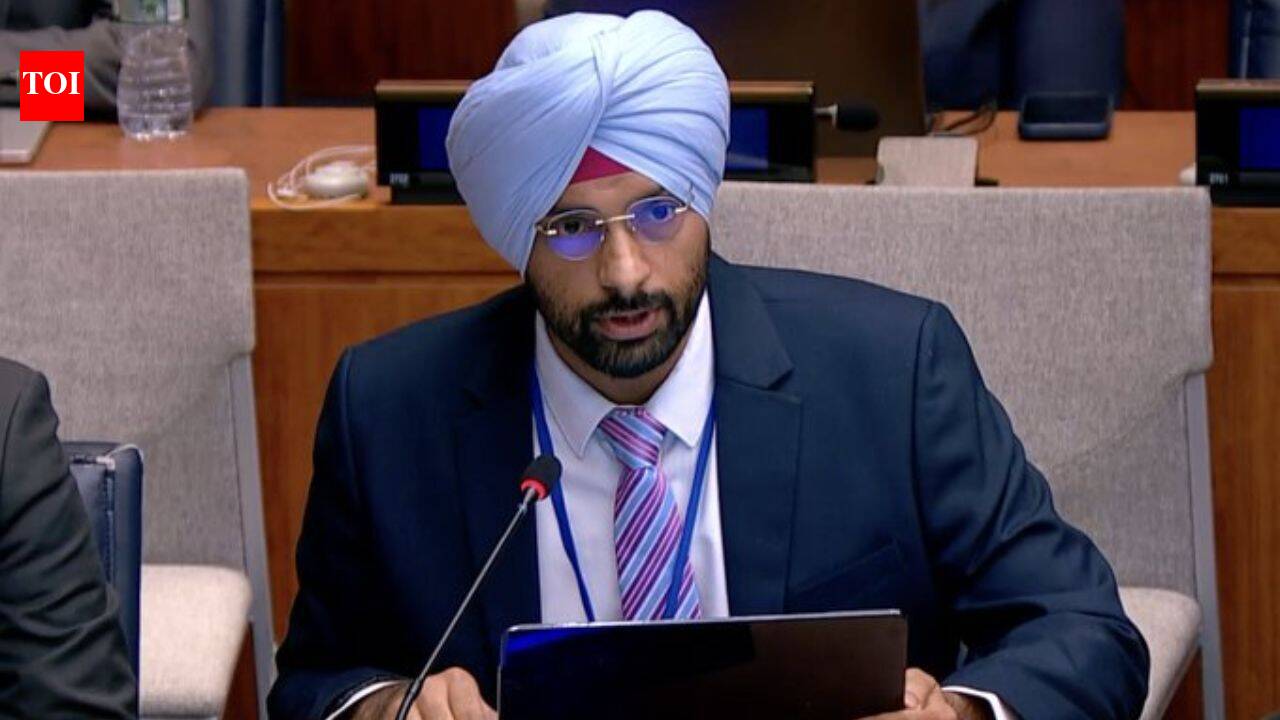
On Friday, October 9, 2026, India’s representative Anmol Sher Singh Bedi said nuclear weapons should not be used as routine tools of political pressure.
He rejected Pakistan’s comments on Jammu and Kashmir, which India describes as an integral part of the country.
Bedi said India’s military capabilities are defensive and warned that using nuclear threats to limit the consequences of other actions could increase the risk of escalation.
He said India would respond to terrorist attacks and would not distinguish between those who sponsor attacks and those who plan them.
He cited India’s May 2025 Operation Sindoor, launched after an attack in Pahalgam killed 26 civilians, mostly tourists.
India has also put the Indus Waters Treaty on hold until Pakistan ends its support for cross-border terrorism, according to the statement at the UN.

India responded to remarks by Pakistan at the United Nations General Assembly First Committee on October 9, 2026.
India’s representative, Anmol Sher Singh Bedi, said nuclear weapons should not be treated as routine instruments of statecraft and that India would not bow to nuclear blackmail.
Bedi said India considers Jammu and Kashmir an integral part of the country and described India’s military capabilities as defensive.
He said India would give a fitting response to any terrorist attack and make no distinction between those who sponsor terrorism and those who mastermind it.
Bedi said India’s May 2025 actions followed the April 22, 2025, Pahalgam attack, in which 26 civilians were killed, and described those actions as measured and intended to avoid escalation.
India also linked the Indus Waters Treaty to mutual trust and cooperation and raised concerns about nuclear proliferation associated with the AQ Khan network.
- Who
- India, represented by Anmol Sher Singh Bedi, responding to remarks by Pakistan
- What
- India warned against using nuclear weapons as political pressure and set out its positions on terrorism, Jammu and Kashmir, and nuclear proliferation
- When
- October 9, 2026
- Where
- United Nations General Assembly First Committee
- Why
- In response to Pakistan’s remarks on Jammu and Kashmir and concerns about escalation and nuclear threats
India
Pakistan
Jammu and Kashmir
India
Bedi said Jammu and Kashmir is an integral and inalienable part of India.
Pakistan
Pakistan’s remarks raised the issue of Jammu and Kashmir; the articles do not provide Pakistan’s full position.
Nuclear weapons and escalation
India
India said nuclear weapons must not be treated as routine instruments of statecraft and that relying on a nuclear threat could increase the risk of escalation.
Pakistan
The articles report that Pakistan raised concerns about escalation, but do not provide a detailed account of its arguments.
Terrorism and India’s response
India
India said any terrorist attack would receive a fitting response and that it would not distinguish between those who sponsor terrorism and those who mastermind it.
Pakistan
The articles do not include a direct Pakistani response to India’s statements on terrorism.
A terror attack in Pahalgam, Jammu and Kashmir, killed 26 civilians, mostly tourists.
India launched Operation Sindoor, targeting what it described as terrorist infrastructure in Pakistan and Pakistan-occupied Kashmir.
India said the Indus Waters Treaty would be held in abeyance until Pakistan credibly and irrevocably ended its support for terrorism.
India exercised its Right of Reply at the UN General Assembly First Committee after remarks by Pakistan.
- India’s representative
- Anmol Sher Singh Bedi, Senior Adviser (Disarmament) at India’s Permanent Mission to the Conference on Disarmament in Geneva
- Pahalgam attack
- April 22, 2025; 26 civilians were killed
- Operation Sindoor
- Launched by India on May 7, 2025
- UN body
- The General Assembly First Committee deals with disarmament and international security
- UN Security Council Resolution 1540
- Adopted in 2004; it requires states to prevent the proliferation of weapons of mass destruction and their means of delivery to non-state actors
What people are saying
Nuclear weapons must not be treated as routine instruments of statecraft
A posture that relies on nuclear overhang to limit the consequences of subconventional activity raises the risk of escalation and not the prospect of restraint,
First, any terrorist attack against India will receive a fitting response. Second, India will not bow to nuclear blackmail. Third, India will make no distinction between those who sponsor terrorism and those who mastermind it,
A state cannot undermine those foundations of trust and cooperation and at the same time insist that the privileges flowing from the relationship remain untouched,”
Sources
Related news
Flash floods in Nepal sweep away homes and bridges, leaving five missing

Police to increase surveillance on deadly road near Kochi airport

Mutt head arrested over alleged sexual exploitation of woman

India condemns Vance’s remarks as US curbs green card filings at IT firms
Pakistani army training plane crash kills both pilots

Sunil Bharti Mittal to receive France’s highest civilian honour
Pakistan urges Afghanistan’s Taliban government to curb cross-border militant attacks

Two men sentenced to life for 2018 murder in Andhra Pradesh

Four, including a toddler, die as car catches fire near Vijayawada
Explosion Near LoC in Poonch Raises Fears of Casualties

Person jumping onto Bengaluru metro track disrupts service