

1 hr ago
AI Agents Are Reshaping Jobs, Not Simply Replacing Workers

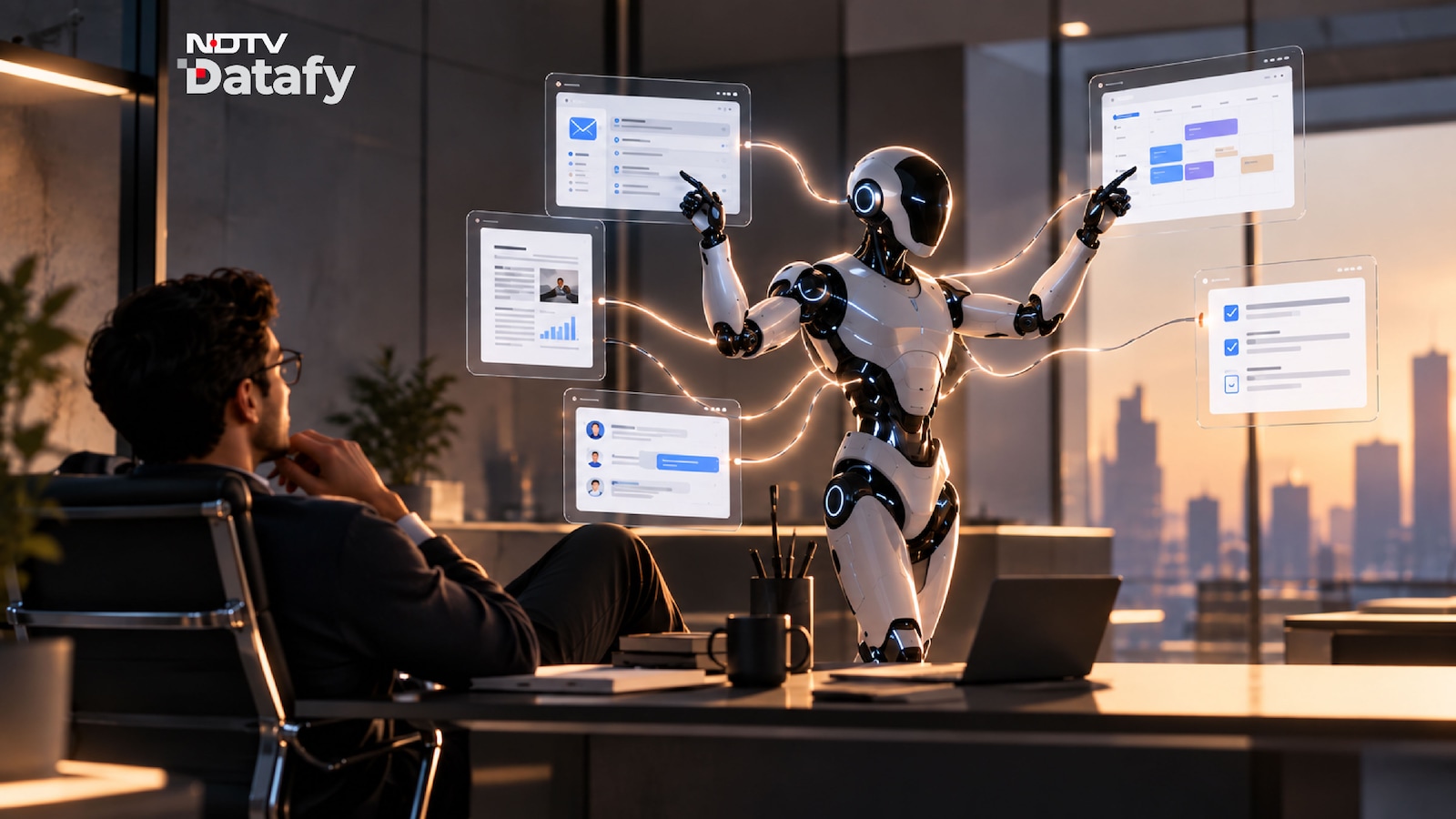
Many companies are testing computer programs called AI agents that can perform tasks.
These programs work best when a company has organised, reliable data.
AI can help with routine jobs such as checking invoices, planning deliveries and estimating jewellery prices.
It can also help managers decide how to assign workers or trucks.
However, people still need to handle unusual complaints, emergencies, creativity and sensitive customer situations.
Companies must decide what an AI agent is allowed to do and when a person must review its work.
In the future, some managers may supervise both human workers and AI agents.
Workers may spend less time collecting information and more time using judgment, communication, creativity and problem-solving.
The panel said AI is more likely to change many tasks gradually than replace every job at once.

More than 80% of Indian organisations are exploring autonomous AI agents, according to Deloitte's 2025 State of GenAI report.
Business leaders say reliable data infrastructure, governance and clear decision boundaries must come before broad AI deployment.
Safexpress uses AI for route optimisation, scheduling, warehouse decisions and automated vehicle-damage reporting.
Orra Fine Jewellery uses AI to estimate custom-ring gold weights and prices, while human designers retain creative control.
Managers and analysts are expected to focus more on supervising AI, interpreting outputs, solving problems and handling sensitive decisions.
- Who
- Aditi Sharma of Salesforce India, Sandeep Dewangan of Safexpress and Avnish Anand of Orra Fine Jewellery and formerly CaratLane discussed the issue, moderated by Mint Associate Editor Abhishek Singh.
- What
- The panel examined how autonomous AI agents could change jobs, business processes and management responsibilities.
- Where
- When
- The discussion took place in a recent episode of Mint's All About AI; Deloitte's cited report is from 2025.
- Why
- Businesses are exploring AI to improve speed, costs, service and quality while determining which decisions still require human judgment.
Automation-Focused View
Human-Oversight View
How far AI should go
Automation-Focused View
AI agents should take over routine, rule-based work such as invoice matching, product tagging, delivery alerts and standard customer queries.
Human-Oversight View
AI should operate within defined limits, with people reviewing decisions where mistakes could cause serious consequences.
What the workforce will do
Automation-Focused View
As AI handles data collection and repetitive tasks, managers and analysts can focus on higher-value work, interpretation and new services.
Human-Oversight View
Human judgment, empathy, creativity, communication and problem-solving remain essential, especially in sensitive or unusual situations.
Adoption priorities
Automation-Focused View
Businesses can gain value by embedding AI into everyday processes and measuring improvements in speed, cost, service and quality.
Human-Oversight View
Companies should first organise their data, establish governance and assess the cost of errors before expanding AI autonomy.
Key facts
- AI adoption
- More than 80% of Indian organisations are exploring autonomous AI agents, according to Deloitte's 2025 State of GenAI report.
- Safexpress infrastructure
- The company built an enterprise data lake and connected its systems before introducing AI.
- Logistics applications
- AI is used for route optimisation, scheduling, warehouse decisions and computer-vision-based damage detection.
- Jewellery applications
- AI estimates gold weight and pricing for custom rings at Orra Fine Jewellery.
- Human oversight
- Unusual customer complaints, emergency delivery decisions and creative jewellery design remain areas requiring people.
- Future management
- Aditi Sharma expects managers may eventually oversee teams made up of both people and AI agents.
Quotes
Sandeep Dewangan
President and Group CIO at Safexpress
“Marketing can experiment and accept some mistakes. But in logistics, a dispatching error delays urgent deliveries. In support, chatbots handle routine queries, and humans take over for anything unusual.”
 livemint.com
“A retailer might use AI for routine price updates once the data is right.”
livemint.com
Sources
Related news

Indian Enterprises Rebuild Data Foundations for Scalable, Trusted AI

Microsoft Says India Has Moved From AI Pilots Into Production

Dell Says Businesses Are Moving AI From Pilots Toward Profits

Enterprises Move From AI Pilots to Automated Decision-Making
Businesses Bet Big on Agentic AI Despite ROI Uncertainty

Dhule Guardian Minister Inspects Drought-Hit Farms, Promises Relief

Nashik Tantrik Arrested Over Extortion, Forced Daughter’s Engagement

Maharashtra Task Force Seeks Feedback On Recruitment Exam Reforms

Dhule Minister Orders Drought Plans as All Talukas Face Trigger-1
