3 weeks ago
Can Fear of Punishment Create a Genuinely Ethical Society?
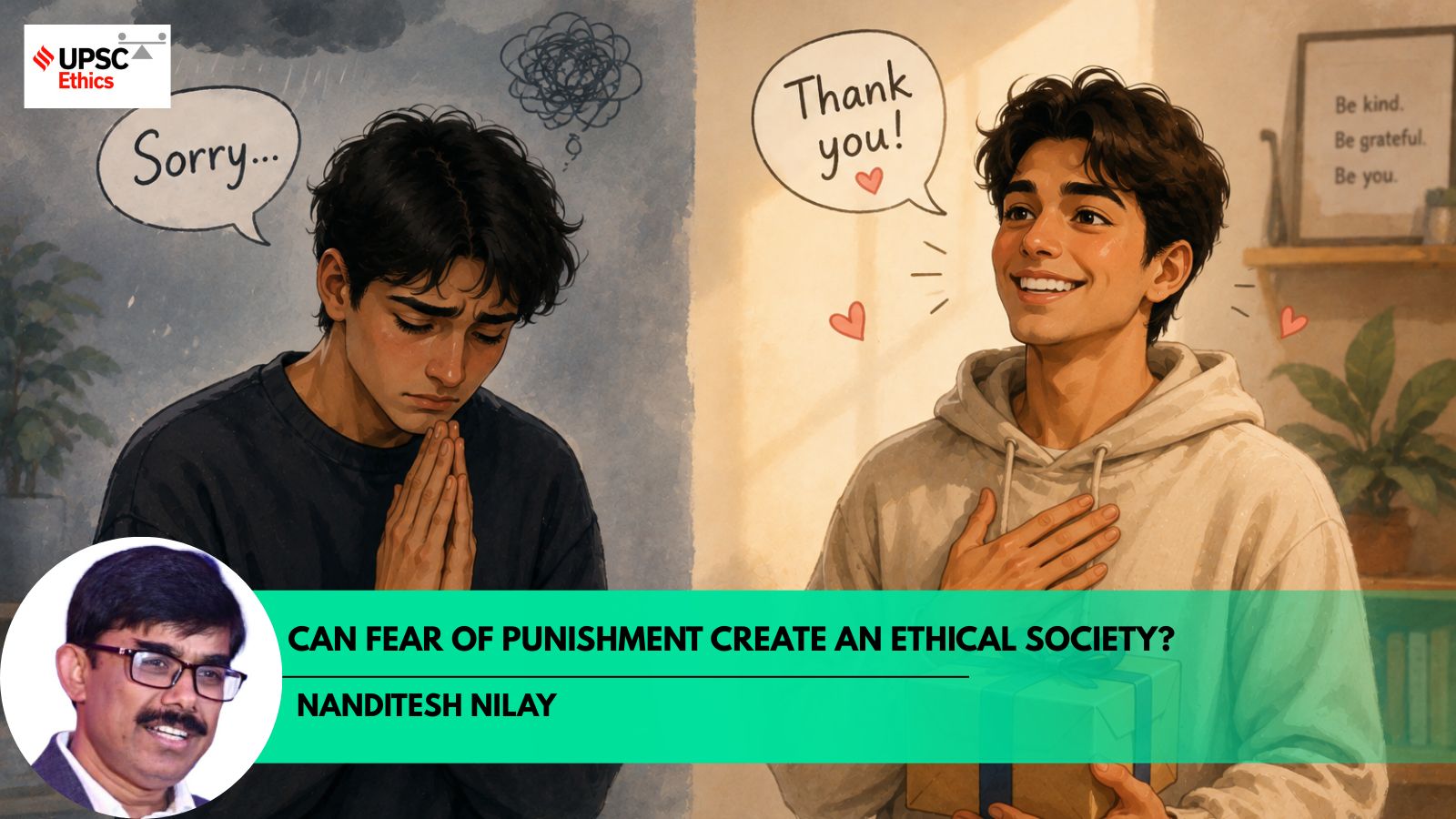
Imagine a child who tells the truth only because they get a cookie for it.
Kant, a famous thinker, said that is not really being honest - the child just wants the cookie.
He thought rewards and punishments make people behave well for the wrong reason.
If a police officer refuses a bribe only because cameras are watching, what happens when the cameras go away?
Kant said we should do the right thing because it is right, not because we get something for it.
He made a rule called the Categorical Imperative: act only in ways you would want everyone to act.
He also said to think about how you would feel if someone did that to you.
The article says it is okay to praise and reward people, but rewards should not be the main reason for being good.
Being good should come from inside your heart, not from what you get.

The Indian Express's UPSC Ethics Simplified column explores whether actions motivated by rewards or fear of punishment are genuinely ethical.
Immanuel Kant warned that children taught through rewards and punishment learn to behave well only to obtain the reward.
Kant's Categorical Imperative holds that one should act only on principles that could be accepted as universal laws, requiring universalisability and reversibility.
The column notes that an official who refuses a bribe only under CCTV surveillance may accept illegal payments once monitoring is removed.
It concludes that a person should do what is right because it is right, with recognition and appreciation following but not serving as the reason for the moral act.
- Who
- Philosopher Immanuel Kant, whose ideas are explored by ethicist and author Nanditesh Nilay in The Indian Express's UPSC Ethics Simplified column.
- What
- An examination of whether doing the right thing for a reward or out of fear of punishment makes an action genuinely ethical.
- Where
- India, published by The Indian Express for UPSC Civil Services Examination aspirants.
- When
- Exact publication date not stated in the article; it is part of the fortnightly UPSC Ethics Simplified series.
- Why
- To show that moral actions should be performed because they are right in themselves, not for rewards, drawing on Kant's Categorical Imperative.
Kantian View
Pragmatic View
Root of genuine morality
Kantian View
An action is moral only when performed for the right reason, not for reward or fear of punishment.
Pragmatic View
In a rule-dependent society, noticing, recognizing and rewarding ethical courage is still wise and can encourage moral behavior.
Rewarding children for honesty
Kantian View
Rewarding honesty teaches children to behave well only to get the reward, risking a moral facade.
Pragmatic View
Parents and teachers may still reward good deeds as long as the act is done because it is right, not primarily for the reward.
Role of surveillance and consequences
Kantian View
An official who refuses a bribe only because of CCTV cameras is not genuinely ethical and may accept bribes when unmonitored.
Pragmatic View
Fear of punishment and oversight remain practical deterrents that help maintain compliance in society.
Key facts
- Column
- UPSC Ethics Simplified (UPSC Essentials series)
- Publication
- The Indian Express
- Ethicist / Author
- Nanditesh Nilay
- Philosopher Discussed
- Immanuel Kant
- Key Concept
- Categorical Imperative
- Target Audience
- UPSC Civil Services Examination aspirants
- Frequency
- Fortnightly
- Editor
- Manas Srivastava
Quotes

Immanuel Kant
German philosopher and founder of deontological ethics
“If you punish a child for bad behaviour and reward them for good behaviour, they will do the right thing solely to obtain the reward…”
 indianexpress.com
“I should never act in such a way that I cannot accept the principle (maxim) behind my action as a ‘universal law’.”
indianexpress.com
Sources
Related news

Tukaram Mundhe’s Example Sparks Debate Over Institutional Ethics

UPSC Mains 2026 Checklist: 15 Ethics Topics Aspirants Shouldn't Miss

Can Development Come at the Cost of Safety in India?

Leading AI Models Cheat Without Seeing It as Wrongdoing

Reddit Praises Auto Driver's Honesty After Returning Extra Rs 5

Understanding Deeper Meaning of Independence Through 'Freedom from Freedom'
Indian Courts and Officials Face Detention, Speech Controversies

ED arrests key accused in alleged Chhattisgarh exam leak

High Court Orders Fresh Probe Into Disha Salian Death Case

Two Years After RG Kar Doctor's Rape-Murder, Case Remains Unresolved

ED widens Chhattisgarh probes with two arrests and searches