

0 months ago
South Africa's Rooibos: Global Tea Sensation Amid Climate Challenges
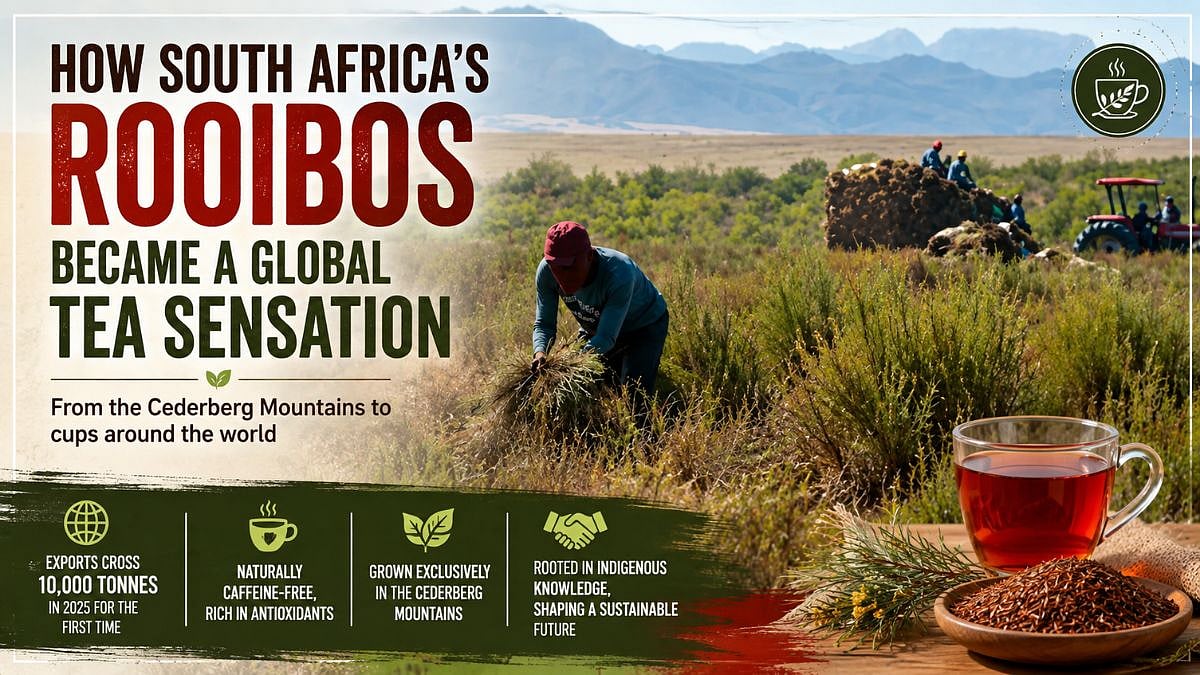
Rooibos is a special tea that grows in only one small part of the world, the Cederberg mountains in South Africa.
Its name means 'red bush' in Afrikaans.
The San and Khoi people used its leaves to make tea long before anyone else.
Today, people all over the world drink rooibos because it has no caffeine, so it won't keep you awake.
Japan buys more of it than any other country.
In 2021, the European Union gave rooibos a special protected name, similar to Champagne for sparkling wine.
That means only real rooibos from South Africa can be called rooibos in Europe.
The plant likes dry weather, but less rain is now falling, which makes harvests smaller.
Farmers and companies are working to keep up with demand while protecting the land and honoring the Indigenous knowledge behind the tea.

Global rooibos consumption rose 12.5% between 2022 and 2024, and South African exports passed 10,000 tonnes for the first time in 2025.
Rooibos grows only in a 60,000-hectare area of the Cederberg region, about 155 miles north of Cape Town.
The European Union granted rooibos Protected Designation of Origin (PDO) status in 2021, the first African product to receive it.
A 2019 benefit-sharing agreement made it a legal requirement for industry companies to pay San and Khoi traditional knowledge holders an annual levy.
Reduced rainfall cut 2023 harvest volumes by 17%, with 2025 production estimated even lower, amid rising shipping costs and US tariffs.
- Who
- Rooibos Limited, the world's oldest and largest rooibos processor, along with farmers, Indigenous San and Khoi communities, and South African industry bodies.
- What
- The global expansion of South African rooibos tea, driven by record exports and new EU protection, while facing climate, trade, and equity challenges.
- Where
- The Cederberg region of South Africa, about 155 miles north of Cape Town, spanning designated areas of the Western and Northern Cape.
- When
- Reported August 5, 2026, covering consumption growth between 2022 and 2024 and record exports in 2025.
- Why
- Rising demand from health-conscious, caffeine-free consumers and protected-name status, set against climate volatility, tariffs, and questions of Indigenous equity.
Critics
Rooibos Industry
Benefit-sharing agreement
Critics
The 2019 agreement does not go far enough to address racial imbalances in the industry's land ownership and Indigenous benefits.
Rooibos Industry
Rooibos Limited says the industry's contribution to Indigenous knowledge holders is 'very fair' and that it buys rooibos from farmers regardless of background.
Land ownership
Critics
A 2017 study found Indigenous communities controlled less than 7% of rooibos-producing land and produced only 2% of South Africa's rooibos tea.
Rooibos Industry
Land distribution is the responsibility of the state, while small-scale farmers of colour can find opportunities in niche markets tied to particular producers.
Key facts
- Global consumption growth (2022-2024)
- 12.5%
- Record exports (2025)
- Over 10,000 tonnes, up from about 5,900 tonnes in 2015
- Growing area
- 60,000 hectares in the Cederberg region, ~155 miles north of Cape Town
- EU protected status
- Protected Designation of Origin (PDO) in 2021, first African product
- Japan's share of exports (2025)
- 33%
- Harvest drop (2023)
- 17% due to reduced rainfall
- US tariff on South African goods
- 12.5%, down from 30%
- Rooibos Limited annual exports
- 400 million rand ($24.17 million) to 50+ countries
Quotes
Marthane Swart
Secretariat of the South Africa Rooibos Council, an industry voluntary organization
““In the beginning, (rooibos) was virtually unknown, so the growth was just driven by more people getting to know it and enjoying its flavour.””
 freepressjournal.in
““It opens up more opportunities to speak about the product (and) raise awareness.””
freepressjournal.in
Sources
Related news
Jalpaiguri Handmade Tea Wins Premium Prices, Foreign Interest

Reading Student Makes First All-British Chocolate Since 1932

Luxmi Tea Launches Makaibari Collective With Small Growers

Makaibari launches collective to boost Darjeeling small growers
Assam Estate Produces India’s First Commercial Matcha

India International Coffee Festival Set for Bengaluru in February 2027

Yen Surge Keeps Traders Alert for Further Official Action

Bangladesh Recall Shanto, Mahmud for Asian Games T20 Squad

Japan Cricket Boss Defends Asian Games Facilities Against Concerns

Mitsubishi Revives Pajero With 201PS Fifth-Generation SUV

Europe's Bond Selloff Deepens as Middle East Tensions Lift Oil
