

5 days ago
Restored Dadabhai Naoroji Portrait Goes on Display in London
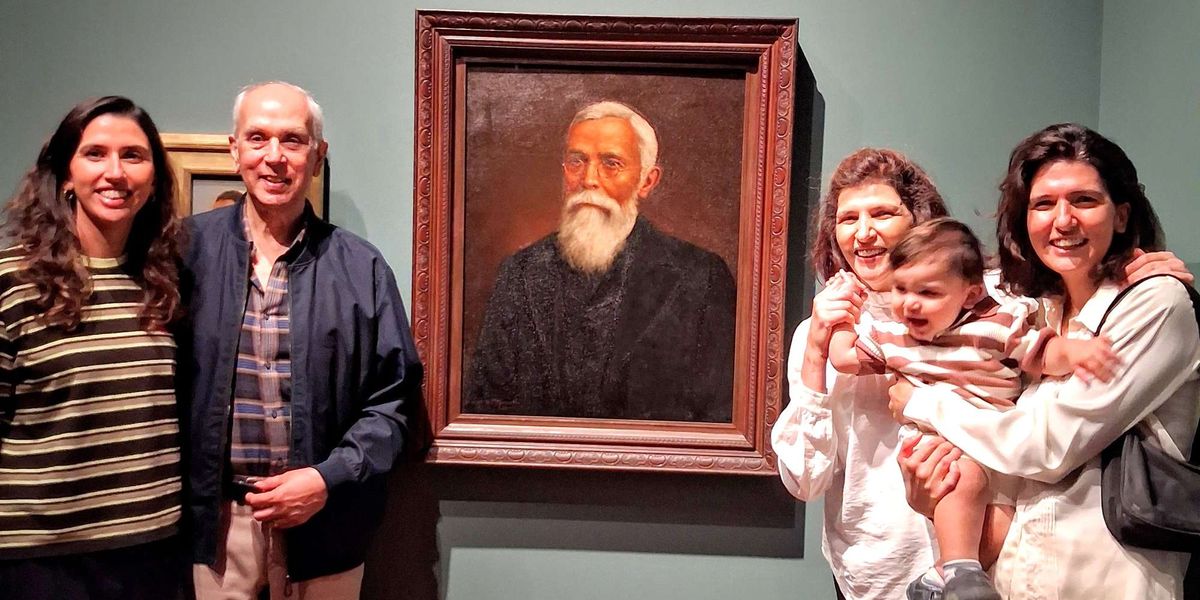
A painting of Dadabhai Naoroji has been cleaned and placed in a major museum in London.
Naoroji was born in India and became the first Asian person to serve as a British MP.
He argued that Britain was taking wealth from India and making the country poorer.
The painting was made in Bombay in 1946, shortly before Indian independence.
It hung for many years in the India Club, a meeting place for people from India and anti-colonial campaigners.
Experts carefully removed dirt, nicotine, and other marks from the painting.
The painting is now being shown in a gallery about the British Empire and people who challenged it.
Many members of the Parsi and British Asian communities said they felt proud to see it there.

A 1946 portrait of Dadabhai Naoroji has gone on display at London’s National Portrait Gallery.
The Courtauld Institute of Art and City & Guilds restored the painting and its frame.
The portrait is on a three-year loan from the Marker family, former India Club operators.
Naoroji was Britain’s first Asian MP and a leading critic of colonial rule.
The painting joins the gallery’s “Empire and Resistance, 1850–1914” display.
- Who
- Dadabhai Naoroji, the subject of the portrait; the Marker family lent it, while conservators from the Courtauld Institute of Art, City & Guilds, and the National Portrait Gallery restored it.
- What
- A restored 1946 oil-on-canvas portrait of Naoroji has been placed on display.
- Where
- The portrait is displayed in room 23 of the National Portrait Gallery in London.
- When
- It went on display on Wednesday, 2 September; the painting was made in 1946.
- Why
- The gallery is highlighting Naoroji’s role as Britain’s first Asian MP, a critic of colonial rule, and an important figure in the history of resistance to empire.
Anti-Colonial Interpretation
Imperial-Era Interpretation
Meaning of Naoroji’s portrait
Anti-Colonial Interpretation
Naoroji is presented as a pioneering critic of British colonial rule whose “drain theory” helped support movements for Indian self-government and independence.
Imperial-Era Interpretation
The portrait is also part of a broader British historical setting in which public institutions and portraiture reflected the power and reach of the empire.
Meaning of the neighboring Queen Victoria painting
Anti-Colonial Interpretation
The gallery describes “The Secret of England’s Greatness” as troubling because it depicts Christianity and white power within a colonial hierarchy.
Imperial-Era Interpretation
The painting reflects the Victorian-era belief that Christian duty and conversion helped explain Britain’s global influence, a view used at the time to justify colonialism.
Key facts
- Artist
- Sorab M. Pithawalla
- Painting date
- 1946
- Dimensions
- 756 x 615 x 24 millimetres
- Loan period
- Three years
- Former location
- The India Club in London
- Gallery display
- “Empire and Resistance, 1850–1914”
- Naoroji’s parliamentary seat
- London’s Finsbury Central, represented from 1892 to 1895
- Restoration findings
- The painting had accumulated dirt, nicotine traces, food residue, and limited paint loss.
Quotes

Lord Karan Bilimoria
British Indian businessman and the first Parsi member of the House of Lords
“I was very happy to see the portrait and it made me feel very proud.”
 easterneye.biz
Sarah Moulden
Senior curator of 19th-century collections at the National Portrait Gallery
“What we love about this painting is that it is allowing us to put Dadabhai Naoroji on the walls in a much more permanent way than we’re ever able to do (before) because the representations we have of Naoroji at the National Portrait Gallery are photographic, or they are in drawings, and those are very light-sensitive media, which means we have to swap them every few months.”
easterneye.biz
Yadgar Marker
Former long-term operator of the India Club and lender of the portrait
“Today is a very happy occasion for all of us to come here to this prestigious institution, the National Portrait Gallery, to honour the installation of a very fine painting of an extremely remarkable man, Dadabhai Naoroji.”
easterneye.biz
Sources
Related news
Dadabhai Naoroji Portrait to Display at National Portrait Gallery
How Dadabhai Naoroji proved Britain drained India's wealth
Air India building to honour 106 Samyukta Maharashtra martyrs

JJ School of Art Legacy Celebrated Through Nationalist Exhibition

Charli XCX's Brat portrait added to National Portrait Gallery
