4 hrs ago
El Niño Strengthens as Indian Ocean Dipole Turns Positive

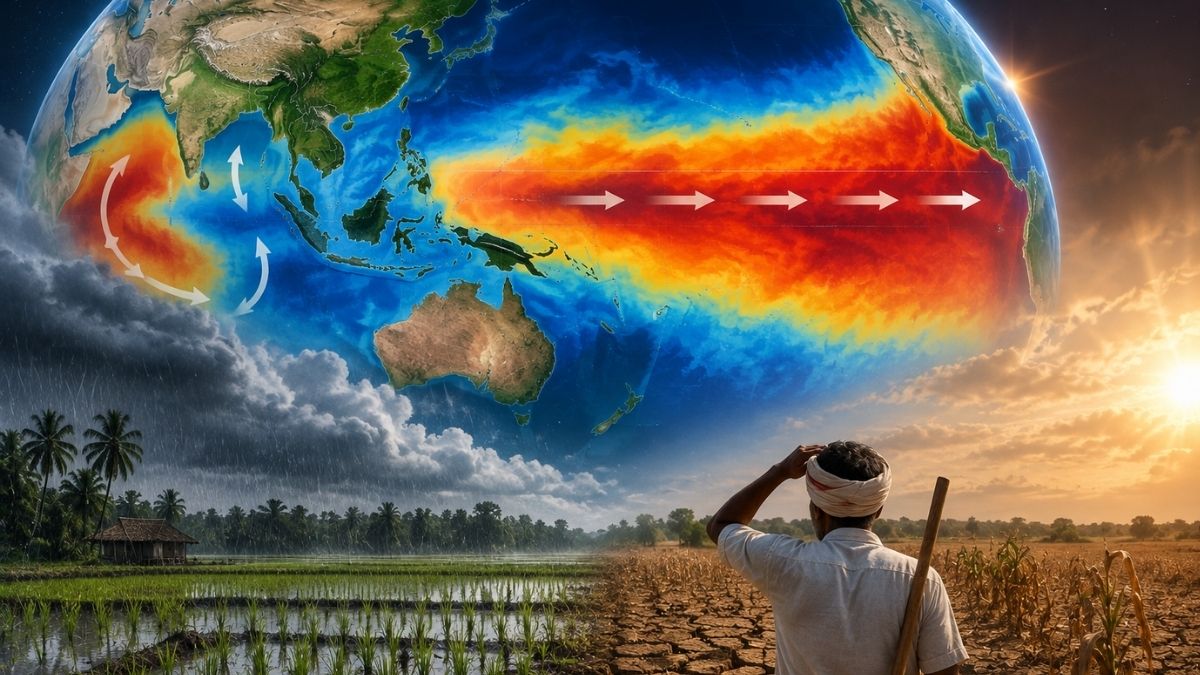
El Niño is a climate pattern that warms part of the Pacific Ocean.
It is getting stronger, and the water is much warmer than usual.
Scientists think it may become stronger still during the coming months.
Some forecasts say it could reach levels higher than those seen in reliable records since 1950.
The current event may last until around March 2027.
Another climate pattern, called the Indian Ocean Dipole, has also moved above its positive level.
However, scientists say this does not yet prove that a positive IOD event has begun.
Seas around much of Australia and globally were also unusually warm.

The Niño 3.4 index rose to 2.51°C, with further warming forecast.
Most models predict El Niño will peak above 3.0°C in late spring or summer.
The event is expected to persist into autumn 2027, according to the report.
The Indian Ocean Dipole index reached +0.65°C, above its positive threshold, but a positive event is not yet confirmed.
Global sea-surface temperatures in August 2026 were the warmest on record in the NOAA ERSSTv5 dataset.
- Who
- The Bureau of Meteorology and climate models are monitoring El Niño and the Indian Ocean Dipole.
- What
- El Niño is strengthening, while the Indian Ocean Dipole index has risen above its positive threshold without confirming a positive event.
- Where
- The main changes are occurring in the tropical Pacific and Indian oceans, with unusually warm waters also around Australia.
- When
- The report was published on September 15, 2026, using observations through September 13, 2026; El Niño is forecast to continue into autumn 2027.
- Why
- Pacific ocean temperatures, atmospheric indicators and model forecasts show a strengthening El Niño, while the IOD index has risen above +0.4°C.
Key facts
- Niño 3.4 index
- 2.51°C
- El Niño forecast peak
- Most models forecast above +3.0°C in late spring or summer.
- Expected duration
- El Niño is expected to persist into autumn 2027, around March.
- 30-day Southern Oscillation Index
- -18.5 through September 13, 2026, below the El Niño threshold of -7.
- IOD index
- +0.65°C for the week ending September 13, 2026.
- Positive IOD threshold
- +0.4°C; exceeding it does not yet confirm a positive IOD event.
- Global August sea-surface temperature
- 1.04°C above the 1961–1990 average, the warmest recorded in the NOAA ERSSTv5 dataset.
Sources
Related news
Very Strong El Niño May Reshape India’s Weather Outlook

Supersized El Niño Could Become Strongest Ever, UN Warns

WMO Warns Very Strong El Niño Could Reshape Global Weather

US Climate Centre Sees 75% Chance of Historic El Niño
El Niño Expected to Peak in November or December

Nobel laureate Ressa urges immediate limits on artificial intelligence

Bhuvneshwar Kumar Recalls Virat Kohli’s Early Captaincy Transition

McCullum Warns Carse to Improve Conduct Before England Return

Australian MP says periods, childbirth and menopause can cost $100,000