6 days ago
Indian Markets Fall as Hormuz Tensions Weigh Sentiment

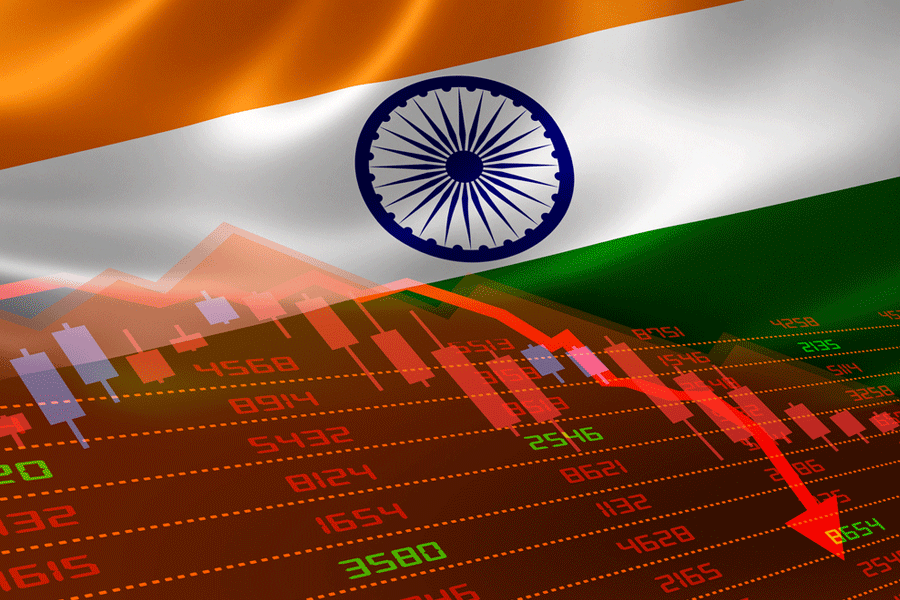
Indian stock markets ended lower on Thursday.
Investors were worried because negotiations linked to tensions around the Strait of Hormuz had not made progress.
These concerns reduced confidence and made people less willing to take risks.
The Sensex and Nifty both fell.
Most market sectors also lost value, especially cement, metals, media and public-sector banks.
A few areas, including private banks, pharmaceuticals and consumer durables, gained slightly.
Lower oil prices and bond yields offered some support because they may help control inflation.
Analysts said technical indicators showed that the market’s recent strength was weakening.
Investors are now watching the US Federal Reserve chair’s speech at Jackson Hole for clues about interest rates and future market conditions.

The Sensex fell 539 points, or 0.70 percent, to close at 76,933.
The Nifty declined 116 points, or 0.48 percent, ending at 24,090.
The Nifty Bank dropped 273 points, or 0.47 percent, to settle at 57,509.
Most sectoral indices declined, led by cement, PSU banks, media and metals.
Investors are awaiting the US Federal Reserve chair’s Jackson Hole speech for policy signals.
- Who
- Indian equity investors, analysts and market participants.
- What
- The Sensex, Nifty and broader Indian markets recorded notable losses.
- Where
- Indian equity markets, with trading reported from Mumbai.
- When
- Thursday; investors are also awaiting the upcoming Jackson Hole speech.
- Why
- Uncertainty over Strait of Hormuz and Middle East negotiations, derivatives-expiry volatility and weaker technical signals weighed on sentiment, although softer crude prices, lower bond yields, foreign inflows and resilient earnings provided support.
Market Concerns
Market Support
Near-term direction
Market Concerns
Analysts said the Nifty’s move below its rising channel and 50-day exponential moving average indicated stronger bearishness and a weakening trend.
Market Support
Foreign institutional investor inflows, resilient earnings and strong domestic demand continue to support Indian equities, especially some mid-cap segments.
Energy and global risks
Market Concerns
Unresolved Middle East negotiations and Strait of Hormuz tensions weakened risk appetite, while derivatives-expiry volatility added pressure.
Market Support
Softer crude oil prices and lower long-term bond yields supported the inflation outlook, and higher energy costs were largely reflected in earnings expectations.
Key facts
- Sensex close
- 76,933, down 539 points or 0.70 percent.
- Nifty close
- 24,090, down 116 points or 0.48 percent.
- Nifty Bank
- 57,509, down 273 points or 0.47 percent.
- Worst-performing sector
- Nifty Cement, down 1.33 percent.
- Other major sectoral declines
- PSU banks fell 0.94 percent, media 0.89 percent and metals 0.86 percent.
- Broader markets
- Nifty Midcap 100 fell 0.10 percent, NSE Smallcap 100 fell 0.13 percent and Nifty Next 50 fell 0.21 percent.
- Rupee
- The rupee weakened against the US dollar, which recovered toward 95.50 after the rupee reached a 10-day low of 95.40 in the previous session.
Quotes
A market participant
A market participant discussing support for Indian equities
“Expiry-led volatility and the lack of a diplomatic breakthrough in the Middle East continue to keep markets range-bound in the near term. While a degree of higher energy prices is largely factored into earnings expectations, the recent moderation in crude oil prices and long-term bond yields is supporting the inflation outlook.”
 thehansindia.com
“Meanwhile, FII inflows and resilient earnings momentum remain supportive for Indian equities, particularly mid-caps, where several segments are relatively insulated from global uncertainties and continue to benefit from strong domestic demand trends.”
thehansindia.com
Sources

Related news

Sensex falls 388 points, Nifty settles below 24,500

Indian Stocks Close Lower as West Asia Tensions Lift Crude

Sensex, Nifty End Lower as Iran-Hormuz Tensions Weigh

Sensex Sinks 493 Points, Nifty Ends Below 24,200

Sensex, Nifty drop as crude hits $91 on Iran-US tensions
Sensex, Nifty Plunge as West Asia Tensions Lift Oil Prices

Chevron Plans $7 Billion Venezuela Expansion Amid U.S. Oil Push
Saudi Arabia Says Iranian Tanker Attack Killed Two Sailors
U.S.-Iran Exchange Escalates Across Middle East, Markets Slide
Trump Aides Seek Quiet Iran War Before Midterm Elections
US Warns Middle East Travelers Amid Escalating Iran-Linked Tensions