1 month ago
NIT Rourkela Secures Patent for 3D Reinforced Composite Technology
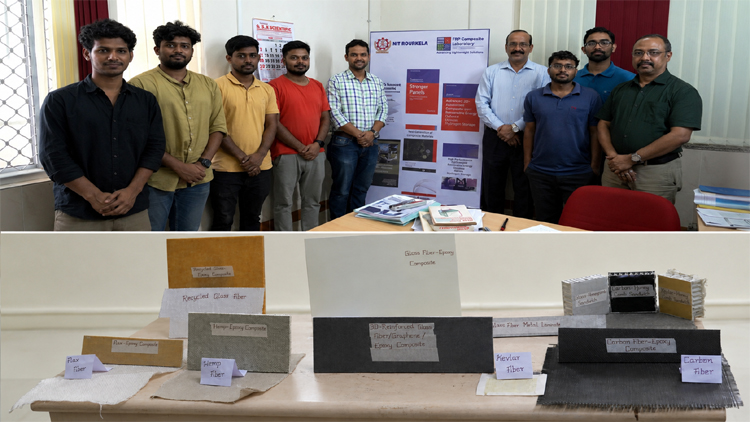
Scientists at NIT Rourkela invented a new way to make strong, lightweight materials that can be used in planes, cars, wind turbines, and more.
They added tiny sheets of graphene to glass fibers and used a special electric field while the material cured.
This makes the material stronger and less likely to crack.
Tests showed it can be up to 37% stronger in pulling tests and 53% tougher when it breaks.
The team wants to try it on bigger parts and work with companies to use it in real products.

NIT Rourkela has patented a 3D reinforced composite manufacturing process that improves strength and damage tolerance of FRP composites.
The technology uses glass fibers and graphene nanoplatelets aligned by a 50 Hz, 800‑volt electric field during curing.
Laboratory tests show up to 37 % higher tensile strength, 63 % better flexural modulus, and 53 % greater fracture toughness.
Potential applications include aerospace, automotive, renewable energy, defense, marine engineering, and hydrogen storage.
Researchers plan to test larger components and seek industry partnerships for commercial deployment.
- Who
- Researchers from NIT Rourkela and MNIT Jaipur
- What
- Patented 3D reinforced composite manufacturing technology
- Where
- National Institute of Technology Rourkela, India
- When
- Why
- To enhance strength, durability, and damage tolerance of FRP composites for various industries
Key facts
- Patent Status
- Granted
- Technology
- 3D reinforced composite manufacturing
- Key Materials
- Glass fibers and graphene nanoplatelets
- Performance Gains
- Tensile +37%, Flexural Modulus +63%, Fracture Toughness +53%
- Potential Applications
- Aerospace, automotive, renewable energy, defense, marine engineering, hydrogen storage
Quotes
Prof. Bankim Chandra Ray
Professor, Metallurgical and Materials Engineering, NIT Rourkela
“Our technology has wide-ranging applications wherever lightweight yet damage‑tolerant materials are essential, including aircraft panels, automotive crash structures, wind turbine blades, marine structures and pressure vessels.”
 deccanchronicle.com
“The innovation could reduce maintenance costs, improve energy efficiency and promote sustainable manufacturing while supporting India's Atmanirbhar Bharat mission in advanced materials.”
deccanchronicle.com