

1 week ago
India Weighs Year-Round Random Drug Tests for Pilots

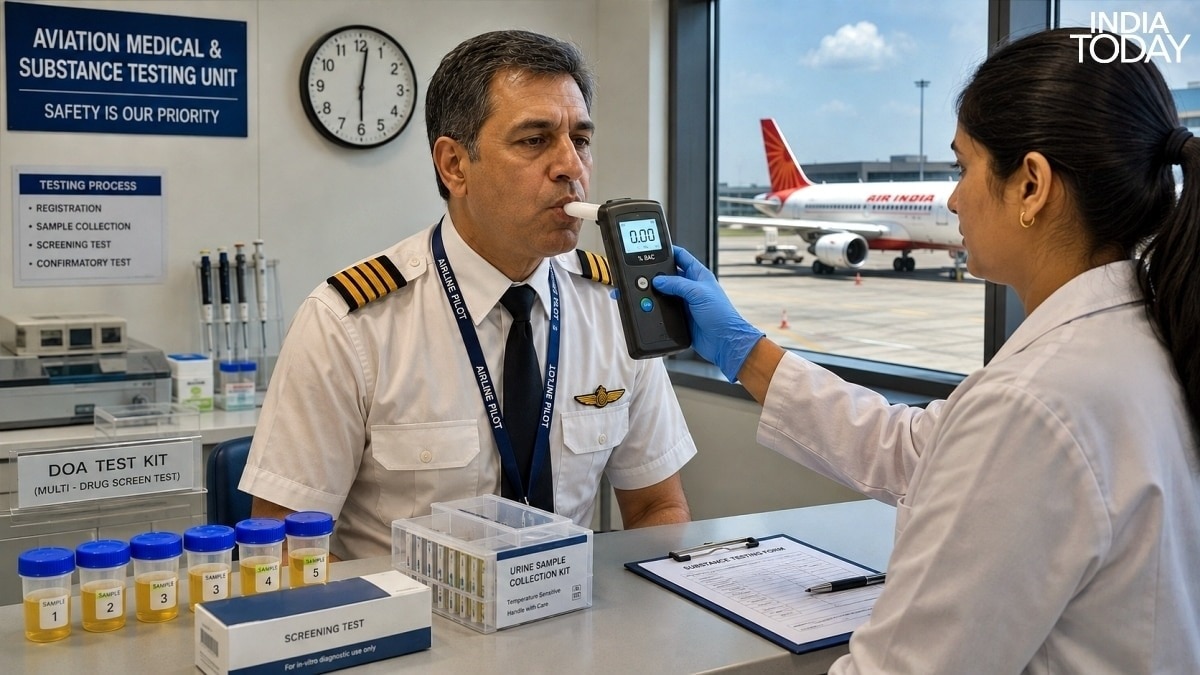
India is thinking about testing every commercial pilot for drugs once at a random time each year.
Right now, the rules require tests for at least 10% of pilots annually.
Officials are discussing whether the larger testing plan would improve safety and be practical for airlines.
The idea gained attention after an Air India flight suddenly lost about 300 feet of altitude.
The flight’s pilot-in-command later received a positive confirmatory test for a banned substance.
Air India and Air India Express responded by testing all of their pilots once.
IndiGo already tests about one-fifth of its pilots each year.
A pilots’ group wants testing to increase gradually rather than immediately cover everyone.
It also suggested using both oral-fluid and urine tests.

The Civil Aviation Ministry is considering random psychoactive-substance tests for every commercial pilot at least once annually.
The Directorate General of Civil Aviation is consulting airlines and other stakeholders about expanding testing beyond the current 10% annual requirement.
The proposal follows an Air India Phuket-Delhi flight’s sudden 300-foot altitude loss and a subsequent positive confirmatory test involving its pilot-in-command.
Air India and Air India Express began mandatory testing of their roughly 5,000 pilots, while IndiGo tests about 20% of its 5,500 pilots annually.
The Federation of Indian Pilots supports stronger testing but has proposed a gradual increase to 20-25% and a hybrid oral-fluid and urine-testing system.
- Who
- The Ministry of Civil Aviation, Civil Aviation Minister K Rammohan Naidu, the Directorate General of Civil Aviation, airlines, commercial pilots and the Federation of Indian Pilots.
- What
- Officials are considering random psychoactive-substance testing for every commercial pilot at least once a year, instead of the current 10% annual coverage.
- Where
- The proposal was discussed at an event in New Delhi. The related flight operated from Phuket to Delhi.
- When
- The minister discussed the proposal on Tuesday; the articles do not specify the date. The Air India altitude-loss incident occurred on 4 August, and the airline group’s mandatory testing began on 13 August.
- Why
- The government is assessing whether universal annual testing would improve aviation safety while remaining operationally workable; the proposal also follows the Air India flight incident and the pilot’s positive confirmatory test.
Universal annual testing advocates
Gradual expansion advocates
Testing coverage
Universal annual testing advocates
The ministry is considering testing every commercial pilot at a random time each year. Federation of Indian Pilots president CS Randhawa said 100% testing is possible and that infrastructure is available.
Gradual expansion advocates
The Federation of Indian Pilots recommended raising the minimum gradually to 20-25%, arguing for a more measured increase rather than an immediate shift to universal testing.
Operational impact
Universal annual testing advocates
Universal testing could provide broader safety coverage than the current 10% requirement, which supporters say does not cover a substantial number of pilots each year.
Gradual expansion advocates
The minister said officials must consider operational effects, including additional sample collection, laboratory capacity, scheduling and crew downtime.
Testing methods
Universal annual testing advocates
A broader programme could use existing testing systems while expanding the number of pilots screened.
Gradual expansion advocates
The pilots’ federation proposed a hybrid model using oral-fluid tests for random, targeted and high-volume screening while retaining urine tests when their longer detection window or medical and regulatory requirements make them more appropriate.
Key facts
- Current rule
- The DGCA framework requires random testing of at least 10% of the overall pilot network annually.
- Proposed coverage
- Every commercial pilot could be tested randomly at least once during the year, potentially increasing minimum coverage tenfold.
- Pilot population
- Major Indian airlines employ roughly 12,000 pilots; all licensed commercial pilots, including charter, helicopter and freighter pilots, number about 25,000.
- Air India response
- Air India and Air India Express began mandatory psychoactive-substance testing for roughly 5,000 pilots on 13 August.
- Triggering incident
- An Air India Airbus A320neo lost about 300 feet during cruise on a Phuket-Delhi flight on 4 August; the pilot-in-command later tested positive in a confirmatory narcotics test.
- IndiGo programme
- IndiGo randomly tests about 20% of its 5,500 pilots each year and has conducted substance testing at induction since 2015.
- Pilot federation proposal
- The Federation of Indian Pilots recommended raising annual random-testing coverage to 20-25% and adding oral-fluid tests alongside urine testing.
Quotes
K Rammohan Naidu
India's Civil Aviation Minister
“There are multiple ways of approaching this dope test. Right now, the rule says 10% across the overall pilot network. DGCA is engaging and one of the opinions from our side is that everyone (commercial pilot) has to go through it in the year at a random time. We have to see how all the stakeholders are going to respond because one is the safety aspect of it and the second thing is the operational impact.”
 telegraphindia.com
 livemint.com
“Right now, the rules say 10 per cent (drug tests) across the overall pilot network, but just like I said, DGCA is engaging (with stakeholders)... One of the opinions from our side is that everyone has to go through it (drug tests) the (whole) year at a random time. So, we have to see how all the stakeholders are going to respond to this.”
telegraphindia.com
CS Randhawa
President of the Federation of Indian Pilots
“And there is enough infrastructure available to carry out such tests. At present, 10% is a small number. And does not cover even a substantial set of pilots every year,”
livemint.com
Sources
Related news

India Considers Year-Round Drug Tests for Commercial Pilots

India Weighs Annual Random Drug Tests for Every Pilot
India Weighs Annual Drug Testing for All Pilots After Incident
India Weighs Annual Dope Tests After Air India Incident
India Weighs Random Dope Tests for All Commercial Pilots
DGCA Seeks Annual Drug Tests for More Than 25% Crew

Pilots Warn Senior Attrition Could Challenge Air India Safety

Air India Express Passenger Arrested After Allegedly Hiding Drugs

New Phuket Resort Offers Luxury Escape From Crowds
