2 hrs ago
CCMB Distributes Climate-Resilient Rice Seeds to Farmers
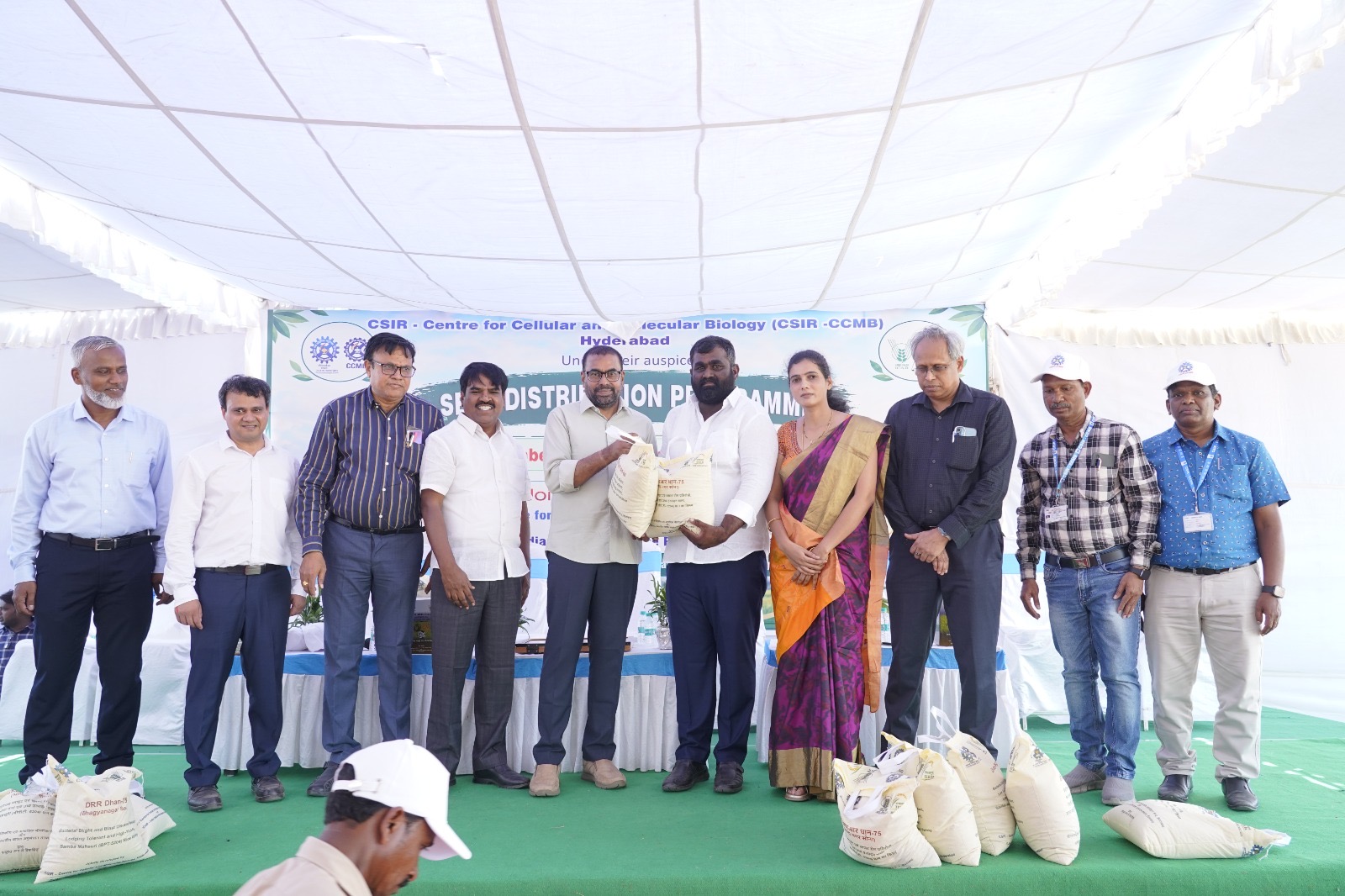
Scientists gave rice seeds to more than 150 farmers in Yadadri Bhuvanagiri district.
The seeds were developed by CCMB and the Indian Institute of Rice Research.
The scientists want to learn how well the rice grows in difficult conditions.
These include plant infections, salty soil and soil with little phosphorus.
The rice varieties are also being studied for high yields and ability to handle changing climate conditions.
Some were described as diabetes-friendly.
Officials explained the seeds to farmers and answered their questions.
The district agriculture officer said the administration would help farmers with selling their harvest.

More than 150 farmers in Telangana’s Yadadri Bhuvanagiri district received rice seeds developed by CCMB and ICAR-IIRR.
The distribution took place at CCMB’s Annex III campus in Bommaipalli, where the institute cultivates rice varieties on a 50-acre facility.
Researchers are studying the varieties’ resilience to infections, parasites, high soil salinity and low phosphorus conditions.
Officials described the varieties as high-yielding and climate-resilient, with some also highlighted as potentially diabetes-friendly.
District agriculture officer Ramana Reddy answered farmers’ questions and said the administration would support procurement of their produce.
- Who
- More than 150 farmers received seeds developed by the Centre for Cellular and Molecular Biology and the Indian Institute of Rice Research.
- What
- Distribution of rice seeds for varieties being studied for resilience and other potential benefits.
- Where
- CCMB’s Annex III campus at Bommaipalli, in Yadadri Bhuvanagiri district, Telangana.
- When
- Not specified in the article.
- Why
- To promote high-yielding, climate-resilient crop varieties and study their ability to withstand infections, parasites and challenging soil conditions.
Research and promotion
Caveats and verification
Potential benefits of the varieties
Research and promotion
Officials and scientists said the rice varieties could support high yields, climate resilience and, in some cases, populations at risk of diabetes.
Caveats and verification
The article describes these as aims and potential benefits under study; it does not report measured results or confirm the varieties’ performance.
Key facts
- Farmers receiving seeds
- More than 150
- Developers
- CSIR-CCMB and ICAR-IIRR
- Distribution site
- CCMB Annex III campus, Bommaipalli
- Facility size
- 50 acres
- Study conditions
- Infections, parasites, high soil salinity and low phosphorus
- Participating personnel
- More than 100 scientists, administrators and officials, alongside district and agriculture department officials
Sources
Related news

Dhanuka Agritech Launches Fujita Fungicide for Rice Blast
Telangana Agricultural University Plans Weather-Ready Crop Diversification Pilot Project
ICAR-SBI Trains Tribal Farmers in Improved Sugarcane Technologies

Bayer CEO urges technology access and crop diversification for India

80% Seed Subsidy Supports Alternative Crops Amid Rainfall Deficit