

2 days ago
India’s Youth Need Better Education and Jobs, Not Labels
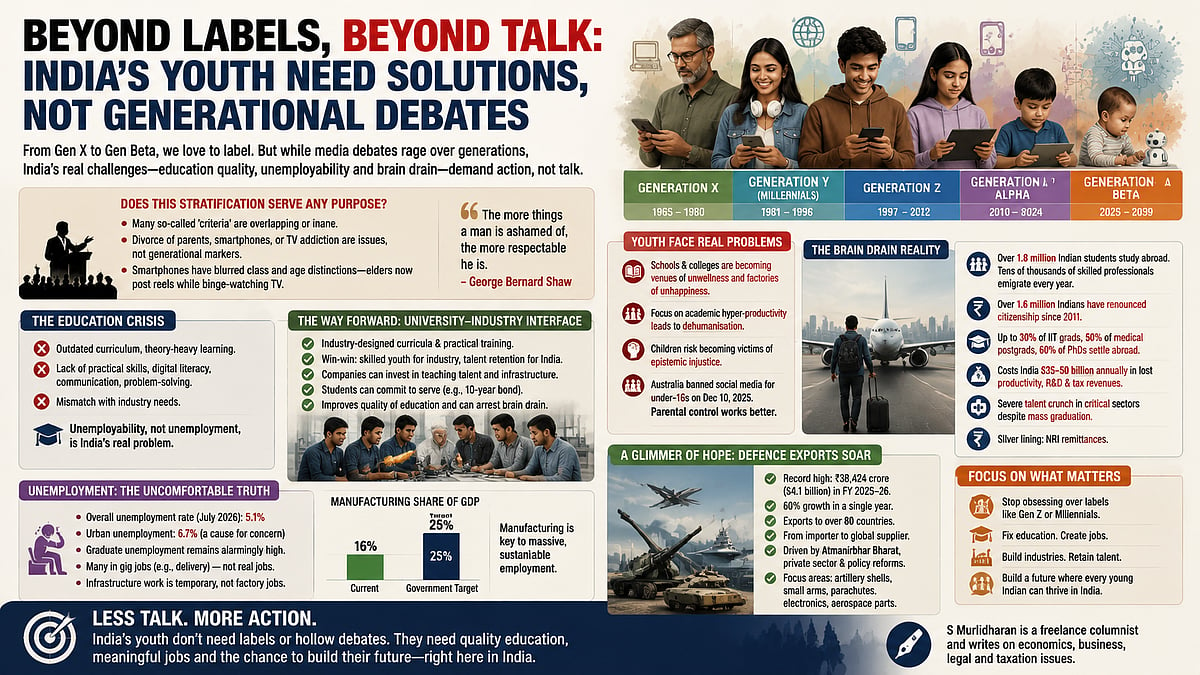
People often sort young people into groups such as Millennials or Generation Z. The article says these labels do not explain all the different problems young people face.
Many Indian graduates struggle because their education does not teach enough practical skills for available jobs.
There are also not enough permanent, well-paying jobs for everyone with a degree.
The article suggests that universities and companies should work together to teach useful skills.
It also says many highly trained Indians leave the country to study or work abroad.
This can make India lose doctors, scientists, engineers, and other skilled workers.
More manufacturing and new industries could create additional jobs.
The main message is that India should focus on education and employment instead of arguing about generation names.

The article argues that generational labels often produce shallow media debates and blur meaningful age and class distinctions.
It identifies graduate unemployability as a structural problem caused by outdated curricula, limited practical training, and insufficient formal jobs.
The article proposes stronger university-industry partnerships, including corporate-supported training aligned with workplace needs.
Brain drain is described as a major loss of Indian talent, although overseas Indians provide significant remittances.
The article urges India to prioritize quality education, manufacturing, and employment over debates about generational identity.
- Who
- Indian youth, graduates, educators, employers, policymakers, and skilled professionals who leave India.
- What
- The article examines generational labeling and argues that India should address poor employability, unemployment, brain drain, and education quality.
- Where
- The discussion focuses on India, with comparisons involving Australia, Germany, the United States, Canada, and other countries.
- When
- The article references Australia’s social-media restriction dated December 10, 2025, and India’s unemployment data for July 2026.
- Why
- The author argues that structural education and employment problems have greater consequences than debates over whether young people belong to a particular generation.
Generational Framing
Structural Reform
Value of generation labels
Generational Framing
Supporters may view generational categories as a way to discuss shared social, economic, and technological experiences.
Structural Reform
The author argues that the categories are overlapping and often fuel animated but shallow media debates rather than addressing young people’s real problems.
Managing youth social-media use
Generational Framing
A national restriction such as Australia’s reported ban on social-media accounts for children under 16 could offer a broad regulatory approach.
Structural Reform
The article questions whether such a policy could be replicated successfully in India and says parental control may work better.
Technology and employment
Generational Framing
AI and factory robotisation may reduce employment opportunities, creating pressure to limit or manage their adoption.
Structural Reform
The article says excluding these technologies could leave India less competitive, so it favors exploring new manufacturing areas while addressing their employment effects.
Key facts
- Generational ranges
- The article lists Generation X as 1965–1980, Generation Y as 1981–1996, Generation Z as 1997–2012, Generation Alpha as 2010–2024, and Generation Beta as 2025–2039.
- Graduate employability
- The article attributes graduate unemployability to outdated curricula, limited practical training, weak digital and communication skills, and insufficient formal white-collar jobs.
- Brain drain
- The article says more than 1.8 million Indian students study abroad and that the overseas Indian diaspora exceeds 17.9 million people.
- Citizenship renunciation
- The article states that more than 1.6 million Indians have renounced their citizenship since 2011.
- Unemployment
- The article cites an overall Indian unemployment rate of 5.1% and urban unemployment of 6.7% as of July 2026.
- Manufacturing
- Manufacturing accounts for 16% of India’s GDP, while the government has aimed for a 25% share.
- Defence exports
- India’s defence exports reached Rs 38,424 crore, or $4.1 billion, in fiscal year 2025–26, according to the article.
Sources
Related news

India’s Youth Work Crisis Affects One in Three Gen Zs

India’s Youth NEET Crisis Exposes Limits of Unemployment Data

India’s Gen Z NEET Crisis Threatens Jobs and Social Stability

Congress Says Modi Government Has Ravaged Youth Education-to-Employment Pathway

Rahul Gandhi: Degree certificates mean nothing amid India's jobs crisis

Mitsubishi Revives Pajero With 201PS Fifth-Generation SUV

IIM-Born CEO Says Australia’s Everyday Life Runs on Trust

UN Report Says 1.5°C Overshoot, Return Remains Possible

Uday Kotak Warns Global Bond Markets Face Roller-Coaster Volatility

Countrywide Visas Services, Reviews, and Complaints Explained
