

2 weeks ago
FMCG distributors seek FSSAI norms for dark stores after crackdown

Some stores that deliver groceries very fast are called dark stores.
They are like small warehouses where food is kept before it is sent to your home.
Recently, officials in Maharashtra checked 86 of these places and stopped 14 food licenses belonging to Blinkit, Zepto and Swiggy Instamart.
They found problems with how food was stored, kept clean, and kept at the right temperature.
A group called AICPDF, which represents product distributors, wants new rules for these dark stores.
They asked the food safety authority, FSSAI, to decide how much space a dark store needs based on how many products it holds.
They suggested a formula: each product should get a little bit of space, so a store with 65,000 products would need about 23,000 to 26,000 square feet.
They also want separate areas for damaged or expired food, good pest control, and regular checks.
The group says food safety should not be rushed just because delivery is promised in 10 minutes.
They want the same safety rules for fast delivery stores as for regular shops.
This way, customers do not have to check every package themselves to make sure their food is safe.

Maharashtra FDA suspended 14 food-business licences linked to Blinkit, Zepto and Swiggy Instamart after inspecting 86 online food storage and delivery establishments.
The All India Consumer Products Distributors Federation (AICPDF) has asked FSSAI to set scientific storage-space norms for quick-commerce dark stores.
AICPDF proposed an SKU-to-space ratio of 0.35–0.40 sq ft per SKU, meaning a dark store with around 65,000 SKUs would need roughly 23,000–26,000 sq ft.
The proposed framework includes aisle and movement space, food-category segregation, temperature-controlled storage, pest control, sanitation, audits and traceability.
AICPDF wants nationwide surprise inspections and equal food-safety standards for quick commerce and traditional trade; expired food was reportedly found at a Zepto outlet in Pune.
- Who
- The All India Consumer Products Distributors Federation (AICPDF), led by National President Dhairyashil H. Patil, along with FSSAI and the Maharashtra FDA.
- What
- A call for a national regulatory framework setting food-safety and storage-space norms for quick-commerce dark stores after 14 licences linked to Blinkit, Zepto and Swiggy Instamart were suspended.
- Where
- Maharashtra, India, including inspections and reported incidents in Kalyan, Mumbai, Pune and Dharavi.
- When
- Reported on August 17, 2026, following a recent Maharashtra FDA crackdown.
- Why
- To ensure dark stores meet the same food-safety, hygiene and storage standards as traditional distributors after alleged deficiencies were found.
Food-safety regulators and distributors
Quick-commerce platforms
Dark store space standards
Food-safety regulators and distributors
Storage capacity should be set scientifically by FSSAI based on the number and type of products stocked, using a proposed SKU-to-space ratio.
Quick-commerce platforms
Storage capacity has been driven primarily by commercial considerations rather than regulatory formulas.
Delivery speed vs food safety
Food-safety regulators and distributors
Food safety cannot operate on a 10-minute business model, and consumers should not have to act as food inspectors.
Quick-commerce platforms
Quick commerce promises delivery in 10 minutes and consumer convenience, which the federation says it does not oppose.
Key facts
- Licences suspended
- 14
- Establishments inspected
- 86
- Platforms affected
- Blinkit, Zepto, Swiggy Instamart
- Proposed SKU-to-space ratio
- 0.35–0.40 sq ft per SKU
- Example dark store size
- ~23,000–26,000 sq ft for ~65,000 SKUs
- Regulator asked to set norms
- Food Safety and Standards Authority of India (FSSAI)
- Federation making the demand
- All India Consumer Products Distributors Federation (AICPDF)
- Reported incident
- Expired food found at a Zepto outlet in Pune
Quotes
Dhairyashil H. Patil
National President of the All India Consumer Products Distributors Federation (AICPDF)
“Quick commerce may promise delivery in 10 minutes, but food safety cannot operate on a 10-minute business model. Consumers should not have to become food inspectors checking dates, packaging and storage conditions.”
 thehindubusinessline.com
Sources
Related news

Quick-commerce firms scramble for food safety staff amid inspections

Maharashtra FDA Suspends Blinkit Food Licence Over Cockroach Infestation
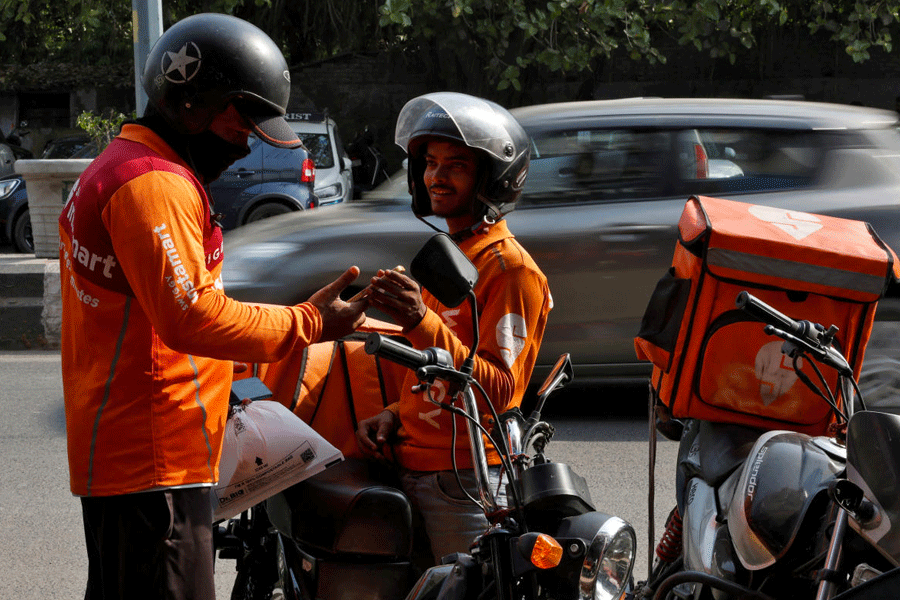
Maharashtra food safety chief suspends Blinkit, Swiggy, Zepto warehouse permits

Mumbai FDA Suspends 10 Licences, Seizes Expired Drinks in Crackdown

Rat in ice cream crate sparks outrage; food licence suspended

Reliance’s Digital Apps Struggle to Turn Reach Into Habit

Quick commerce projected to drive half of India’s e-retail growth

MSCI Removal Puts Swiggy Shares Under Fresh Selling Pressure

Cockroach Allegedly Spotted On Dessert Plate At Virar Restaurant
Internet Stocks Rally as MSCI Rejig Boosts IPO Activity
