9 months ago
Inquiry Over Infrastructure Builds Thinking Nation

The article discusses the importance of inquiry-based learning in India's education system.
It highlights that while India has made progress in infrastructure, the focus should be on fostering curiosity and critical thinking among students.
The article mentions that the last census in India was conducted in 2011, and there is a lack of updated and transparent public datasets on important issues like pollution, health, and education.
It emphasizes the need for students to question and interpret data, rather than just memorizing facts.
The article also references India's rich intellectual traditions, such as the concept of pramāṇa, which involves valid means of knowing through direct perception and reasoning.
It concludes by stressing that investing in teachers' ability to nurture curiosity is crucial for producing better questions and a more informed citizenry.

India has not conducted a full census since 2011, leading to outdated and opaque public datasets on crucial issues.
The OECD's PISA 2025 Science Framework and India's National Education Policy 2020 emphasize the importance of inquiry-based learning and evidence-based decision-making.
Science education in India has traditionally focused on memorization rather than curiosity and critical thinking.
Inquiry-based learning empowers students to question, interpret, and use evidence, preparing them for citizenship in a world with rapid misinformation.
India's intellectual traditions, such as the concept of pramāṇa, align with modern evidence-based thinking and should be integrated into classrooms.
- Who
- India's education system and policymakers
- What
- The need to prioritize inquiry-based learning over infrastructure in science education
- Where
- India
- When
- Present and future
- Why
- To foster curiosity, critical thinking, and evidence-based decision-making among students
Key facts
- Last Census
- 2011
- OECD PISA 2025 Science Framework
- Emphasizes preparedness for life, explaining phenomena, evaluating scientific enquiry, and interpreting evidence for decision-making
- India's National Education Policy 2020
- Calls for conceptual understanding, creativity, critical thinking, and logical decision-making
- Pramāṇa
- Valid means of knowing, including pratyakṣa (direct perception) and anumāna (reasoning)
- Nyāya School
- Developed the concept of pramāṇa, resembling evidence-based thinking
- Vidya dadāti vinayam
- Knowledge imparts humility
- Sa Vidyā Yā Vimuktaye
- That is knowledge which liberates
Sources
Related news

Supreme Court Seeks Class 6 Exemption From Three-Language Policy

Chakma Council to Implement NEP, Add Weekly Mizo Speaking Day
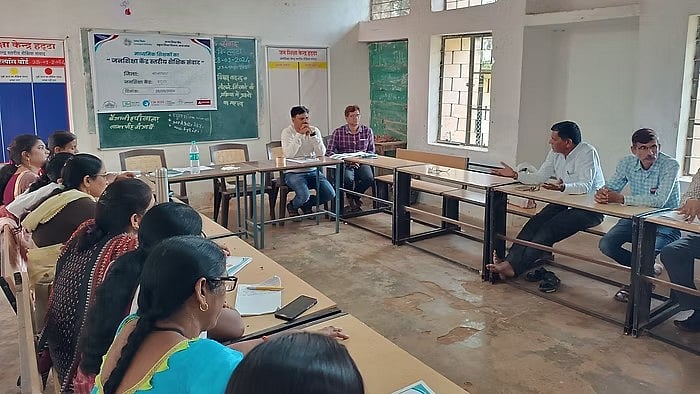
Madhya Pradesh Begins Late Training For New Class 7 Syllabus
NCERT Says Grade 9 Maths Topics Integrated, Not Dropped

NCERT Clarifies Grade 9 Maths Syllabus, Adds Algorithms Chapter