2 weeks ago
Weighing Physical vs Financial Assets: Portability and Liquidity Risks

When you save money, you can choose to invest it in different ways.
Some investments are called financial, like stocks and bonds, which exist on paper or in digital accounts.
Others are physical, like buying a piece of land or a gold bar that you can actually touch and hold.
Touching your investment can feel nice and reassuring.
If a physical investment does not grow much in value, you can sometimes still use it, like building a house on your land or making jewellery from your gold.
But physical investments have downsides too.
If your job makes you move to another city, you cannot easily take your land with you.
Turning gold into cash takes time and effort, and you need a safe place to store it, like a bank locker, which can be hard to get.
Because of this, the article says people who move often for work should mostly invest in financial assets.
Land should only be used to park extra cash, not money you need for important life goals, since it is hard to sell quickly.
For rental income, Real Estate Investment Trusts can be a good choice, though their prices can go up and down.

The article weighs investing in physical assets like land and gold against financial assets such as equity and bonds.
Physical assets are 'touch-and-feel' investments that can be converted to consumption use, such as building a house on land or turning gold bars into jewellery.
Real estate is not portable, making it a poor fit for investors who frequently relocate for work.
Gold takes effort to convert into cash and requires safe storage, with bank lockers noted as not easily available.
Real Estate Investment Trusts (REITs) are listed on stock exchanges, carry market risk, and may be an optimal alternative to lumpy real estate investments for rental income.
- Who
- Individual investors deciding how to allocate annual savings across asset classes; the advice comes from an unnamed investment trainer.
- What
- A guide comparing physical assets (real estate and gold) with financial assets, focusing on portability, liquidity, storage, and conversion to cash.
- Where
- Location not specified; the advice applies generally, including to investors who relocate between cities and states for work.
- When
- Article published on August 16, 2026, addressing ongoing investment planning considerations.
- Why
- To help investors decide how much to allocate to physical assets while accounting for work-related relocation, illiquidity, and storage challenges.
Key facts
- Topic
- Asset allocation between physical and financial assets
- Physical assets discussed
- Real estate (land) and gold
- Key drawback of real estate
- Not portable and not liquid
- Key drawback of gold
- Effortful to convert to cash; requires safe storage as bank lockers are not easily available
- REITs
- Listed on stock exchanges, exposed to market risk, suggested as alternative for rental income
- Article type
- Personal investment advice column
- Publication date
- August 16, 2026
Sources
Related news

Radhika Gupta Explains What Actually Counts As An Investment

Radhika Gupta Calls Gold the ‘Joker’ in Diversified Portfolios
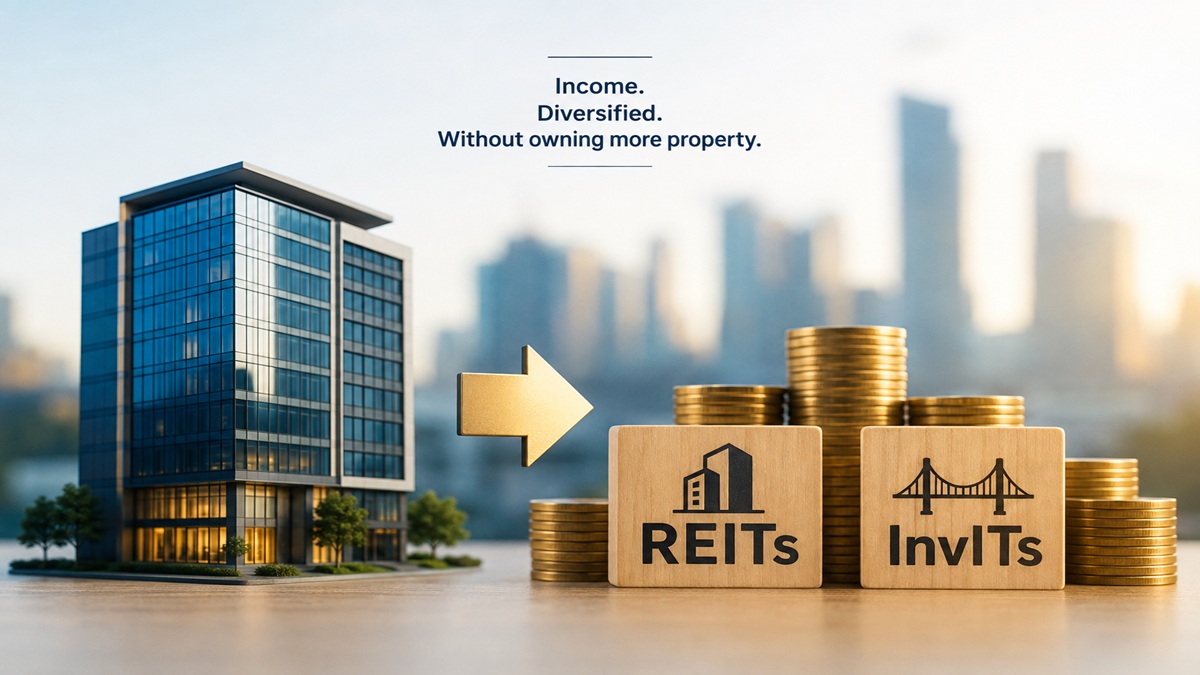
Rich Indians Seek Property Income Without Buying More Buildings

Digital Gold Could Unlock India's $5 Trillion Opportunity, Luniya Says

Real estate becomes core asset for India's wealthy investors