1 week ago
Rich Indians Seek Property Income Without Buying More Buildings
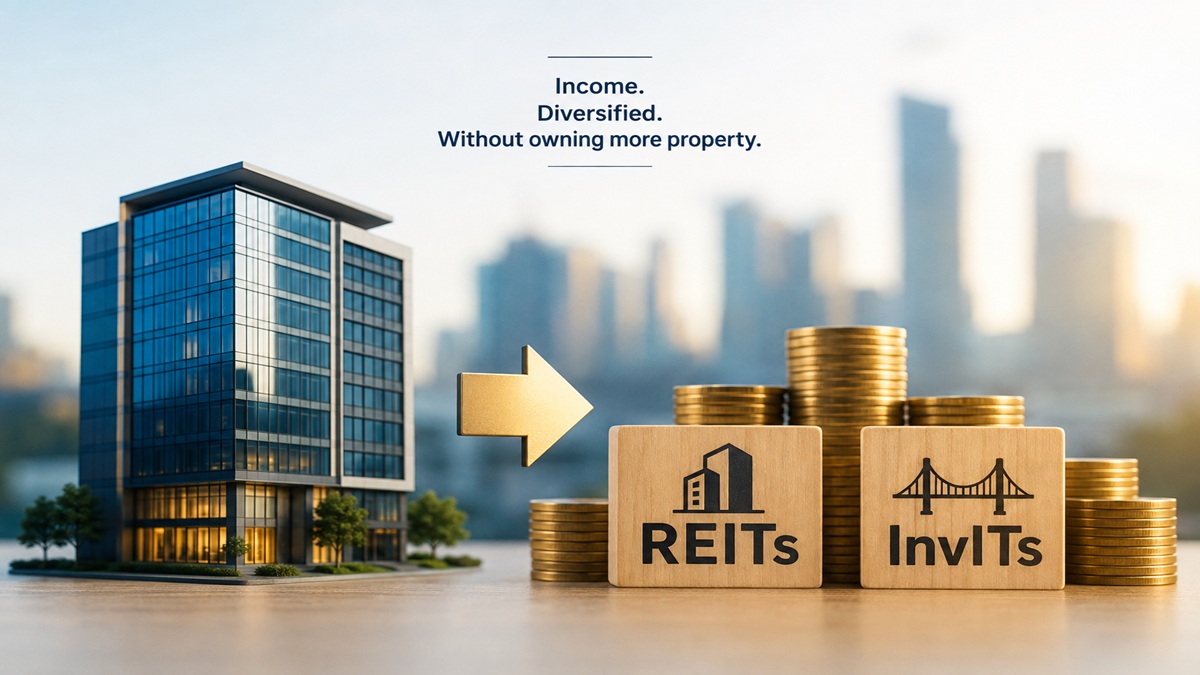
Many wealthy Indian families already own houses, offices and other property.
Buying even more can put too much of their money in one place.
REITs let people invest in groups of income-producing buildings without owning a whole building themselves.
InvITs do something similar for infrastructure such as roads and power networks.
These investments can pay regular distributions, often around 6%–9%.
However, the payments are not guaranteed, and prices can rise or fall.
They are also harder to trade than large, popular stocks in some market conditions.
The main idea is to earn income from real assets while spreading risk more widely.

Indian family offices are increasingly using REITs, InvITs and other alternatives for real-asset exposure without buying additional physical property.
The EY-Julius Baer report says alternatives account for 40%–45% of allocations in many family offices.
Listed REITs and InvITs reportedly offer distribution yields of about 6%–9%, but their returns and prices are market-linked rather than guaranteed.
Six listed REITs manage more than 200 million square feet of Grade-A commercial real estate, while InvITs provide exposure to infrastructure such as roads and power transmission.
Chirag Muni cautions that liquidity, volatility and limited track records mean investors should assess cash-flow quality and portfolio fit instead of chasing yields.
- Who
- Wealthy Indian families and family offices, with views from Chirag Muni of Anand Rathi Wealth Limited.
- What
- They are increasingly considering REITs, InvITs, private credit, private equity and AIFs instead of buying more concentrated physical property.
- Where
- India, across Indian family-office and listed real-asset markets.
- When
- The report and figures cited are from 2026, including data as of March 2026 and Q4 FY26.
- Why
- To obtain income and real-asset exposure while reducing concentration, operational responsibilities and capital tied up in individual properties.
Diversified real-asset exposure
Caution over market-linked products
Portfolio role
Diversified real-asset exposure
REITs and InvITs can provide income, diversification and exposure to multiple properties or infrastructure assets without direct ownership and its operational duties.
Caution over market-linked products
They may not suit investors seeking stable, liquid income, and their usefulness depends on the investor’s existing property exposure and overall portfolio.
Income expectations
Diversified real-asset exposure
Distributions of around 6%–9%, along with possible rental escalations or infrastructure revenue adjustments, can support income and potential long-term appreciation.
Caution over market-linked products
Distributions can change and should not be treated like fixed rent or a fixed-deposit return; investors should examine the sustainability and quality of cash flows.
Liquidity and risk
Diversified real-asset exposure
Listed units can generally be bought or sold through the market more easily than physical property, which can take months to sell and involve paperwork and transaction costs.
Caution over market-linked products
REIT and InvIT liquidity and market depth are still evolving in India, while interest rates, valuations, occupancy, leverage and refinancing conditions can cause volatility.
Key facts
- Alternative allocation
- Alternatives account for 40%–45% of allocations in many family offices, according to the EY-Julius Baer report.
- REIT and InvIT assets
- Listed REITs and InvITs together manage more than ₹9.8 lakh crore as of March 2026.
- Typical distributions
- REITs and InvITs typically provide distributions of about 6%–9%, although these are not guaranteed returns.
- Listed REIT holdings
- Six listed REITs own or manage more than 200 million square feet of Grade-A commercial real estate, with approximately ₹3.12 lakh crore in gross AUM in Q4 FY26.
- InvIT market
- India has approximately 28 registered InvITs, collectively managing more than ₹7.1 lakh crore of assets.
- InvIT asset mix
- InvIT AUM is allocated across roads at 44%, optical fibre at 30%, telecom at 14% and power at 8%.
- Risk classification
- The report classifies REITs and InvITs as medium-risk assets rather than low-risk investments.
Quotes
Chirag Muni
Executive Director at Anand Rathi Wealth Limited
“Considering the liquidity challenges and lack of track record, it is not suggested for investors to invest in this segment.”
 financialexpress.com
“REITs and InvITs can provide distribution yields of around 6% to 9%, but both are market-linked investments.”
financialexpress.com
Sources
Related news

India’s Rich Shift Wealth Into Private Markets And Alternatives

India’s Family Office Assets Set to Grow 1.5 Times

Indian Family Offices Shift Up To 45% Toward Alternatives

India’s Alternative Investment Market Could Exceed $2 Trillion by 2034

India’s Ultra-Rich Population Could Exceed 25,000 by 2031

Real estate becomes core asset for India's wealthy investors

Ashish Dhawan Builds Religare Stake Amid Restructuring Uncertainty

Why SIPs Alone Cannot Guarantee Financial Security

Rays of Belief IPO Draws Retail Demand, QIBs Hold Back

Foreign Portfolio Investors Buy ₹30,918 Crore as Markets Stay Cautious

Why Young Investors Should Not Avoid Debt Mutual Funds