1 week ago
YouTuber’s Haridwar Begging Experiment Draws Debate Over Earnings

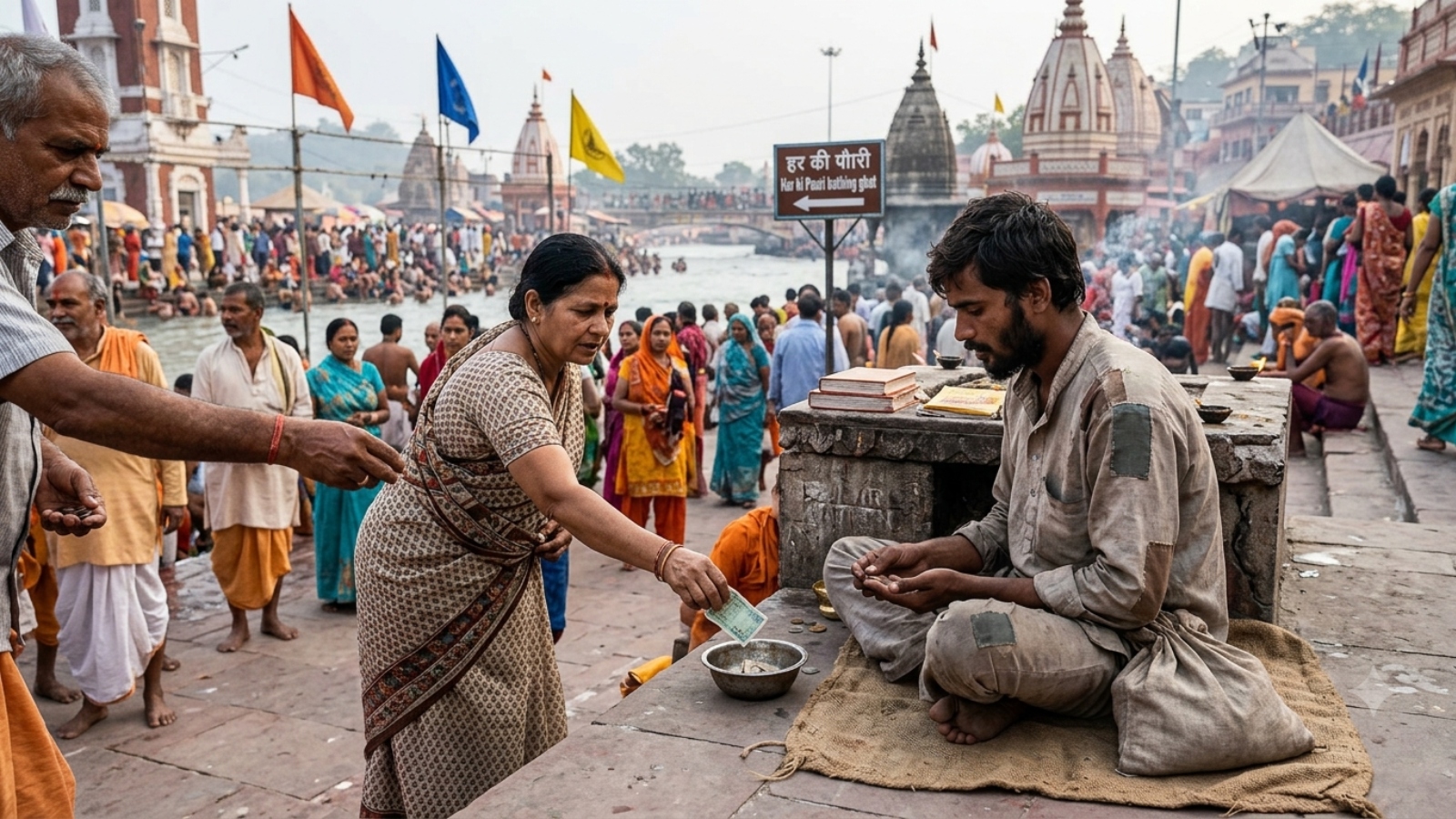
Two friends wanted to learn how much money someone might collect by begging at a large religious event.
Puroshottam Vashisht’s friend Sachin dressed like a beggar and asked visitors for money.
He carried a bowl and wore a QR code so people could pay digitally.
The first part of the experiment brought in little money, but donations increased later.
After about eight hours, they said they had collected around Rs 4,000.
Some people helped Sachin, while others refused, mistreated him or asked him to leave.
Rain and many hours of walking made the experiment tiring.
The friends said begging is not an easy or dependable way to earn money.
Some online users focused on the possible income, while others said the experiment does not show the everyday reality of people who beg.

YouTuber Puroshottam Vashisht and his friend Sachin tested begging at Haridwar’s 2026 Kawad Mela.
Sachin wore torn clothes, covered his face with dirt, carried a bowl and displayed a UPI QR code.
He collected about Rs 130 initially, Rs 800 after four hours and roughly Rs 4,000 after eight hours.
The experiment involved rejection, mistreatment, kindness, rain, fatigue and occasional requests from guards to leave.
The pair said begging was physically and mentally exhausting and urged viewers to pursue honest work instead.
- Who
- YouTuber Puroshottam Vashisht and his friend Sachin conducted the experiment.
- What
- They tested how much money could be collected by begging and reported around Rs 4,000 after roughly eight hours.
- Where
- At the Kawad Mela in Haridwar, Uttarakhand, India.
- When
- The experiment took place during the 2026 Kawad Mela; an X post about it was dated August 19, 2026.
- Why
- They wanted to examine the potential earnings and the physical and mental demands of begging.
Caution About Begging’s Reality
Focus On Its Earning Potential
Meaning of the Rs 4,000 figure
Caution About Begging’s Reality
The experimenters and some users said the result should not be treated as a typical income figure because earnings can vary and begging involves vulnerability, risks and loss of dignity.
Focus On Its Earning Potential
Other users focused on the reported Rs 4,000 in eight hours and calculated that longer hours or repeated daily work could produce much higher monthly earnings.
Whether begging is easy work
Caution About Begging’s Reality
Vashisht and Sachin described the activity as physically and mentally exhausting because Sachin had to repeatedly approach strangers.
Focus On Its Earning Potential
Some commenters portrayed begging as an easy or relatively unrestricted way to collect money, citing the absence of income-tax, professional-tax and filing requirements.
Broader social concerns
Caution About Begging’s Reality
Users highlighted mistreatment, vulnerability and claims that organized groups control where some people beg and how they operate.
Focus On Its Earning Potential
Another commenter criticized people for choosing what they viewed as easy income instead of pursuing innovation and productive work.
Key facts
- Participants
- Puroshottam Vashisht and Sachin
- Event
- Haridwar’s 2026 Kawad Mela
- Experiment duration
- Approximately eight hours
- Reported collection
- Around Rs 4,000
- Collection after four hours
- About Rs 800
- Digital payments
- The UPI QR code brought in around Rs 40
- Monthly projections
- The pair estimated nearly Rs 1.2 lakh based on daily repetition; one commenter suggested Rs 2.4–Rs 3 lakh, but other users disputed such projections.
Quotes
Pratham (@CapitalLens_ )
X user commenting on the experiment
“He was abused and treated badly by some. Others treated him with kindness. But the shocking part? He collected Rs 4,000 in just 8 hours. That’s Rs 500/hour. If someone does this for 12–13 hours, it could reach Rs 8,000–Rs 10,000/day. That’s potentially Rs 2.4–Rs 3 lakh/month.”
 indianexpress.com
“Interesting experiment, but it also highlights how complicated the reality of begging is income can vary hugely, while the dignity and vulnerability involved are often overlooked.”
indianexpress.com
Sources
Related news
KBC 18 Contestant Advances To Rs 50 Lakh Question

Triggered Insaan's 50-hour livestream raises Rs 70 lakh for Assam flood victims

Snabbit Worker's ₹46,641 July Earnings Spark Gig Economy Debate

Late-Night DM Helped JEE Aspirant Reach ₹1 Crore by 22
ChatGPT Earned Rs 579 in Seven-Day Rs 4,000 Challenge
August 25 Reveal Sparks Disappointment Amid Scam Claims

Uttarakhand CM Dhami Promises Action on Kumaon Traders’ Concerns
NHAI Seeks Bids to Complete Haridwar-Nagina Highway Work
Western Railway Extends 24 Special Trains Across 12 Routes
Patanjali Yog Gram Offers Ayurveda Wellness Retreat In Haridwar

Kangana Ranaut and Baba Ramdev End Feud on Raksha Bandhan