17 hrs ago
India Regains A- Sovereign Rating After 36 Years

A credit rating is like a report card showing how likely a country is to repay its loans.
On September 2, the Japan Credit Rating Agency gave India a better long-term rating, moving it from BBB+ to A-.
India had not held an A-grade rating for 36 years.
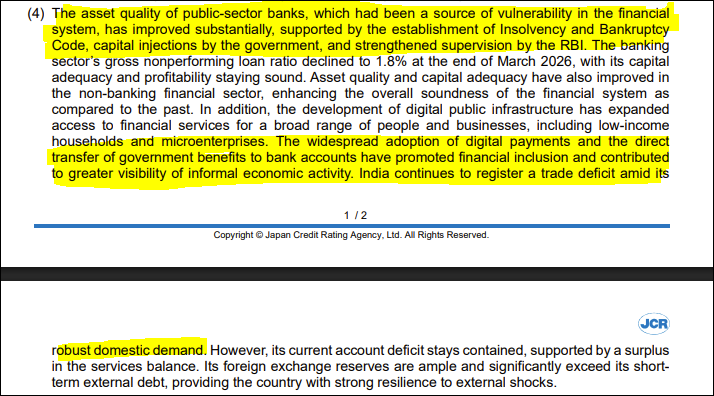
The agency pointed to strong economic growth, public investment, tax changes, and healthier banks.
A higher rating can make it easier and cheaper for the government and companies to borrow money.
It may also make investors more confident about investing in India.
Other major rating agencies still give India lower ratings.
The article says India’s reforms and economic stability helped win this upgrade.
Some critics questioned India’s recent growth figures, but the article says the figures reflect methodological improvements rather than an attempt to inflate growth.

Japan Credit Rating Agency upgraded India’s long-term sovereign rating from BBB+ to A- on September 2.
The upgrade marks India’s return to an A-grade sovereign rating after losing it in the early 1990s.
The agency cited roughly 7% growth, strong consumption and public investment, tax changes, and improving bank asset quality.
The rating could reduce borrowing costs by lowering perceived sovereign risk and encouraging demand for government bonds.
The upgrade increases pressure on S&P Global, Moody’s, and Fitch, which continue to rate India below the A-grade.
- Who
- India and the Japan Credit Rating Agency; other major agencies including S&P Global, Moody’s, and Fitch are also involved in the ratings landscape.
- What
- India’s long-term sovereign rating was upgraded from BBB+ to A-, and its country ceiling was raised to A.
- Where
- The rating applies to India’s sovereign creditworthiness.
- When
- The upgrade was announced on September 2; India had last held an A-grade rating in January 1988.
- Why
- The Japan Credit Rating Agency cited strong growth, private consumption, public investment, tax measures, political and macroeconomic stability, structural reforms, and improving bank asset quality.
Supporters of the Upgrade
Critics and Skeptics
Rating methodology
Supporters of the Upgrade
The article argues that rating agencies have historically used opaque methods and standards that disadvantaged fast-growing emerging economies such as India.
Critics and Skeptics
Credit-rating agencies assess institutional strength, governance, growth, external accounts, fiscal conditions, debt sustainability, and monetary flexibility before assigning ratings.
Recent GDP figures
Supporters of the Upgrade
The article says the latest growth figures are supported by revised methodology, improved price deflators, double deflation, and closer alignment with international national-accounting standards.
Critics and Skeptics
Some critics suggested that the revised GDP figures were contrived or made current growth appear higher.
Meaning of the upgrade
Supporters of the Upgrade
Supporters view the A- rating as an external validation of India’s reforms, stability, and long-term growth prospects that could attract more capital.
Critics and Skeptics
The article notes that other major agencies still rate India below A-grade, indicating that the upgrade is not yet a consensus view among rating agencies.
Key facts
- Upgrading agency
- Japan Credit Rating Agency
- Previous rating
- BBB+
- New rating
- A-
- Country ceiling
- Raised to A
- Last A-grade
- January 1988, when Moody’s assigned India an A2 rating
- Reported real GDP growth
- 7.8% in the first quarter of 2026-27
- Gross nonperforming loan ratio
- 1.8%, according to the cited assessment
- Other agencies’ ratings
- S&P Global: BBB; Moody’s: Baa3; Fitch: BBB-
Sources
Related news
Japan Agency Upgrades India Sovereign Rating to A-

India Wins JCR Sovereign Rating Upgrade After Strong GDP Growth

Japan’s JCR Upgrades India’s Sovereign Rating to A-

Japan Agency Upgrades India Rating; Singh Defends New GDP Method
S&P Affirms India’s BBB/A-2 Rating With Stable Outlook

UPSC Key Covers India-China Talks, Judiciary, Economy and Security