1 week ago
Supreme Court Limits SC/ST Act’s Public-View Requirement
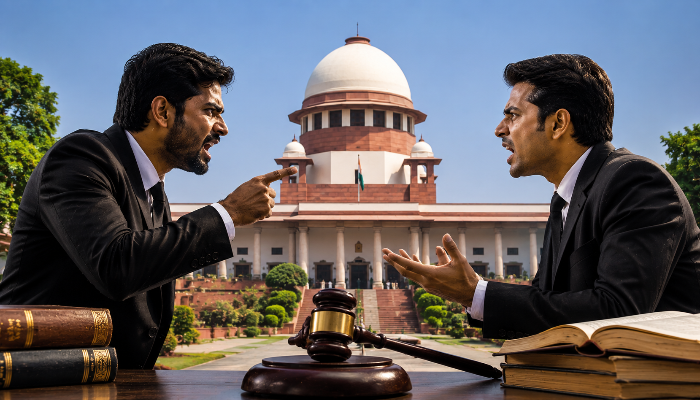
The Supreme Court heard a case about alleged caste-based insults at a school.
A father said the school manager and other staff attacked him and used casteist words after his son was hurt in a quarrel.
The manager said the alleged words were spoken inside a closed room that was not open to the public.
The law says these particular offences must happen in a place where the public can see or hear them.
The court said simply being inside a school does not make an incident public.
Teachers said they saw a quarrel and scuffle, but they did not say they heard the alleged casteist remarks.
The court therefore cancelled the case against the manager under the SC/ST Act.
Other accusations against him will still be considered.
The manager’s wife had also filed a separate counter-case against the complainant.

The Supreme Court held that alleged casteist remarks inside a closed room do not automatically satisfy the SC/ST Act’s “public view” requirement.
Justices Vikram Nath and Sandeep Mehta quashed proceedings against a school manager under Sections 3(1)(r) and 3(1)(s).
The complainant alleged that the manager and school staff assaulted him and used caste-based slurs after his son was injured in a student quarrel.
Teachers confirmed an altercation but did not state that they heard or witnessed the alleged casteist remarks.
Proceedings involving other alleged offences, including rioting, causing hurt, wrongful confinement and intentional insult, will continue.
- Who
- The Supreme Court bench of Justices Vikram Nath and Sandeep Mehta, hearing an appeal by a school manager accused under the SC/ST Act.
- What
- The court set aside the Allahabad High Court’s order and quashed proceedings under Sections 3(1)(r) and 3(1)(s) of the SC/ST Act against the manager.
- Where
- The alleged remarks were said to have occurred inside enclosed school room “A”; the appeal was decided by the Supreme Court of India.
- When
- The ruling was delivered on Thursday, August 20, according to the reports; the alleged incident occurred on January 24, 2020, and the Allahabad High Court rejected the manager’s challenge in April 2023.
- Why
- The court found that the alleged remarks were not shown to have been made where members of the public could see or hear them, and witness statements did not substantiate the alleged casteist abuse.
Complainant’s Allegations
Manager’s Defence and Supreme Court Finding
What happened at the school
Complainant’s Allegations
The complainant alleged that the school manager and staff assaulted him with lathis and shouted casteist slurs after he went to the school following his son’s injury in a student quarrel.
Manager’s Defence and Supreme Court Finding
The manager disputed the SC/ST Act allegations and argued that the remarks were allegedly made inside an enclosed room without public access.
Whether the incident was public
Complainant’s Allegations
The Allahabad High Court found a prima facie case and refused to quash the proceedings, holding that the allegations should continue to be examined.
Manager’s Defence and Supreme Court Finding
The Supreme Court held that an incident inside a confined room cannot be treated as occurring within public view when members of the public cannot see or hear it.
Strength of the evidence
Complainant’s Allegations
The complaint and FIR alleged caste-based abuse, leading to charges under Sections 3(1)(r) and 3(1)(s) of the SC/ST Act.
Manager’s Defence and Supreme Court Finding
The Supreme Court noted that the FIR did not specifically attribute casteist slurs to the manager, while teachers confirmed only an altercation and not the alleged remarks. Other alleged offences remain pending.
Key facts
- Relevant provisions
- Sections 3(1)(r) and 3(1)(s) of the Scheduled Castes and the Scheduled Tribes (Prevention of Atrocities) Act.
- Public-view requirement
- The alleged insult or caste-based abuse must occur where members of the public can see or hear it.
- Alleged incident
- The complainant said he went to the school after his son was injured in a quarrel and was then assaulted and subjected to caste-based abuse.
- Disputed location
- The manager argued that the alleged remarks were made inside enclosed room “A,” which had no window and was not open to the public.
- Witness evidence
- Teachers described an altercation and scuffle but did not say they were present when the alleged remarks were made or that they heard them.
- Supreme Court outcome
- Proceedings under Sections 3(1)(r) and 3(1)(s) of the SC/ST Act were quashed against the school manager.
- Other proceedings
- Cases involving alleged rioting, causing hurt, wrongful confinement and intentional insult will continue.
Quotes
Supreme Court bench comprising Justices Vikram Nath and Sandeep Mehta
The Supreme Court bench that heard and decided the appeal involving the school manager.
“It could thus be seen that, to be a place ‘within public view’, the place should be open where the members of the public can witness or hear the utterance made by the accused to the victim. If the alleged offence takes place within the four corners of the wall where members of the public are not present, then it cannot be said that it has taken place at a place within public view.”
 thestatesman.com
 scroll.in
“Tested on this principle, the prosecution case does not satisfy the statutory requirement. The FIR does not state that the alleged caste-based abuses were uttered in the presence or hearing of members of the public. On the contrary, the incident is alleged to have occurred inside a room in the school.”
 opindia.com
Sources


Related news

Supreme Court Says Private Caste Abuse Isn’t SC/ST Offence
Allahabad High Court Limits Caste-Name Use Under SC/ST Act

Allahabad High Court Revives Student Leader’s Caste Abuse FIR Plea

Court refuses to discharge Congress leader in casteist abuse case

Mumbai Court Sentences Chembur Man For Casteist Slurs Against Ambedkar

NCSC Seeks Warring Arrest in Buta Singh Remarks Case
PUCL Urges CJI Action Over Rajasthan High Court Allegations

Supreme Court Questions IPS Deputation for CAPF Leadership Positions

Supreme Court Quashes 20-Year Conviction, Reaffirms Juvenile Legal Protections

Two Years After RG Kar Doctor's Rape-Murder, Case Remains Unresolved

ED widens Chhattisgarh probes with two arrests and searches