1 hr ago
NCLT Approves Record 107 Resolution Plans in Second Quarter

The National Company Law Tribunal, or NCLT, decides whether certain business rescue plans can go ahead.
In the second quarter of FY27, it approved 107 plans, more than in any earlier quarter since it began in 2017.
These plans were worth Rs 11,071 crore.
The tribunal approved 185 plans in the first half of the financial year.
Some cases are still waiting for decisions, although the number of pending plan-approval applications has gone down.
NCLT says it is organizing cases and court workloads more closely.
It also has fewer members than its approved staffing level, and some members are due to retire.
The tribunal has introduced online services to help people view records and obtain certified copies.

NCLT approved 107 resolution plans worth Rs 11,071 crore in the second quarter of FY27, its highest quarterly total since its 2017 inception.
The second-quarter total was 78% above the 60 plans approved in the same quarter last year and exceeded the previous high of 90.
NCLT approved 185 plans in the first half of FY27, compared with 257 for all of FY26 and a record 288 in FY25.
Pending applications seeking approval of resolution plans fell from 363 in April to 294 by September-end; orders were reserved in 41 other matters.
The tribunal has 48 members against a sanctioned strength of 62, and is improving case management and online access to records.
- Who
- The National Company Law Tribunal (NCLT).
- What
- It approved a record 107 resolution plans worth Rs 11,071 crore in the second quarter of FY27.
- Where
- At NCLT benches and courts in India.
- When
- The second quarter of FY27; the article also reports figures through September-end.
- Why
- NCLT attributed the improved performance to administrative and institutional measures to improve case-flow management, registry processes, and use of judicial resources.
Tribunal capacity
Operational improvement
Staffing and court functioning
Tribunal capacity
NCLT remains 14 members short of its sanctioned strength, four members are due to retire by the end of 2026, and the shortage affects court functioning.
Operational improvement
The tribunal has improved case-flow management, case listing, workload redistribution, and prioritization of older cases and resolution-plan approvals.
Backlog
Tribunal capacity
A substantial number of matters remain pending, including 294 applications for approval of resolution plans at September-end.
Operational improvement
Pending applications fell from 363 in April, while NCLT reported record quarterly approvals and 185 approvals in the first half of FY27.
Key facts
- Second-quarter approvals
- 107 resolution plans
- Value of second-quarter plans
- Rs 11,071 crore
- Increase from same quarter last year
- 78%, from 60 plans
- First-half FY27 approvals
- 185 resolution plans
- Cumulative approvals since 2017
- 1,735 resolution plans
- Pending plan-approval applications
- 294 at September-end, down from 363 in April
- NCLT staffing
- 48 members—26 judicial and 22 technical—against a sanctioned strength of 62
- Reserved matters
- Orders were reserved in 41 matters at September-end
Quotes
National Company Law Tribunal
The tribunal responsible for the resolution plan approvals discussed in the article.
“The improvement in performance has been accompanied by a series of administrative and institutional measures undertaken in recent months to strengthen case-flow management, streamline registry processes and make effective use of the judicial resources available to the tribunal.”
 financialexpress.com
“The shortage of members has an impact on the functioning of courts, with 13 courts presently functioning on a full-day basis and 18 courts functioning on a half-day basis.”
financialexpress.com
Official statement
An official statement about NCLT's reporting mechanism.
“The new reporting mechanism provides a real-time and holistic picture of the workload and pendency across the benches and courts, enabling the tribunal to take more informed decisions on redistribution of cases, wherever required.”
financialexpress.com
Sources
Related news
Supreme Court Flags NCLT Infrastructure and Staff Shortages

Supreme Court Seeks Tribunal Vacancy Details From Centre
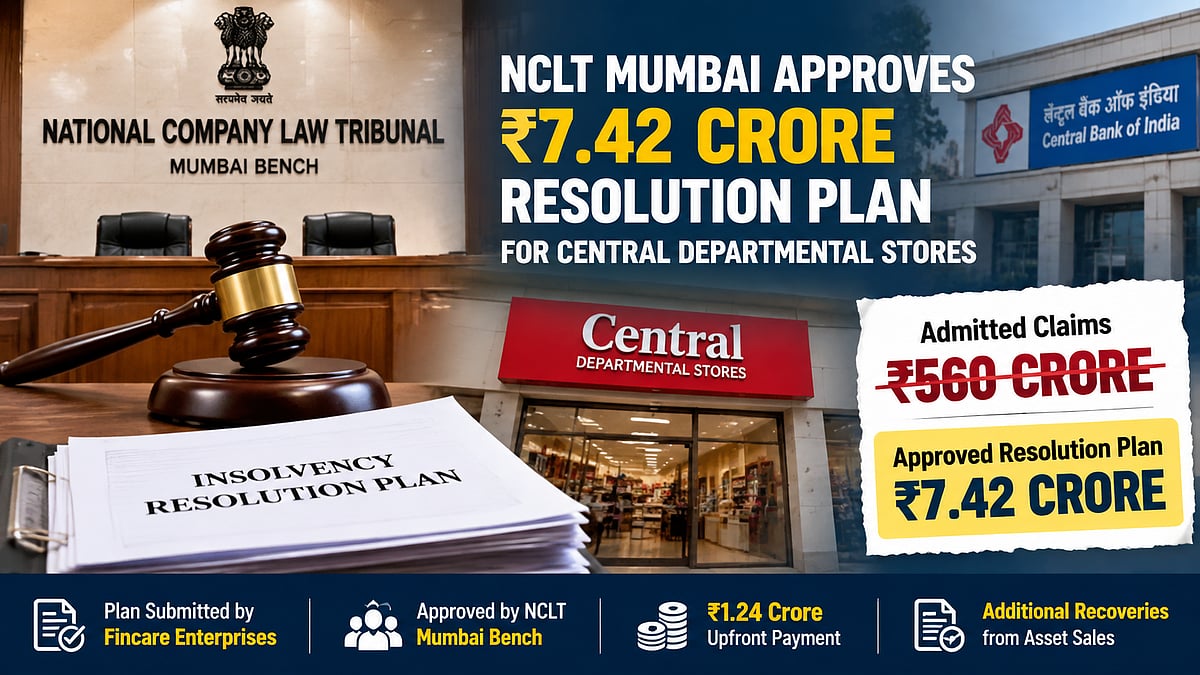
NCLT Approves ₹7.42 Crore Plan Despite ₹560 Crore Claims
Supreme Court Seeks Faster Appointments to Debt Tribunals

Bengal SIR Tribunal Judge Threatens Resignation Over Massive Backlog

IBC Faces Prolonged Timelines and Steep Haircuts
Supreme Court Challenge to Election Commission Immunity Sees Little Progress

Rajpal Yadav’s Film Failure at Center of Cheque-Bounce Case

Punjab Employees Consider Political Campaign Over DA Arrears

Supreme Court Urges Rajpal Yadav to Rebuild Image Through Films