2 hrs ago
Paralysed Pilot Weighs Brain Implants Against EEG Headgear
Owen Collumb cannot move most of his body because of a spinal injury.
He is testing technology that lets people control computers with their thoughts.
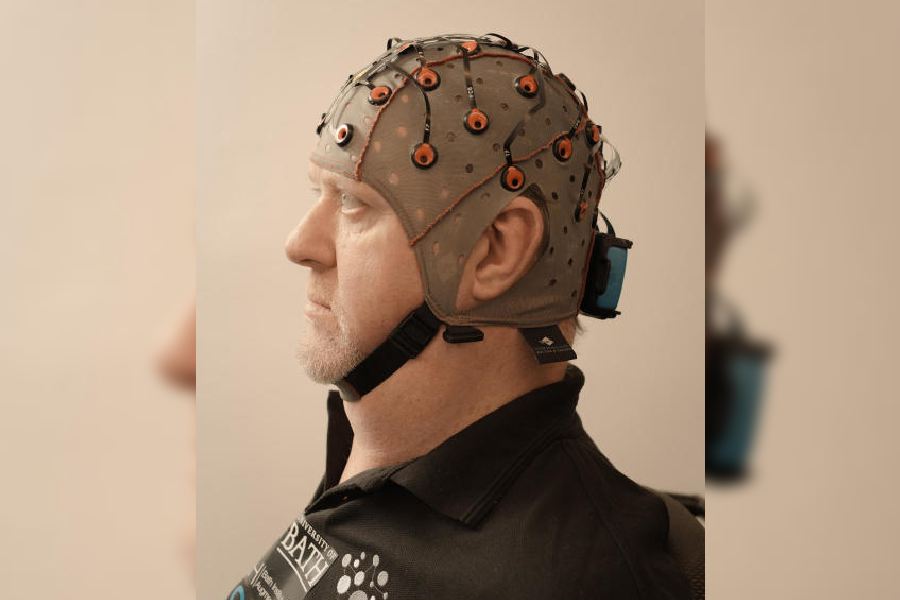
His team uses a special hat with electrodes that reads electrical activity from his brain.
Artificial intelligence helps turn those signals into computer commands.
The system can help him perform tasks such as moving objects in virtual worlds.
At the 2024 Cybathlon, he finished fourth.
A competitor with an electrode implanted in his brain won the competition.
Implants can usually read brain signals more clearly than hats worn on the head.
Collumb is still unsure whether having an implant would improve his everyday life enough to justify the procedure.

Owen Collumb, paralysed after a 1993 motorcycle crash, uses brain-computer interface technology to control computers.
His University of Bath team uses a 32-electrode EEG headgear system to translate brain activity into commands.
Collumb finished fourth in the 2024 Cybathlon brain-computer interface competition.
Phillip McKenzie’s team won after using an implanted electrode that enabled faster and more precise control.
Although implants generally provide better control, Collumb remains hesitant because of their invasive nature.
- Who
- Owen Collumb, Damien Coyle’s University of Bath team, and competing brain-computer interface teams, including Phillip McKenzie’s winning team.
- What
- They tested brain-computer interfaces that translate brain activity into computer commands for people with severe physical disabilities.
- Where
- Training took place in Bath, United Kingdom; Collumb lives in Dublin, Ireland; the Cybathlon was hosted in Switzerland.
- When
- Collumb was injured in 1993; he trained in summer 2024 and competed in the Cybathlon in October 2024.
- Why
- The technology is intended to give people with limited movement more control over computers, virtual tasks, and potentially assistive devices such as wheelchairs.
Noninvasive EEG Headgear
Implanted Brain Electrodes
Safety and accessibility
Noninvasive EEG Headgear
EEG electrodes are placed on the scalp, making the system easier and cheaper to use without opening the skull.
Implanted Brain Electrodes
Implants require a surgical procedure involving the skull and are invasive and expensive.
Control and precision
Noninvasive EEG Headgear
Surface EEG can provide useful computer control, but signals must pass through skin, hair, bone, and fluid and can be difficult to interpret.
Implanted Brain Electrodes
Implants capture clearer signals from specific brain regions and can provide more precise, faster control, potentially down to individual finger movements.
Everyday-life value
Noninvasive EEG Headgear
Collumb is content with what his current system can do and sees it as sufficient for now.
Implanted Brain Electrodes
The winning team’s performance suggests implants may offer greater capabilities, although Collumb does not yet see enough personal benefit to choose one.
Key facts
- Participant
- Owen Collumb, who was paralysed after a 1993 motorcycle accident
- Technology tested
- A brain-computer interface using electroencephalography, or EEG
- EEG equipment
- A skintight hat with 32 electrodes
- Competition
- The Cybathlon’s brain-computer interface category
- Collumb’s result
- Fourth overall in the October 2024 competition
- Winning result
- Phillip McKenzie’s implanted-electrode team completed every task perfectly in record time
- Key concern
- Collumb remains hesitant about receiving an invasive brain implant
Quotes
Owen Collumb
Paralysed Cybathlon pilot who uses a noninvasive brain-computer interface.
“Competing is one thing. And then life, and living, and possibilities of giving me more choice and control of my life is another thing.”
 telegraphindia.com
“An implant onto my brain cell, I don’t see it necessarily benefiting my life.”
telegraphindia.com
Sources
Related news

Brain Implant Helps Speech-Impaired Man Say “I Love You”

Neuralink Video Shows Participant Speaking Through Mind

Smart Play Uses AI to Measure Mind and Body

Paralysed Kolkata Teen Wins Two Para Rowing Medals

World’s First Live AI-Assisted Surgery Removes Brain Tumour