3 weeks ago
US employers unexpectedly shed jobs as unemployment rate falls

In July, American employers hired fewer workers than anyone expected.
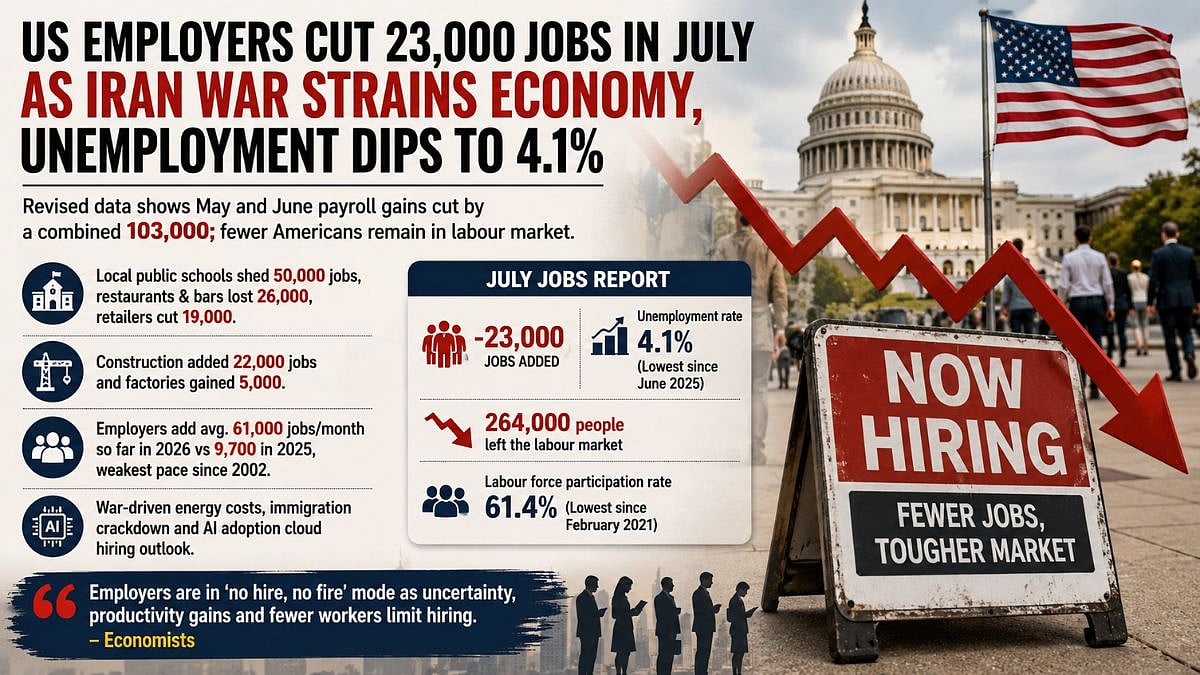
In fact, employers cut 23,000 jobs, meaning fewer people had jobs at the end of the month.
The numbers for May and June were also adjusted to show fewer jobs than first reported.
Even though jobs were lost, the unemployment rate went down to 4.1 out of every 100 workers.
That sounds strange, but it happened because fewer people were looking for work.
People who kept their jobs got smaller raises, with pay growing only 3.2 percent compared with a year before, the slowest increase in more than five years.
Most job losses came from government, hotels, restaurants, and stores, though private companies added 30,000 jobs.
Big companies like Microsoft, Uber, and Visa announced layoffs during the month.
The news might make the Federal Reserve wait before raising interest rates, but new reports about prices could change the plan.

US nonfarm payrolls fell by 23,000 in July, with May and June figures revised down by a combined 103,000.
The unemployment rate declined to 4.1% as the labor force participation rate slid to 61.4%, the lowest since the 1970s outside the pandemic.
Average hourly earnings rose 3.2% from a year earlier, the slowest pace in more than five years.
Job losses were concentrated in government, leisure and hospitality, and retail trade, while private payrolls rose 30,000, led by healthcare and social assistance.
The report could prompt the Federal Reserve to delay interest-rate increases, and investors reduced bets on a September rate hike.
- Who
- US employers and workers, as measured by the Bureau of Labor Statistics; the Federal Reserve is weighing the data.
- What
- Nonfarm payrolls unexpectedly fell by 23,000 in July, the unemployment rate declined to 4.1%, and wage growth slowed to 3.2%.
- Where
- United States.
- When
- July 2026, with the report released on a Friday in early August; May and June figures were also revised downward.
- Why
- Rising prices, uncertainty from the Iran war, volatile summer government education payrolls, and high-profile corporate layoffs weighed on hiring, and the weak data could prompt the Federal Reserve to delay rate increases.
Labor market weakness
Labor market strength
Labor market trajectory
Labor market weakness
Payrolls fell 23,000 in July and May-June figures were revised down by 103,000, suggesting the labor market is weaker than previously thought and may be starting to falter; financial-activities employment hit a four-year low amid concerns about artificial intelligence adoption.
Labor market strength
Private-sector payrolls rose 30,000 for a second month, ADP Research found wage gains for job switchers at a near-year high, Bank of America Institute saw gains among lower-income households, and small-business hiring plans hit a nearly four-year high.
Federal Reserve's next move
Labor market weakness
The outsized downside report could prompt the Federal Reserve to delay interest-rate increases, and investors reduced bets on a September rate hike.
Labor market strength
Upcoming consumer price data, including July figures next week, could ultimately decide the Fed's course of action next month as officials weigh inflation against employment risks.
Key facts
- Nonfarm payroll change (July)
- -23,000
- May-June revision
- Downward revision of 103,000 combined
- Unemployment rate
- 4.1%
- Labor force participation rate
- 61.4%, lowest since the 1970s excluding the pandemic
- Average hourly earnings growth
- 3.2% year over year, slowest pace in more than five years
- Private-sector payrolls
- +30,000 for a second month, led by healthcare and social assistance
- Local government job losses
- Nearly 60,000, almost entirely in education
- Fed rate hike expectations
- Investors reduced bets on a September rate hike after the report
Quotes
Christopher Hodge
Chief U.S. economist at Natixis North America
“"We thought that only an outsized move to the downside would shake the Fed’s thinking. This print was indeed such an outsized move. There has been very little inflationary impulse from the labor market previously, but now policymakers must be on guard for a more significant slowdown in jobs."”
 livemint.com
Sources
Related news
US Employers Cut 23,000 Jobs as Iran War Pressures Economy

US Jobs Shock: Employers Cut 23,000 Jobs in July

US hiring stalls: 23,000 jobs lost as wage growth slows

Treasury yields fall as jobs report dashes Fed hike bets
US loses 23,000 jobs as labour market slowdown deepens

Stocks Poised for Best Week Since April as Payrolls Fall

Bank of America Vice President Killed in Times Square Stabbing

Times Square Stabbing Leaves One Dead; Suspect Had Ominous Posts

Social Media Posts Preceded Fatal Times Square Stabbing Rampage

Times Square Stabbing Kills Bank Executive as Police Shoot Suspect

Beyond Nvidia, power and cooling firms benefit from data-centre boom