

3 weeks ago
US Employers Cut 23,000 Jobs as Iran War Pressures Economy
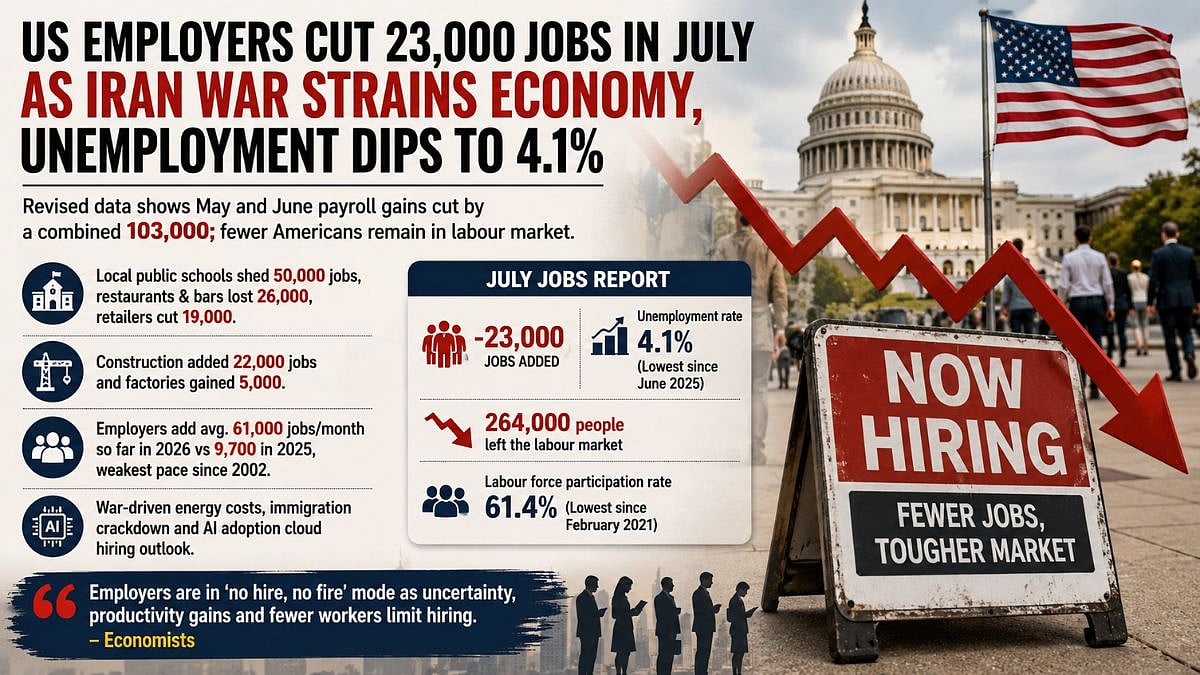
Last month, the United States lost 23,000 jobs.
That surprised experts, who thought companies would add lots of new jobs.
The unemployment number, which shows how many people want jobs but cannot find them, went down to 4.1%.
But it went down for a strange reason: 264,000 people stopped looking for work, so they were no longer counted as unemployed.
Schools, restaurants, and stores let many workers go, while construction and factories added a few jobs.
People who work for President Trump said the factory numbers show their plan is working.
The fighting in the Persian Gulf has made energy more expensive, which hurts family budgets.
Computers, robots, and artificial intelligence are also doing some jobs that people used to do.
Even though jobs were cut, people who have jobs feel safe because companies do not want to let workers go.
Experts are watching closely to see what happens next.

U.S. employers unexpectedly cut 23,000 jobs in July, and Labor Department revisions shaved 103,000 jobs off May and June payrolls.
The unemployment rate fell to 4.1%, the lowest since June 2025, but only because 264,000 people left the labor market; participation fell to 61.4%, the lowest since February 2021.
Public schools cut 50,000 jobs, restaurants and bars 26,000, and retailers 19,000, while construction added 22,000 and factories 5,000 jobs.
The White House said the 'Trump industrial resurgence is on schedule,' while economists described an unusual 'no hire, no fire' job market.
The report is a political setback for President Donald Trump and the Republican Party before midterm elections to keep control of Congress, with the Persian Gulf conflict and AI clouding the hiring outlook.
- Who
- U.S. employers, the U.S. Department of Labor, President Donald Trump's administration, and economists such as BMO Capital Markets' Sal Guatieri.
- What
- Employers unexpectedly cut 23,000 jobs in July while the unemployment rate fell to 4.1%, the lowest since June 2025.
- Where
- United States; the report was announced in Washington.
- When
- The report was released on Friday, August 7, 2026, covering July; May and June payroll gains were revised down by 103,000, and the jobless rate was 4.2% in June.
- Why
- The rate fell because 264,000 people left the labor market, and hiring is constrained by worker shortages, productivity gains, the Persian Gulf conflict's surging energy prices, and the rise of AI; a Federal Reserve study puts the monthly 'break-even' hiring rate near zero, and Federal Reserve Bank of San Francisco researchers found landing a job has gotten harder.
Data Skeptics
Trump Administration
Industrial resurgence vs. overall job losses
Data Skeptics
Overall payrolls fell by 23,000 jobs with 103,000 more revised away, marking a sharp reversal and a political setback for President Trump before the midterm elections.
Trump Administration
Manufacturing and factory construction jobs grew again in July, showing the 'Trump industrial resurgence is on schedule' even as government payrolls shrink.
AI's effect on employment
Data Skeptics
Rising productivity and artificial intelligence could take jobs away from workers, adding uncertainty to the hiring outlook.
Trump Administration
Artificial intelligence could make workers more efficient and better-paid rather than replace them.
Key facts
- Net jobs change in July
- -23,000 (forecasters expected gains near 100,000)
- Unemployment rate
- 4.1% (lowest since June 2025)
- May-June payroll revisions
- -103,000
- People leaving the labor market
- 264,000; participation rate 61.4%, lowest since February 2021
- Biggest sector losses
- Public schools -50,000; restaurants and bars -26,000; retailers -19,000
- Construction and factory gains
- Construction +22,000; factories +5,000
- Average monthly hiring in 2026
- 61,000 jobs (vs. 9,700 in 2025)
- Job-switcher pay raise
- 7% year-over-year vs. 4.4% for workers who stayed (ADP)
Quotes
White House spokesman Kush Desai
White House spokesperson
“"The Trump industrial resurgence is on schedule. Manufacturing and factory construction jobs grew again in July even as government payrolls continued to significantly shrink."”
 freepressjournal.in
 deccanchronicle.com
Sal Guatieri
Senior economist at BMO Capital Markets
“"There are just fewer people available to hire."”
freepressjournal.in
deccanchronicle.com
Ingrid Chen, Marianna Kudlyak, and Riva Mikhlin
Researchers, Federal Reserve Bank of San Francisco
“Instead of being pulled in, the pipeline into employment is shrinking such that the recovery is no longer reaching workers at the margins.”
deccanchronicle.com
Sources

Related news

US employers unexpectedly shed jobs as unemployment rate falls
US loses 23,000 jobs as labour market slowdown deepens

US Jobs Shock: Employers Cut 23,000 Jobs in July

US hiring stalls: 23,000 jobs lost as wage growth slows

Trump Faces Economic Pressure as July Jobs Report Disappoints
Bessent Defends Weaker US Jobs Market Amid Deportations
