3 hrs ago
India’s Defence Reforms Reshape Industry Through Corridors, Startups And Exports

India is trying to make more military equipment inside the country.
The government wants Indian companies, factories and startups to play a bigger role.
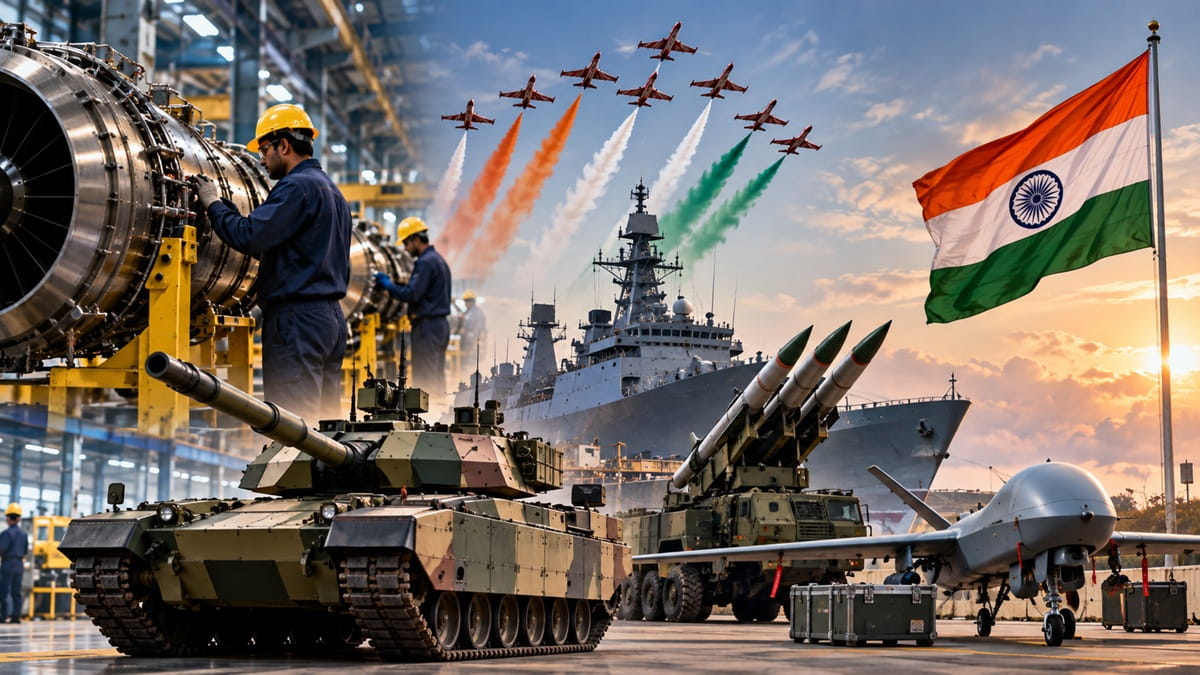
Defence production reached a record Rs 1.78 lakh crore in 2025–26.
Defence exports also grew to Rs 38,424 crore and reached more than 80 countries.
New rules encourage the armed forces to buy more products designed and made in India.
Startup programmes provide money, testing help and military problems for companies to solve.
Government laboratories are sharing technologies with private companies.
Defence corridors in Uttar Pradesh and Tamil Nadu are bringing factories and suppliers together.
The plan could reduce imports, but companies must still meet demanding standards for quality, delivery and long-term support.

India’s defence production reached Rs 1.78 lakh crore in 2025–26, more than doubling since 2020–21.
Defence exports rose to Rs 38,424 crore in 2025–26, reaching customers in more than 80 countries.
Procurement reforms, indigenisation lists and proposed 2026 rules aim to expand domestic design and manufacturing.
iDEX, ADITI and the Technology Development Fund are supporting startups and deep-tech defence projects.
Uttar Pradesh and Tamil Nadu corridors, technology transfers and private investment are building wider supply chains.
- Who
- The Government of India, the Ministry of Defence, public-sector companies, private firms, MSMEs, startups and foreign investors are involved.
- What
- India is expanding domestic defence production and exports through procurement reforms, innovation funding, technology transfers, industrial corridors and investment changes.
- Where
- Across India, especially in the Uttar Pradesh and Tamil Nadu defence industrial corridors and the BrahMos facility in Lucknow.
- When
- The reported measures and figures cover developments through 2025–26, with some data cited as of March, May and August 2026.
- Why
- To strengthen national security, reduce import dependence, create domestic industrial capacity and position India as a defence exporter.
Industrial Expansion Case
Implementation Concerns
Domestic procurement
Industrial Expansion Case
Supporters say indigenous procurement and indigenisation lists create predictable demand, helping Indian manufacturers invest in capacity, research and supply chains.
Implementation Concerns
The policy’s success depends on whether domestic suppliers can meet military requirements for quality, reliability, delivery schedules and lifecycle support.
Startup and technology support
Industrial Expansion Case
Innovation programmes, grants and DRDO technology transfers can help startups turn ideas into usable products and reduce development costs.
Implementation Concerns
The programmes are intended to address technologies that may be expensive or risky for young companies, indicating that development and commercialisation remain challenging.
Private and foreign investment
Industrial Expansion Case
Higher foreign-investment limits, longer licences and defence corridors could attract capital, technology partnerships and global manufacturers.
Implementation Concerns
Public-sector companies still accounted for approximately 76% of production in 2025–26, while only part of the corridor investment commitments had been grounded or realised.
Key facts
- Defence production
- Rs 1.78 lakh crore in 2025–26, up 15.6% from the previous year.
- Defence exports
- Rs 38,424 crore in 2025–26, compared with Rs 686 crore in 2013–14.
- Indigenous procurement
- The Defence Acquisition Council approved more than Rs 6 lakh crore of systems designed by DRDO and manufactured by Indian industry.
- Startup support
- iDEX had engaged 676 startups, MSMEs and innovators and produced 551 design and development contracts by March 2026.
- Technology transfer
- DRDO had transferred technologies to 134 partner companies, signed 2,180 agreements and opened more than 2,780 intellectual property rights for industry use.
- Industrial corridors
- Uttar Pradesh attracted Rs 42,057 crore in commitments, while Tamil Nadu attracted Rs 32,699 crore.
- Private-sector role
- Private companies contributed about 24% of defence production and 45.16% of exports in 2025–26.
Sources
Related news
New DRDO Initiatives Open Defence R&D To MSMEs

DRDO Missile Technology Transfer Boosts Private Defence Production
India’s Defence Production Reaches Record Rs 1.78 Lakh Crore
India Approves DRDO Missile Technology Transfer to Domestic Industry
India Opens DRDO Missile Technology To Domestic Industry

Rajnath Singh Calls DRDO-Industry Partnership Key to Defence Manufacturing

India’s CNC Boom Puts Jyoti and Macpower Stocks to Watch

Why Working Capital Matters for Business Cash Flow and Valuation
India's Super Sukhoi Upgrade Aims to Keep Fighters Lethal
DheyaTech Raises ₹43 Crore to Scale Indigenous Micro Turbines