

1 hr ago
Timely Clean-Air Action Could Cut Delhi PM2.5 Exposure 20%
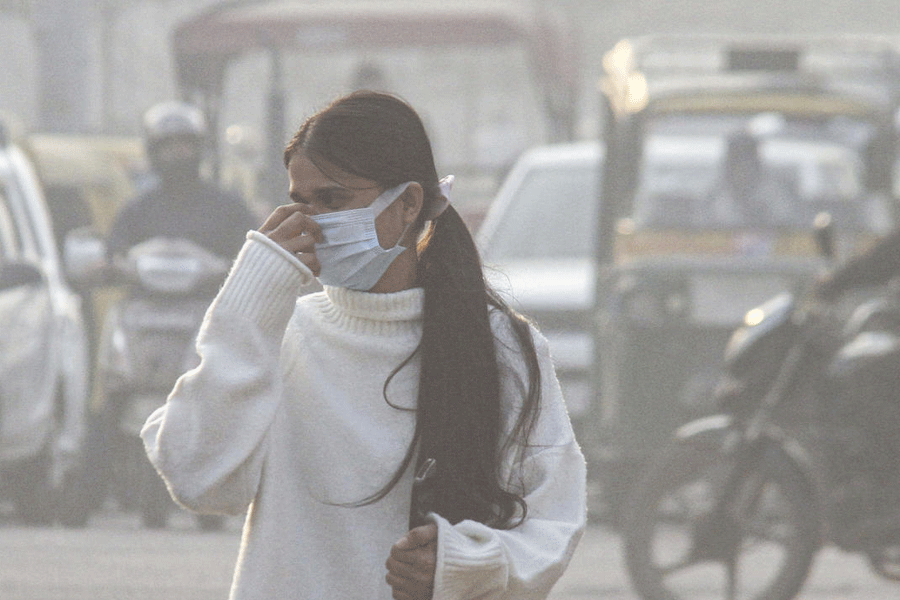
A new report says Delhi could have much cleaner air by 2040 if it follows air-quality rules on time.
Starting the rules in 2026 could reduce people’s exposure to tiny pollution particles called PM2.5 by 20%.
If action is delayed by eight years, the improvement could fall to 10%.
That means people could face more health problems from polluted air.
The report suggests 25 actions that can reduce both air pollution and climate change.
These include using renewable energy, saving energy, and using cleaner cooking and heating methods.
Cleaner vehicles and stronger vehicle standards could also help.
The report says delays around the world could cost a lot of economic benefits.

Delhi could reduce its PM2.5 exposure burden by 20% by 2040 if national air-quality standards are met on schedule from 2026.
An eight-year implementation delay could halve that reduction to 10%, increasing health impacts over the period.
The UNEP and CCAC report identifies 25 measures addressing both climate change and air pollution.
These measures include renewable energy, energy efficiency, clean cooking and heating, and stricter vehicle-emission standards.
The report estimates that each year of delay could forfeit more than 0.5% of global GDP in combined market and non-market benefits.
- Who
- The United Nations Environment Programme (UNEP) and the Climate and Clean Air Coalition (CCAC) issued the report; Delhi’s residents are affected by the projected pollution exposure.
- What
- The report assessed the economic and health benefits of coordinated climate and clean-air action, including projected reductions in Delhi’s PM2.5 exposure.
- Where
- Delhi, with global economic and air-pollution impacts assessed in the report.
- When
- The projection extends to 2040, with national air-quality standards assumed to begin on schedule from 2026; the report also assesses benefits through 2100.
- Why
- Timely implementation of air-quality and climate measures could reduce pollution exposure, health impacts, and economic losses.
Key facts
- Projected Delhi reduction by 2040
- 20% reduction in PM2.5 exposure burden if standards are implemented on schedule from 2026.
- Reduction after delay
- An eight-year delay could reduce the projected improvement to 10%.
- Solutions identified
- The report identifies 25 measures addressing both climate change and air pollution.
- Examples of measures
- Renewable power, energy efficiency, clean cooking and heating, and stricter vehicle-emission and efficiency standards.
- Global annual benefits in 2035
- Equivalent to 2.8% of global GDP, according to the report.
- Global annual benefits in 2050
- Equivalent to 4.5% of global GDP.
- Cost of yearly delay
- More than 0.5% of global GDP in combined market and non-market value, or over USD 1.5 trillion.
- Main delay factor
- Institutional barriers account for about 2.4 years of delay over a notional 15-year implementation period.
Quotes
UNEP and CCAC report
The joint report by the UN Environment Programme and the Climate and Clean Air Coalition
“Strengthening enabling conditions -- economic, social, technological and institutional -- can bring all 25 solutions fully into place up to a decade sooner, substantially boosting reductions in PM2.5 and ozone precursors over the 2025-2050 period.”
 telegraphindia.com
“A delay of this scale roughly halves the emissions reductions achievable by 2035.”
telegraphindia.com
Sources
Related news
India's Clean Air Efforts Show Progress, Officials Emphasize Shared Responsibility
London ULEZ Study Finds Children’s Lungs Can Recover

Clean Air Day 2026: 108 Indian Cities Improve, 22 Worsen
Wildfires and heat waves threaten global air-quality gains

Pune Air Action Hub Proposes Data-Based Use Of ₹105 Crore

Delhi, Neighbouring States Set Seven-Month Pollution Awareness Plans
