7 months ago
Dust Storms and Air Pollution in South Asia

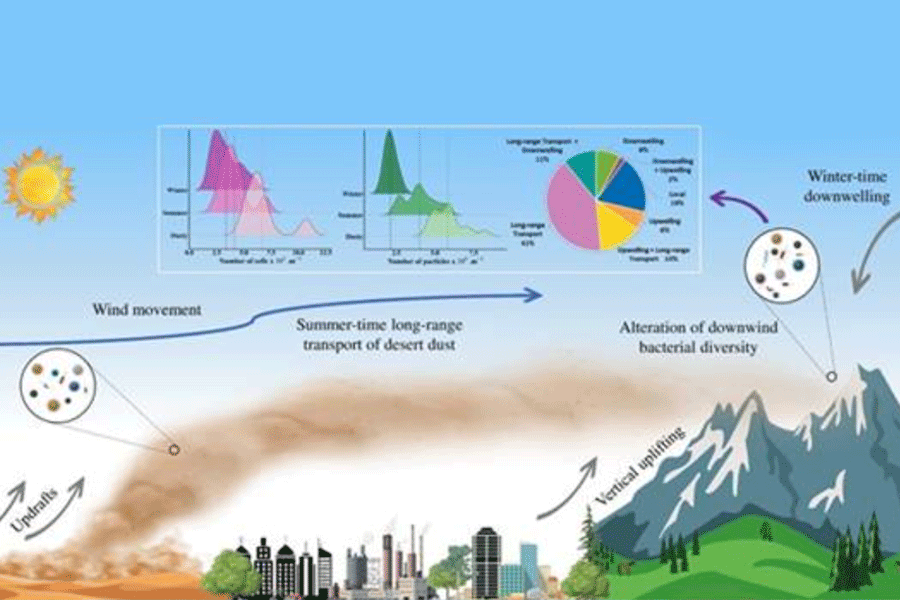
Scientists found that big dust storms from Western India can travel far and carry tiny germs.
These germs can cause sicknesses like coughs, skin problems, and tummy aches when they reach the Eastern Himalayas.
The researchers studied these dust storms for over two years and found that the germs mix with other dirty air before settling in the mountains.
Another study from a different place also found similar germs in dust storms, which can make people and plants sick.
The government warned that these dust storms can be bad for our health.
Additionally, a report by the World Bank highlights that air pollution in the Indo-Gangetic Plains and Himalayan Foothills spreads across national borders, requiring cooperation among countries to tackle the issue effectively.
India has been working with neighboring countries through various initiatives to monitor and reduce air pollution, but there are still challenges in funding and coordination.

Dust storms from Western India carry pathogens to the Eastern Himalayas, causing respiratory and skin diseases.
Research by Bose Institute and DST monitored dust storms for over two years, published in 'Science of the Total Environment'.
Pathogens mix with local air pollution and long-range travellers, reshaping bacterial communities in the Himalayas.
Similar study by Weizmann Institute found pathogens in dust storms linked to human and plant diseases.
Government warns of serious public health risks due to airborne pathogens from dust storms.
- Who
- Researchers from Bose Institute, Department of Science and Technology (DST), IIT Bombay, World Bank, and regional cooperation initiatives
- What
- Dust storms from Western India carrying pathogens to the Eastern Himalayas and transboundary air pollution in the Indo-Gangetic Plains and Himalayan Foothills
- Where
- Eastern Himalayas, Indo-Gangetic Plains, Himalayan Foothills, and neighboring countries
- When
- Study conducted over two years, findings published recently; World Bank report released recently
- Why
- To understand the health impacts of transboundary dust transport and air pollution, and to highlight the need for regional cooperation in tackling air pollution
Key facts
- Source of Dust Storms
- Western India
- Affected Region
- Eastern Himalayas, Indo-Gangetic Plains, Himalayan Foothills
- Health Impacts
- Respiratory and skin diseases, gastrointestinal infections
- Research Institution
- Bose Institute, Weizmann Institute of Science, IIT Bombay
- Journal
- Science of the Total Environment
- Study Duration
- Over two years
- Similar Study
- Weizmann Institute of Science
- Report
- A Breath of Change: Solutions for Cleaner Air in the Indo-Gangetic Plains and Himalayan Foothills
- Regional Initiatives
- Kathmandu Roadmap (2022), Thimphu Outcome (2024)
- Global Platforms
- Climate and Clean Air Coalition (CCAC), WMO Global Atmosphere Watch (WMO GAW) programme
Quotes

World Bank report
A report by the World Bank titled 'A Breath of Change: Solutions for Cleaner Air in the Indo-Gangetic Plains and Himalayan Foothills'
“Air pollution in the IGP-HF (Indo-Gangetic Plains and Himalayan Foothills) region spreads far beyond national borders… In areas with the highest local contribution, such as Kathmandu Valley (Nepal), Uttar Pradesh (India), and Dhaka (Bangladesh), it reaches only about 60%. On the other side of the spectrum, in Nepal’s Terai region, 68% of air pollution has been estimated to originate in other countries. The transboundary nature of the IGP-HF airshed underscores the need for regional cooperation.”
 indianexpress.com
Sources
Desert bacteria rides dust plumes to the Himalayas, raising concerns over health risks
Are dust storms from Western India causing respiratory, skin diseases in Eastern Himalayas? Study reveals troubling link