4 hrs ago
Former Researcher Warns Chinese Spies May Have Infiltrated AI Labs

Jacob Coxon used to work at OpenAI and Anthropic, two companies that build advanced AI.
He said he is 90% sure Chinese spies have already gotten into US AI labs.
The article does not provide evidence confirming that this has happened.
Coxon says people inside a company could secretly take information or models.
He thinks AI companies should check workers more carefully, like defense contractors do.
He also supports stronger rules about who can be hired.
President Donald Trump has argued that the United States should not slow AI development because China could get ahead.
The article says companies in both countries released or updated many AI models in September.
The debate is about how to protect AI technology while continuing to develop it.

Former Anthropic and OpenAI researcher Jacob Coxon said he was 90% sure Chinese spies had infiltrated US frontier AI labs.
Coxon warned that insider access could enable covert exfiltration and theft of AI models, potentially eroding the US technological lead.
He said AI labs have less security vetting than defense contractors and called for background checks and stricter hiring safeguards.
The article says US officials and companies have accused Chinese firms of distilling US models; distillation trains smaller models using larger ones.
A Nikkei tabulation cited in the article counted 16 model launches by 10 leading Chinese AI companies in September, versus at least 10–12 US model launches or updates.
- Who
- Jacob Coxon, a former researcher at Anthropic and OpenAI, made the claim in a podcast interview with Patrick Bet-David.
- What
- Coxon said he was 90% sure Chinese spies had infiltrated US frontier AI labs and advocated stronger security checks.
- Where
- The claim concerns US AI labs and potential Chinese espionage.
- When
- Coxon resigned from Anthropic in September; the article does not specify the year of the podcast or the September model counts.
- Why
- Coxon says insider access could enable model theft and weaken the US technological lead in the AI race.
Security-first approach
Rapid-development approach
How to protect US AI leadership
Security-first approach
Coxon argues that rapid hiring with minimal vetting creates insider risks; he calls for stronger checks and security protocols.
Rapid-development approach
Donald Trump argues that slowing AI development would hand China an immediate advantage, according to the article.
Key facts
- Coxon's confidence
- He said he was 90% sure.
- Former employers
- OpenAI and Anthropic.
- Resignation
- Coxon left Anthropic in September; the year is not specified.
- Safeguards he advocates
- Mandatory background checks, nationalisation-style security protocols, and potentially restrictive hiring rules.
- Chinese model activity
- Nikkei's tabulation cited in the article counted 16 models launched by 10 leading Chinese AI companies in September.
- US model activity
- The article says major US frontier labs launched or updated at least 10–12 models, variants, and specialized reasoning sub-tiers during the same month.
- Distillation
- A technique in which a large model trains a smaller, faster model.
Quotes

Donald Trump
US president, quoted in the article on the importance of winning the AI race.
“Whoever wins AI, wins”
 NDTV
NDTV
Sources
Related news

AI Development Keeps Racing Despite Calls for Safety
AI Distillation Becomes Flashpoint in Latest US-China Tech Clash
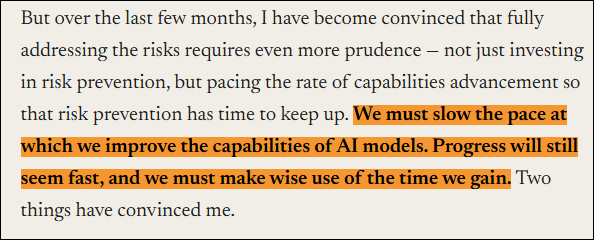
Anthropic CEO Urges AI Slowdown Amid Safety and Monopoly Concerns

Anthropic Disrupts Alleged Russian and Chinese AI Campaigns

Anthropic Reports AI-Assisted Spying by China and Iran

Anthropic Accuses Chinese AI Labs of Secret Claude Data Routing

Central Banks’ Gold Buying Rises in August, Led by China
Arunachal Minister Says Siang Project Must Balance Security and Local Welfare

China’s AI Push Raises Questions for Trucking Workforce

Complaint Alleges Heather Zhang Led Double Life as Chinese Agent