2 hrs ago
AI Distillation Becomes Flashpoint in Latest US-China Tech Clash
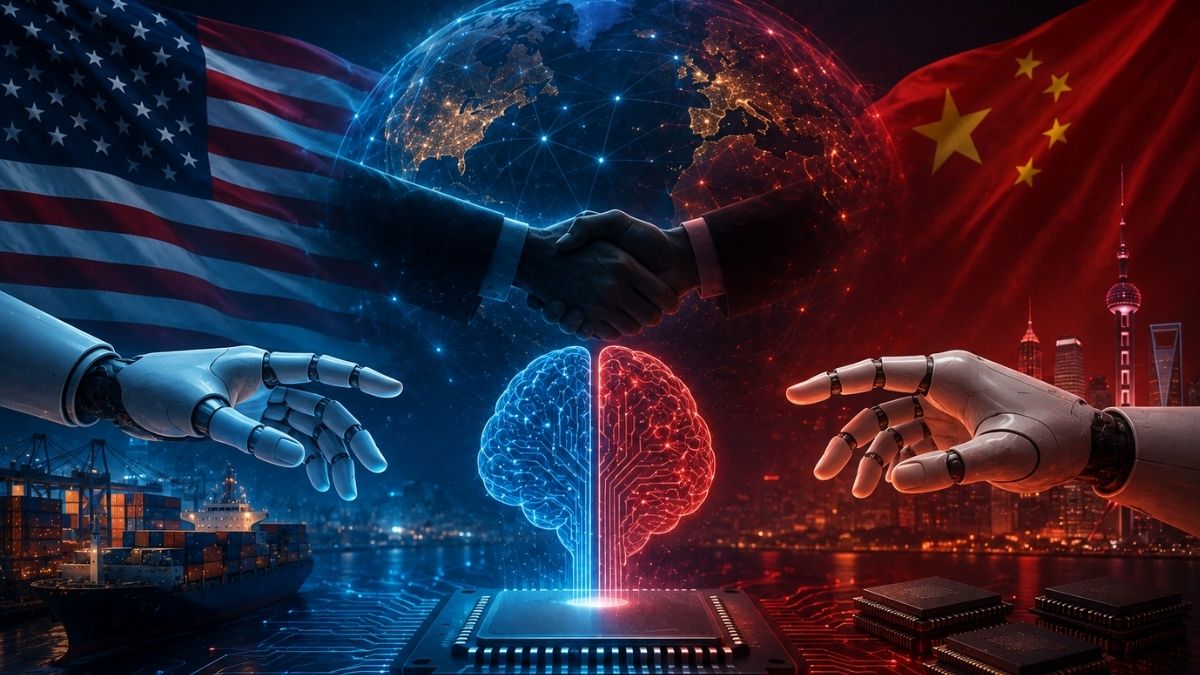
AI distillation is a way to teach a smaller AI system by showing it answers produced by a stronger system.
This can make the smaller system cheaper and easier to run.
The United States says some China-based companies used this method secretly and on a very large scale.
US officials allege that the companies used fake accounts, stolen payment information or other methods to access American AI models.
They say this could help the companies copy useful abilities without spending as much money, electricity and computer power.
Anthropic said it found very large numbers of exchanges connected to several China-based laboratories.
China says the accusations are unfounded and that distillation is a normal technique.
The disagreement is part of the wider competition between the United States and China over chips, computers and advanced AI.
Experts cited in the reports said the allegations are contested and do not alone explain China’s AI progress.

US agencies accuse China-linked companies of using large-scale AI distillation to extract capabilities from American frontier models.
AI distillation uses a powerful “teacher” model’s outputs to train a smaller “student” model.
The technique is legal and widely used, but the dispute concerns alleged unauthorized, covert and industrial-scale access.
Anthropic reported millions of exchanges involving campaigns it attributed to Alibaba-affiliated operators, DeepSeek and Zhipu.
China rejected the allegations as unfounded and said distillation is commonly used across the AI industry.
- Who
- The United States government and Anthropic accused China-linked or China-based AI companies and laboratories; China rejected the accusations.
- What
- The dispute concerns whether AI distillation was used legitimately or through unauthorized, industrial-scale extraction of capabilities from US frontier models.
- Where
- The alleged activity involved access to US AI models and China-based laboratories, with some access reportedly routed through proxies and third-party resellers.
- When
- The US cybersecurity advisory was issued on September 8; Anthropic also reported activity observed between May and July 2026, in June and July, and during July.
- Why
- US officials and Anthropic say the activity could let companies reproduce advanced capabilities with less computing power, research and development, and cost.
US Allegations and Security Concerns
China’s Rejection and Industry Defense
Nature of the activity
US Allegations and Security Concerns
US agencies and Anthropic say China-based companies conducted covert, unauthorized and industrial-scale campaigns to extract capabilities from US frontier models.
China’s Rejection and Industry Defense
China says the accusations are unfounded and characterizes distillation as a common technique used across the AI industry.
Impact on the AI competition
US Allegations and Security Concerns
US officials say unauthorized distillation could help Chinese companies narrow the technology gap without comparable investments in computing, electricity and research.
China’s Rejection and Industry Defense
Academic Will Cong said the US allegations should be treated as a contested claim rather than as the sole explanation for China’s AI progress.
Technology transfer
US Allegations and Security Concerns
US officials and analysts argue that model outputs may represent a form of technology transfer that deserves protection alongside advanced chips and other inputs.
China’s Rejection and Industry Defense
China accused Washington of seeking a monopoly over the AI industry, while the reported evidence comes primarily from US government and company investigations.
Key facts
- US advisory
- The National Security Agency, Federal Bureau of Investigation and Cybersecurity and Infrastructure Security Agency issued a joint advisory on September 8.
- Distillation definition
- A stronger teacher model generates outputs that developers use to train a smaller student model.
- Anthropic finding
- Anthropic said an Alibaba-affiliated campaign reached almost 3 million exchanges per day at its peak and involved more than 3,500 fraudulent accounts.
- Reported activity
- Anthropic said it observed more than 151 million exchanges linked to that campaign between May and July 2026.
- Other campaigns
- Anthropic attributed more than 12.1 million exchanges over 14 days in July to DeepSeek and more than 3.4 million exchanges over 17 days in June and July to Zhipu.
- China’s position
- China called the allegations unfounded and said distillation is widely used by AI companies.
- Broader context
- The dispute is part of US-China competition involving advanced AI, semiconductors, computing infrastructure and military applications.
Sources
Related news

Anthropic Disrupts Alleged Russian and Chinese AI Campaigns
AI Rivalry Hangs Over Trump-Xi Summit Amid Chip Disputes

Anthropic Accuses Chinese AI Labs of Secret Claude Data Routing
China Says AI Is Not a Monopoly of Great Powers
Anthropic CEO Urges AI Slowdown Amid Safety and Monopoly Concerns
Trump Faces Difficult Choices in Contest With China Over AI
Marc Faber Warns of Debt Crisis, Market Deflation and Conflict
US Treasury Targets Iran’s Networks as Vance Defends Regional Role
Georgia To Suspend Sanctioned Iranian Airline Flights September 21