

3 weeks ago
Gold prices now driven by inflation, monetary policy: report

Gold is a shiny metal that many people buy to keep their money safe.
For a long time, people thought gold prices mostly went up when there were wars.
A new report says that is changing.
Now, things like how fast prices are rising, which is called inflation, matter more.
Interest rates and decisions by central banks also matter a lot.
The report comes from a company called Motilal Oswal Financial Services.
It studied the first half of 2026 and found that rising bond yields can push gold prices down.
This can happen even during conflicts between countries.
The report thinks gold might drop a little before going up again.
It expects gold to reach $4,800 per ounce in the overseas markets.
Big factors later will include what the US Federal Reserve says and how much money is available around the world.

Motilal Oswal Financial Services' H1 2026 report says inflation, interest rates and monetary policy now influence gold more than geopolitical conflicts.
Rising bond yields emerged as the key headwind for gold, outweighing traditional safe-haven demand despite elevated tensions.
Gold started 2026 strongly, supported by policy uncertainty, ETF inflows, central-bank buying and expected US Federal Reserve rate cuts.
The report forecasts a 6-8 per cent correction before gold moves toward $4,800 per ounce overseas and Rs 1.68 lakh per 10 grams domestically.
Inflation trends, Fed communication, global liquidity, central bank demand and investment flows are expected to drive gold and silver in H2 2026.
- Who
- Motilal Oswal Financial Services Ltd (MOFSL), including Head of Commodities Research Navneet Damani and Commodities Analyst Manav Modi
- What
- A report stating that inflation, interest rates and monetary policy have become more important drivers of gold prices than geopolitical conflicts
- Where
- Global precious metals markets, including overseas markets, the Indian domestic market and factors involving China and Japan
- When
- Published as the H1 2026 Precious Metals Report, with forecasts looking ahead to H2 2026
- Why
- Markets increasingly assess conflicts through their impact on inflation and interest rates, while tariffs have evolved from a growth risk into an inflationary force
New Market View
Traditional Safe-Haven View
Primary driver of gold prices
New Market View
Inflation, interest rates and monetary policy now exert more influence on gold prices than geopolitical conflicts.
Traditional Safe-Haven View
Gold has traditionally been seen as a safe-haven asset whose price is driven up by wars and geopolitical tensions.
Bond yields vs safe-haven demand
New Market View
Rising bond yields are the key headwind for gold, outweighing safe-haven demand even during elevated geopolitical tensions.
Traditional Safe-Haven View
Elevated geopolitical tensions should support gold through traditional safe-haven buying from investors.
Key facts
- Report
- H1 2026 Precious Metals Report
- Publisher
- Motilal Oswal Financial Services Ltd (MOFSL)
- Primary gold price drivers
- Inflation, interest rates and monetary policy
- Key headwind
- Rising bond yields
- Overseas gold target
- $4,800 per ounce, then above $5,500 over a 12-15 month horizon
- Domestic gold target
- Rs 1.68 lakh per 10 grams, then Rs 1.93 lakh per 10 grams
- Expected correction
- 6-8 per cent from current levels
- USD/INR assumption
- 95.5
Quotes
Navneet Damani
Head of Research, Commodities at Motilal Oswal Financial Services
“"Inflation trajectory, Fed communication, global liquidity conditions, central bank demand and investment flows are expected to remain the key variables for gold and silver during H2 2026."”
 rediff.com
“"H1 2026 demonstrated that the relationship between war and gold has become increasingly conditional."”
rediff.com
Sources
Related news

Gold, Silver Rally Likely to Extend on Inflation Data, Tensions

Gold Slips as Mideast Tensions Sustain Federal Reserve Hike Bets
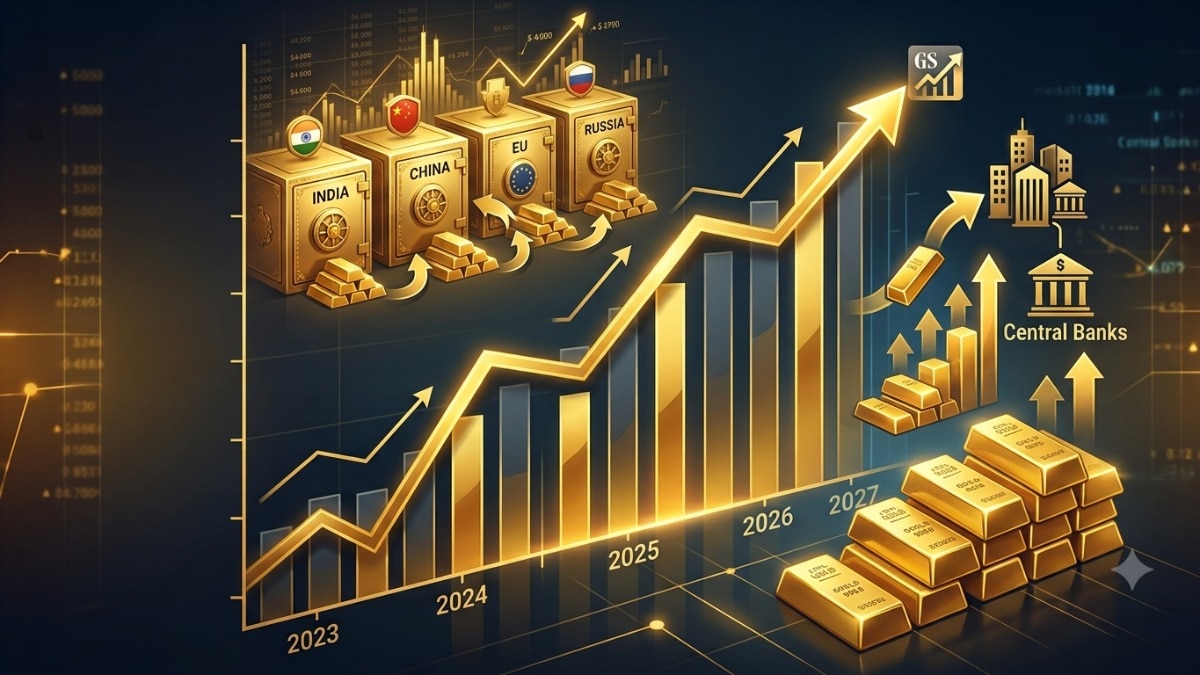
Gold Tops $4,600 as Central Banks Fuel Further Rally

Gold and Silver Outlook After Jackson Hole Shock
Gold’s Bull Run Faces Rate and Geopolitical Headwinds

Gold Loans Quadruple as India’s Untapped Gold Wealth Fuels Growth

Hexaware Names EXL Executive Vivek Jetley CEO as Srikrishna Exits

Foreign Investors Deliver India's Strongest Stock Inflow In 23 Months

Auto stocks plunge despite strong August sales and demand outlook

Brokerages See Up to 55% Upside in Seven Stocks
