1 month ago
Rare Meteorite Type Killed Dinosaurs
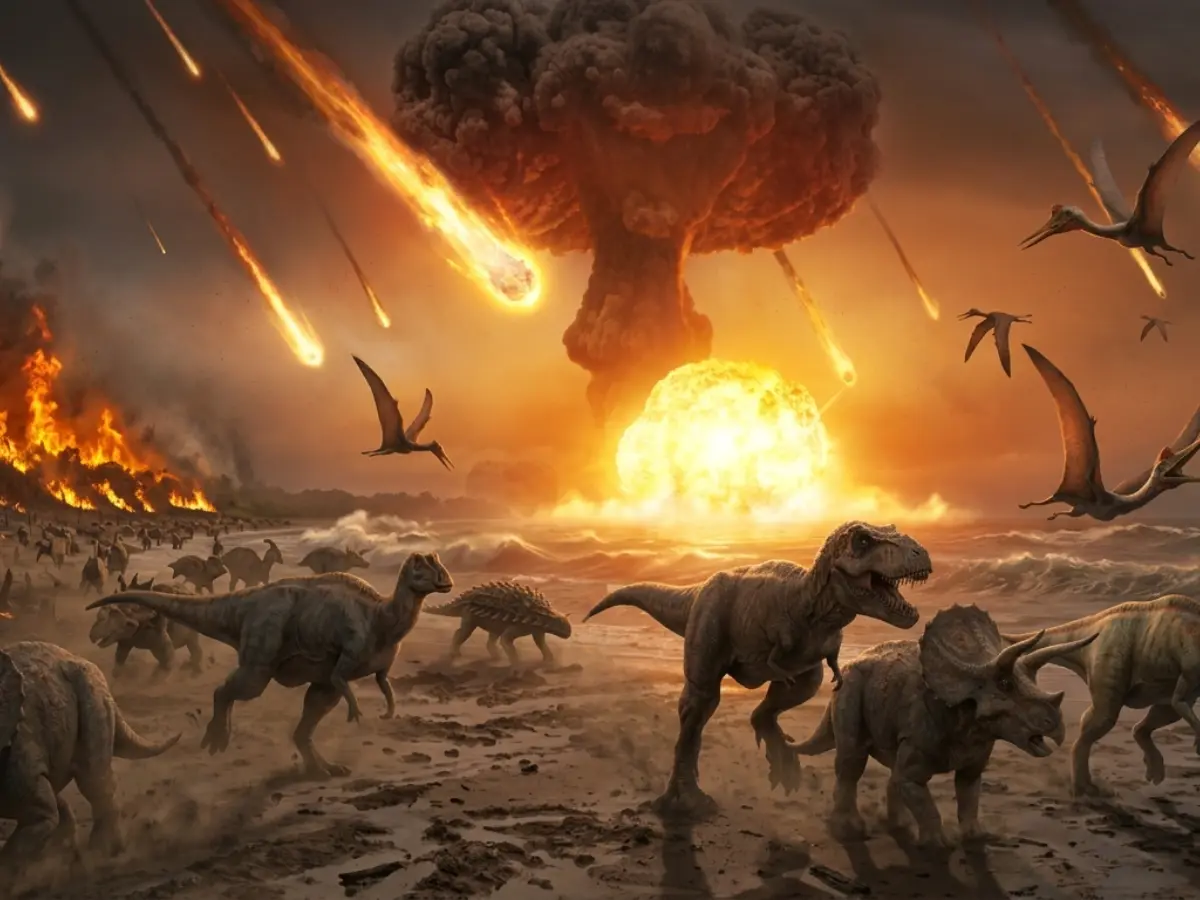
Scientists have discovered that the meteorite that killed the dinosaurs was a very rare type called carbonaceous chondrites of the Ornans class.
This type of meteorite is not commonly found on Earth, which shows how unlucky the dinosaurs were.
The study used advanced nickel isotope analysis to find out the meteorite's composition.
The meteorite hit the Yucatán Peninsula in Mexico at a speed of 64,000 km/hr, causing a mass cooling that killed all life slowly.
The study does not change how we understand the dinosaur extinction but clarifies that sulphur did not play a major role in the event.

The meteorite that killed the dinosaurs was a rare type called carbonaceous chondrites of the Ornans class.
The meteorite impacted the Yucatán Peninsula in Mexico at a speed of 64,000 km/hr.
The impact caused a mass cooling that killed all life slowly.
The study clarifies that sulphur did not play a major role in the mass extinction event.
The study was published in Science Advances on July 20.
- Who
- Researchers from the University of British Columbia (UBC), Paris, Brussels, and Vienna
- What
- A study on the meteorite that killed the dinosaurs
- Where
- The meteorite impacted the Yucatán Peninsula in Mexico
- When
- Published on July 20
- Why
- To understand the composition and rarity of the meteorite that caused the dinosaur extinction
Significance of Meteorite Type
Impact of Sulphur Content
Rarity of Meteorite
Significance of Meteorite Type
The meteorite was an extremely rare type, carbonaceous chondrites of the Ornans class, indicating it traveled a great distance.
Impact of Sulphur Content
The rarity of the meteorite type does not change the understanding of the dinosaur extinction event.
Role of Sulphur
Significance of Meteorite Type
The study clarifies that sulphur did not play a major role in the mass extinction event.
Impact of Sulphur Content
The impact of the meteorite, rather than its sulphur content, was the primary cause of the mass extinction.
Key facts
- Meteorite Type
- Carbonaceous chondrites of the Ornans class (CO chondrites)
- Percentage of Similar Meteorites on Earth
- Less than 5%
- Impact Location
- Yucatán Peninsula, Mexico
- Impact Speed
- 64,000 km/hr
- Percentage of Dinosaurs Extinct
- 75%
- Study Publication Date
- July 20
- Study Publication Journal
- Science Advances
Quotes
Dr Philippe Claeys
visiting professor at UBC and study co‑author
““Carbonaceous chondrites of the Ornans class – CO chondrites – make up a tiny fraction of that group,” he further said, adding “it really underscores how unlucky the dinosaurs were.””
 wionews.com
Sources
Related news

Professor, Five Students Arrested in IGKV Paper Leak

Pune Police Bust Interstate Burglary Gang, Recover ₹37 Lakh Jewellery

Three Arrested After Palghar Jeweller Loses Rs 90 Lakh

Two Juveniles Apprehended After Rein Bazar House Burglary

Special NIA Court Planned in Visakhapatnam for Andhra Pradesh

Climate Change Exposes Millions Of Indian Children To Heat Stress

Climate Heat Stress Threatens India’s Children and Elderly