1 hr ago
Supreme Court rejects Abu Salem plea for release over remission
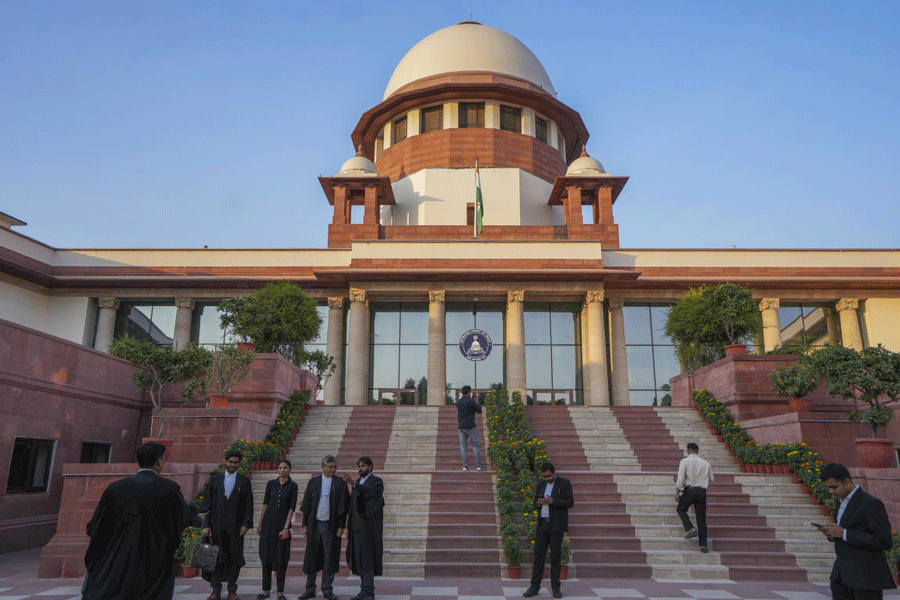
Abu Salem asked the Supreme Court to release him from prison.
He said he had already spent more than 25 years in custody.
He counted time spent awaiting trial and time earned through good conduct.
India had promised Portugal that he would not be imprisoned for more than 25 years.
The Bombay High Court said ordinary prison rewards cannot shorten this fixed term.
The Supreme Court agreed with that position and rejected his request.
Salem will remain imprisoned for now.
The 25-year period is calculated to end in November 2030, while a detailed Supreme Court judgment is still awaited.

The Supreme Court dismissed Abu Salem’s plea seeking release from custody.
Salem argued that undertrial detention, imprisonment and earned remission exceeded 25 years.
The Bombay High Court held that ordinary prison remission cannot reduce the 25-year term.
Salem was extradited from Portugal to India on November 11, 2005.
The courts calculated the 25-year period as expiring in November 2030.
- Who
- Gangster and 1993 Mumbai serial blasts convict Abu Salem, and the Supreme Court bench of Justices Vikram Nath and Sandeep Mehta.
- What
- The Supreme Court dismissed Salem’s plea seeking release from custody before completion of the 25-year term.
- Where
- The case was heard by the Supreme Court of India; Salem is lodged at Nashik Road Central Prison.
- When
- The Supreme Court delivered its ruling on Thursday; the 25-year period is calculated to end in November 2030.
- Why
- The court rejected the argument that undertrial detention and earned prison remission automatically reduce the fixed 25-year term.
Abu Salem’s position
Courts’ position
Counting custody periods
Abu Salem’s position
Salem argued that his undertrial detention, post-conviction imprisonment and earned remission should all count toward the 25-year limit.
Courts’ position
The Bombay High Court and Supreme Court rejected his request for immediate release on this basis.
Effect of earned remission
Abu Salem’s position
Salem claimed nearly three years of remission for good conduct had helped him complete the maximum term.
Courts’ position
The High Court held that ordinary remission under prison rules is administrative and does not automatically reduce a court-imposed sentence.
Meaning of the Portugal assurance
Abu Salem’s position
Salem relied on India’s assurance that he would not be imprisoned for more than 25 years and argued that he had already reached that limit.
Courts’ position
The courts accepted the 25-year limit but calculated it from his arrest on November 11, 2005, with the period ending in November 2030; any formal remission must follow the Supreme Court’s directions.
Key facts
- Extradition date
- November 11, 2005
- Extraditing country
- Portugal
- Maximum term
- 25 years under India’s assurance to Portugal
- Relevant conviction
- 1993 Mumbai serial blasts case
- Current prison
- Nashik Road Central Prison
- Projected term completion
- November 2030, calculated from November 11, 2005
- Supreme Court bench
- Justices Vikram Nath and Sandeep Mehta
Quotes

Bombay High Court
The High Court that rejected Salem’s plea for immediate release
“The petitioner cannot claim an automatic reduction of the 25-year term by inclusion of earned remissions. Earned remissions are under the prison rules and therefore, it has no application.”
 telegraphindia.com
 deccanchronicle.com
“There is no question the sovereign assurance of 25 years being further reduced on account of remissions earned”
 thehansindia.com
Sources
Supreme Court rejects gangster Abu Salem plea for release after 25 years in jail - Telegraph India

Supreme Court rejects Abu Salem’s plea for release, says 25-year term cannot be cut by remission
SC Dismisses Gangster Abu Salem's Plea Seeking Release from Custody

SC dismisses Abu Salem's plea seeking premature release from jail
Related news
Supreme Court Rejects Abu Salem’s Plea For Early Release
Supreme Court to Hear Tejpal’s Surrender Exemption Plea

Supreme Court Sets September 2 Deadline for Dara Singh Remission

Supreme Court Presses Odisha Over Dara Singh Remission Delay
2011 Mumbai Blasts Accused Gets Bail After 15 Years
Supreme Court Rejects Tejpal’s Exemption Plea, Orders Surrender Before Appeal

India Regulator Opens Door to Tougher Food Warning Labels
India Intensifies Food Safety Crackdown as Warning Labels Advance

Delhi Building Collapses Expose Failure to Act on Warnings