12 months ago
New 6G Chip Achieves Blazing Speeds, 10x Faster Than 5G
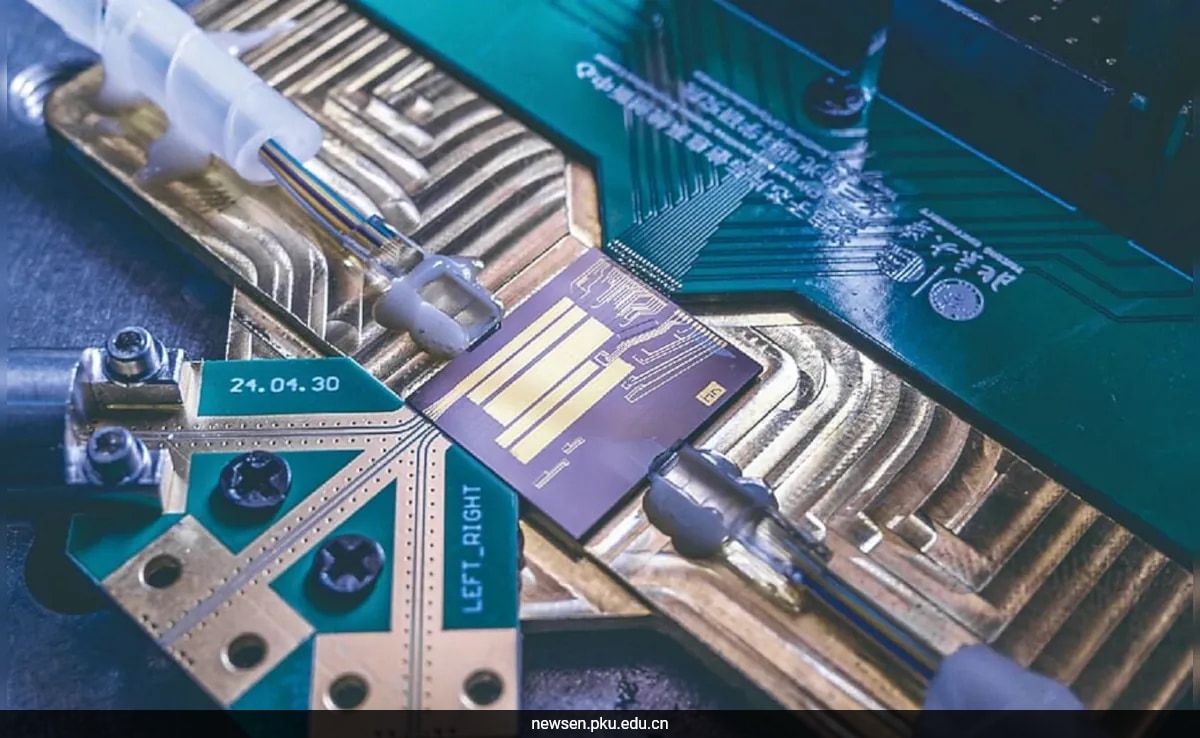
Imagine a tiny computer chip that makes the internet work super fast!
Scientists made a new chip called a 6G chip.
It can send information much faster than what we have now (5G).
This chip is like a super-powered internet cable, but it's tiny, only as big as a small button.
It can send information up to 100 billion bits every second.
This could make the internet much faster for things like watching videos, playing games, and helping doctors do surgeries remotely.
It's not available yet, but it's a big step towards faster internet in the future, possibly by the 2030s!

Engineers created a 6G chip surpassing 100 Gbps, nearly 10x faster than 5G.
The chip was developed by researchers from China and the United States.
The chip measures only 11 x 1.7 millimeters, operating across 0.5 GHz to 115 GHz.
The technology uses a novel electro-optic modulator for converting radio signals.
6G networks are anticipated to launch around the 2030s, with this a significant step forward.
- Who
- Engineers from China and the United States
- What
- Developed a prototype 6G chip with speeds over 100 Gbps
- Where
- China, United States
- When
- Recently
- Why
- To address growing demands for connected devices and enable faster data transfer for applications like virtual reality and AI.
Key facts
- Speed
- Exceeding 100 Gbps
- Chip Size
- 11 x 1.7 mm
- Frequency Band
- 0.5 GHz to 115 GHz
- 5G Speed Comparison
- Up to 10 Gbps (theoretical), 150-300 Mbps (actual)
- Developers
- Peking University, City University of Hong Kong, UC Santa Barbara
- Publication
- Nature journal
- Expected Rollout
- 2030s
Quotes
Professor Wang Xingjun
Researcher from Peking University
“High-frequency bands such as millimetre-wave and terahertz offer extremely large bandwidth and ultra-low latency, making them suitable for applications like virtual reality and surgical procedures.”
 NDTV
NDTV
“As the demand for connected devices grows rapidly, next-generation networks must leverage the strengths of different frequency bands.”
NDTV
Sources
Related news

India’s Wind Pipeline Signals Sharp Capacity and Manufacturing Surge

India’s Solar Module Glut Threatens Factories With Low Utilisation

Modi-Xi Signals May Help Reset India-China Ties

India’s Fourth BRICS Chair Faces a Much Larger Summit

Nepal Families Seek Missing Loved Ones After Deadly Flash Floods