

3 hrs ago
UPSC GS1 Practice Explores Poompuhar and Gandhian Thought
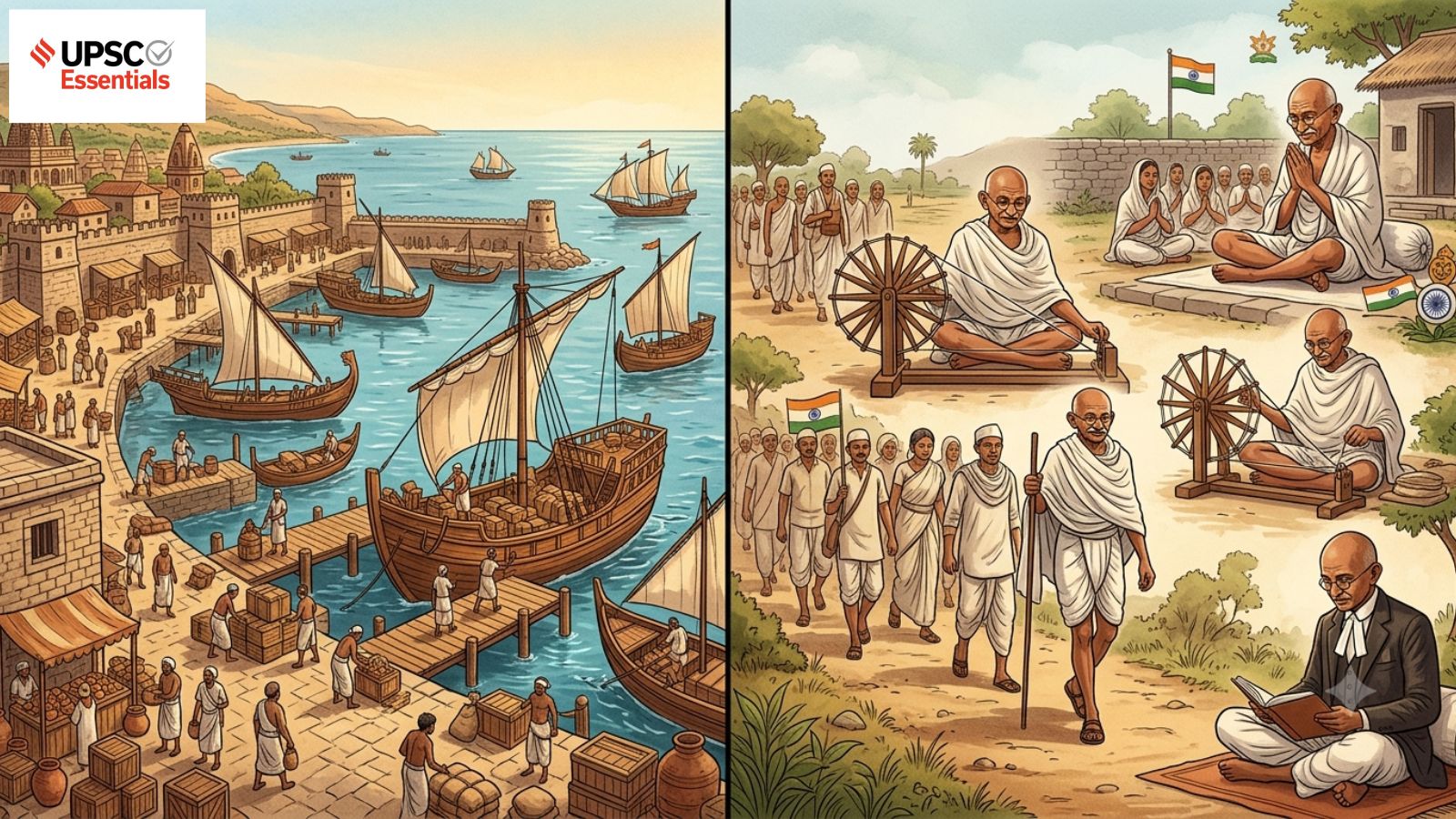
This article gives students two history questions to practise for the UPSC exam.
The first question is about Poompuhar, an ancient port near the Cauvery River.
Poompuhar helped move goods between inland India and overseas regions.
People from different places also met there and exchanged ideas, customs and technologies.
The second question is about Mahatma Gandhi’s connection with Leo Tolstoy.
Their correspondence helped Gandhi think more deeply about truth, love and non-violence.
Gandhi combined these ideas with Indian traditions such as Jainism and the Bhagavad Gita.
He then used them in practical struggles, including resistance activities in South Africa.

The article presents two GS1 answer-writing questions on ancient maritime exchange and Gandhian intellectual development.
Poompuhar, located near the Cauvery River’s mouth, connected inland regions with Bay of Bengal and Indian Ocean trade networks.
Sangam texts, literary works and archaeological findings indicate Poompuhar’s commercial importance and cultural interactions with distant regions.
Gandhi’s 1909–10 correspondence with Leo Tolstoy reinforced the links among truth, love, non-violence and resistance to injustice.
The practice material explains how Gandhi combined global ideas with Indian traditions and practical experiences in South Africa.
- Who
- UPSC aspirants, ancient traders and communities connected with Poompuhar, and Mahatma Gandhi and Leo Tolstoy.
- What
- A GS1 answer-writing practice article examines Poompuhar’s commercial and cultural role and the influence of Gandhi’s correspondence with Tolstoy.
- Where
- Poompuhar was near the mouth of the Cauvery River, while Gandhi’s engagement with Tolstoy was connected to his work in South Africa and the Transvaal.
- When
- The material is identified as Week 174; Gandhi’s correspondence with Tolstoy is discussed in the context of 1909–10.
- Why
- The article aims to help UPSC candidates prepare answers on ancient Indian history, culture and the evolution of Gandhian thought.
Key facts
- Practice series
- UPSC Essentials Mains Answer Practice, GS1, Week 174
- Poompuhar
- Also known as Kaveripoompattinam; located near the mouth of the Cauvery River
- Trade networks
- Connected Tamilakam with regions to the west through Arabia and the Red Sea, and with Southeast Asia and China
- Evidence on Poompuhar
- Sangam and post-Sangam accounts, literary works and a fragment of a West Asian torpedo jar
- Key literary works
- Pattinappalai and Manimekalai describe Poompuhar’s maritime and urban life
- Gandhi–Tolstoy correspondence
- Discussed in relation to 1909–10 and ideas of morality, truth and non-violence
- Related institution
- Tolstoy Farm in South Africa housed families of Satyagrahis and reflected Tolstoy’s influence on Gandhi’s community experiments
Sources
Related news

Gandhi Writes to Tolstoy on Non-Violence and Morality

Angmo Urges Government to Treat Education Protests as Wake-Up Call

Gurumurthy Links Ancient Indian Philosophy to Modern Challenges

Modi Gifts Putin Russian Thirukkural Translation Ahead of BRICS Summit

Fadnavis Calls for Cultural Ties Beyond Economic Cooperation
