50 mins ago
M R Masani’s Liberal Dilemma Over India’s Politicised National Life
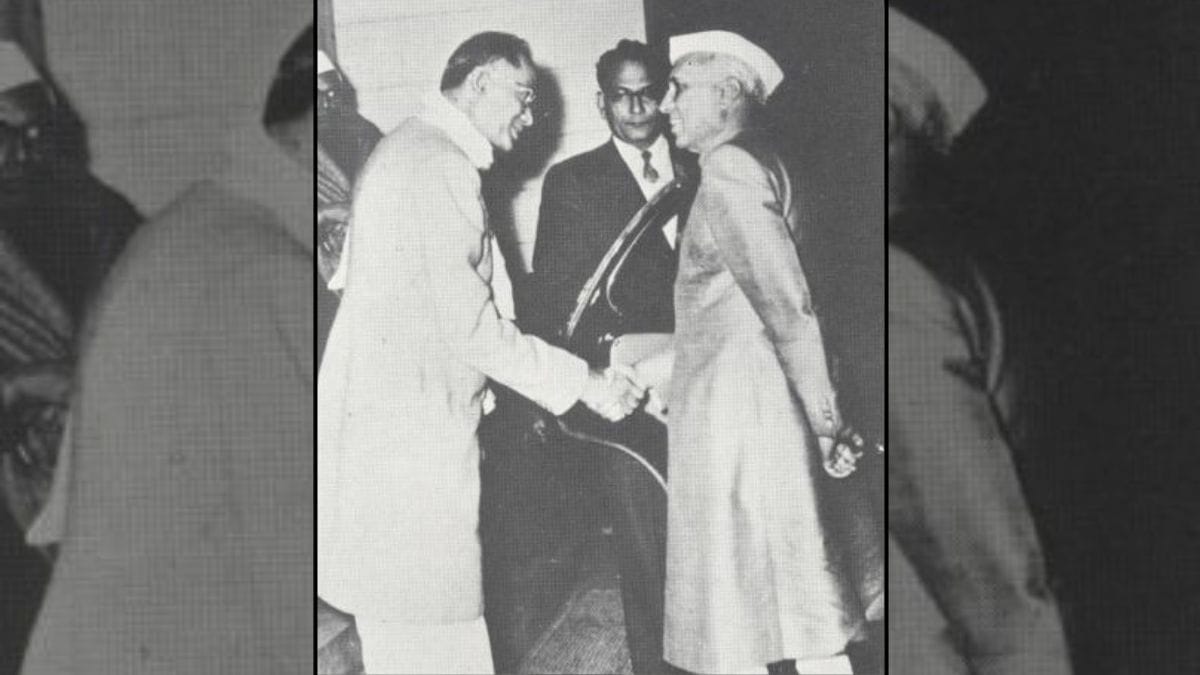
M R Masani wrote about a difficult choice facing people who believe in liberal democracy.
He supported Jayaprakash Narayan’s effort to oppose Indira Gandhi’s authoritarian government.
However, he did not join the group that later became the Janata Party because he feared its members would not cooperate well.
Some friends believed his participation could have improved the party, but Masani disagreed.
He said he might have resigned after a short time because of disagreements with colleagues.
Masani also worried that people were becoming disappointed with all political parties.
He argued that too much government control had made nearly every part of national life political.
His solution was strong but limited government and a new democratic movement.

M R Masani recalled declining Jayaprakash Narayan’s request to help form the Janata Party during the 1976 Emergency.
Masani said he supported Narayan’s objective but doubted that the proposed coalition could work together or solve India’s problems.
He argued that excessive state control had politicised industry, trade, agriculture, education, arts and sports.
Masani called for strong but limited government instead of India’s expansive, centralised administration and controls.
He urged liberals to create a democratic alternative based on discipline without dictatorship before authoritarianism gained further support.
- Who
- M R Masani, Jayaprakash Narayan, the Janata Party, India’s liberals and other political parties are central to the essay.
- What
- Masani examined the liberal’s choice between joining flawed political movements and remaining outside politics, while advocating limited government.
- Where
- The discussion focuses on India, particularly political power concentrated in New Delhi, with references to Bombay and Maharashtra.
- When
- The essay was published in 1979 and discusses events during the Emergency in 1976, the March 1977 election and developments through 1978-79.
- Why
- Masani argued that statism, centralised power and excessive government controls had politicised national life and increased corruption and the temptation to seek power.
Political Participation
Principled Independence
Whether liberals should join political coalitions
Political Participation
Some of Masani’s friends believed that joining the Janata Party apparatus and government could have made a meaningful difference.
Principled Independence
Masani believed the coalition’s internal contradictions would have forced him to resign within months, as he said happened after he joined the Minorities Commission.
Choosing between imperfect political options
Political Participation
Liberals may participate in an existing party or group to influence events and prevent a worse outcome.
Principled Independence
Masani preferred Gandhi’s principle of rejecting the lesser evil rather than compromising core liberal values.
Role of government
Political Participation
The essay describes a political system in which broad government intervention had become deeply embedded across national life.
Principled Independence
Masani argued for a major reduction in state control and for a democratic alternative that combined discipline with freedom, not dictatorship.
Key facts
- Author
- M R Masani
- Essay source
- The Indian Liberals archive; published in 1979 under the title “The dilemma of the liberal”
- Emergency reference
- Jayaprakash Narayan approached Masani in late 1976 about helping form a new political party
- Janata Party
- Masani said he voted for Jayaprakash Narayan’s candidates in March 1977 but declined active involvement
- Government model proposed
- Strong but limited government rather than a large, centralised administration
- Examples of opposition
- The Indian press rejected proposals by two Janata Government ministers to nationalise certain major enterprises
- Public protest
- Masani addressed a convention in Bombay on 25 May protesting Maharashtra’s amended Sales Tax Law
Quotes

Mahatma Gandhi
Indian independence leader and political thinker cited by Masani
“that Government is best which governs the least”
 theprint.in
Sources
Related news
The Day After I-Day: Snapshots of Freedom and Unfreedom

Indian Politics Needs Far-Reaching Reforms, Not Whimsical Fixes
Cockroach Janata Party Chooses Pressure Group Over Political Party
Yogendra Yadav Urges Parties to Unite Behind Youth

Tavleen Singh Challenges ‘Dimagi Naxal’ Label, Defends Dissent

Political Parties Urged to Mentor Gen Z, Respect Institutions

Rahul Gandhi Links Tribal Students’ Fight to Adivasi Identity

Gujarat Parties Reportedly Received More Donations Than Most National Parties
Manipur violence leaves 306 dead, 49 missing since 2023

Amit Shah Begins Three-Day Goa Visit With Security Agenda