5 hrs ago
Oil Trade Paradoxes Shape India’s and America’s Energy Choices
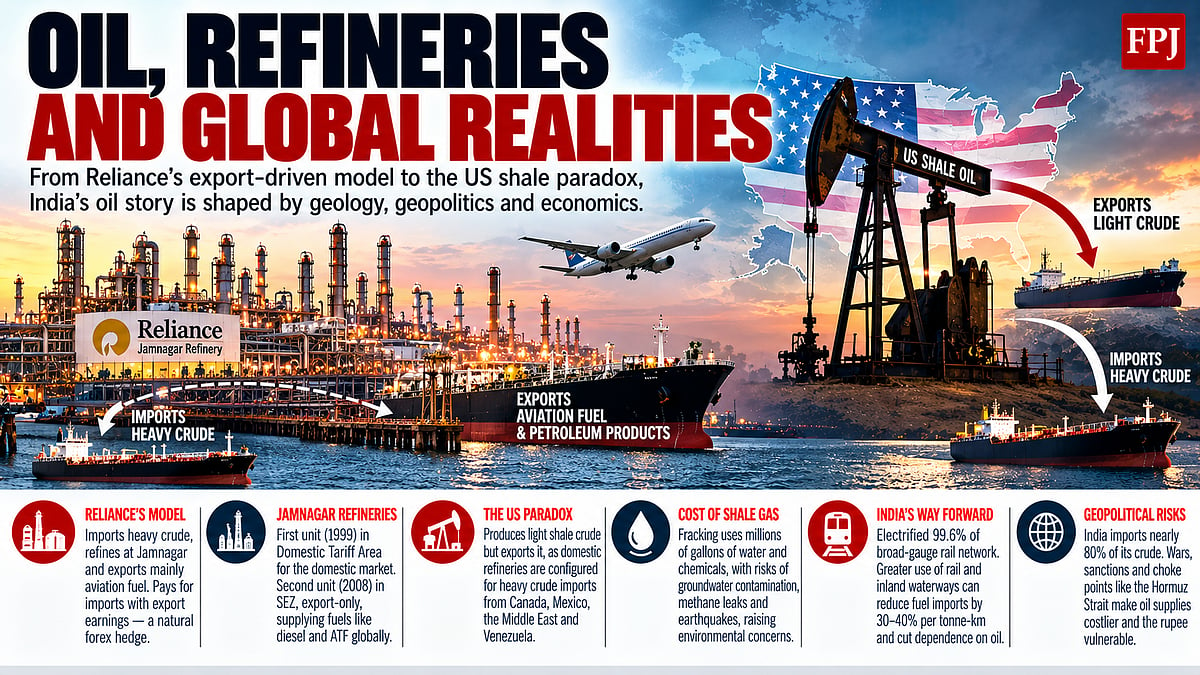
India does not have enough oil of its own, so it buys much of the crude oil it uses.
Reliance turns some imported crude into fuels at its Jamnagar refineries and sells many products abroad.
The article says one refinery mainly serves India, while another mainly exports.
The United States produces a lot of shale oil, but its refineries are described as better suited to heavier oil.
So the US can export some oil and still import the kind its refineries need.
Getting shale oil and gas from the ground can use a lot of water and may create environmental problems.
The article says those challenges make shale gas difficult to produce commercially in India.
It suggests using more trains, electric vehicles and waterways to reduce oil use.
These steps could also help India spend less on imported fuel.

India imports nearly 80% of its crude, while Reliance refines imported oil at Jamnagar and exports a significant share of its products.
Reliance operates one Jamnagar refinery unit mainly for India’s domestic market and another as an export-only unit.
The article says US refineries are configured for heavier crude, while much of US shale oil is lighter and is exported.
The article describes fracking’s water use and environmental risks, and says India’s water scarcity and other barriers limit commercial shale gas production.
It argues that India could reduce fossil-fuel dependence by expanding rail, electric vehicles and water transport.
- Who
- India, the United States and Reliance Industries are the main subjects.
- What
- The article examines oil imports, refining, exports and the challenges of shale extraction, particularly for India and the United States.
- Where
- The discussion focuses on India and the United States, including Reliance’s refineries in Jamnagar, Gujarat.
- When
- The article gives no publication date; it refers to Reliance refinery units built in 1999 and 2008.
- Why
- It argues that differences in oil reserves, refinery capabilities, transport costs and environmental constraints shape each country's energy choices.
Reasons to keep current oil trade patterns
Reasons to reduce oil dependence
US crude imports and exports
Reasons to keep current oil trade patterns
The article says exporting lighter domestic crude while importing heavier crude can make economic sense because US refineries are configured for heavier oil and retooling them would be costly.
Reasons to reduce oil dependence
The article notes that exporting crude while importing it can seem counterintuitive and describes logistical and legal constraints on moving oil across the United States.
India’s energy security
Reasons to keep current oil trade patterns
The article says importing crude from nearby suppliers can make logistical sense, and that Reliance’s exports of refined products add value and provide a natural foreign-exchange hedge.
Reasons to reduce oil dependence
It argues that dependence on imported oil leaves India exposed to currency pressure, geopolitical disruptions and possible sanctions, and recommends expanding rail and water transport and electric vehicles.
Key facts
- India's crude imports
- The article says India imports nearly 80% of its crude oil.
- Reliance refinery locations
- Reliance operates two large refinery units in Jamnagar, Gujarat.
- Reliance refinery dates
- The article says the domestic-market unit was built in 1999 and the export-only SEZ unit in 2008.
- US shale production
- The article says the US accounts for 89% of global shale gas production.
- Indian Railways electrification
- The article says 99.6% of Indian Railways’ broad-gauge network is electrified, covering more than 70,000 route kilometres.
- Inland water transport
- The article puts inland water transport at about 2% of India's freight movement and cites a government target of 5%.
Sources
Related news
India Supplies Europe’s Diesel Despite Record Crude Import Dependence

India’s Russian Crude Imports Fall as Refiners Diversify
Global Diesel Crunch Puts India at Center of Supply
India’s Russian Crude Imports Fall Amid Possible United States Tariffs
Indian Refiners Weigh Cutting Russian Crude Purchases Amid US Sanctions
Russian Oil Uncertainty Pressures India's Refiners Amid Middle East War
Railway Constable Rescues Passenger From Moving Train Gap
Reliance’s Anant Ambani Plans Massive Solar Farm in Kutch

Why SP Chose Reliance Executive Dhanraj Nathwani for Rajya Sabha

Anant Ambani Named Sustainability Professor of Practice at Newcastle University