3 weeks ago
Web's Altruistic Gift: Our Collective Responsibility for Ethical Digital Engagement
The World Wide Web is the system that lets people visit websites and share information.
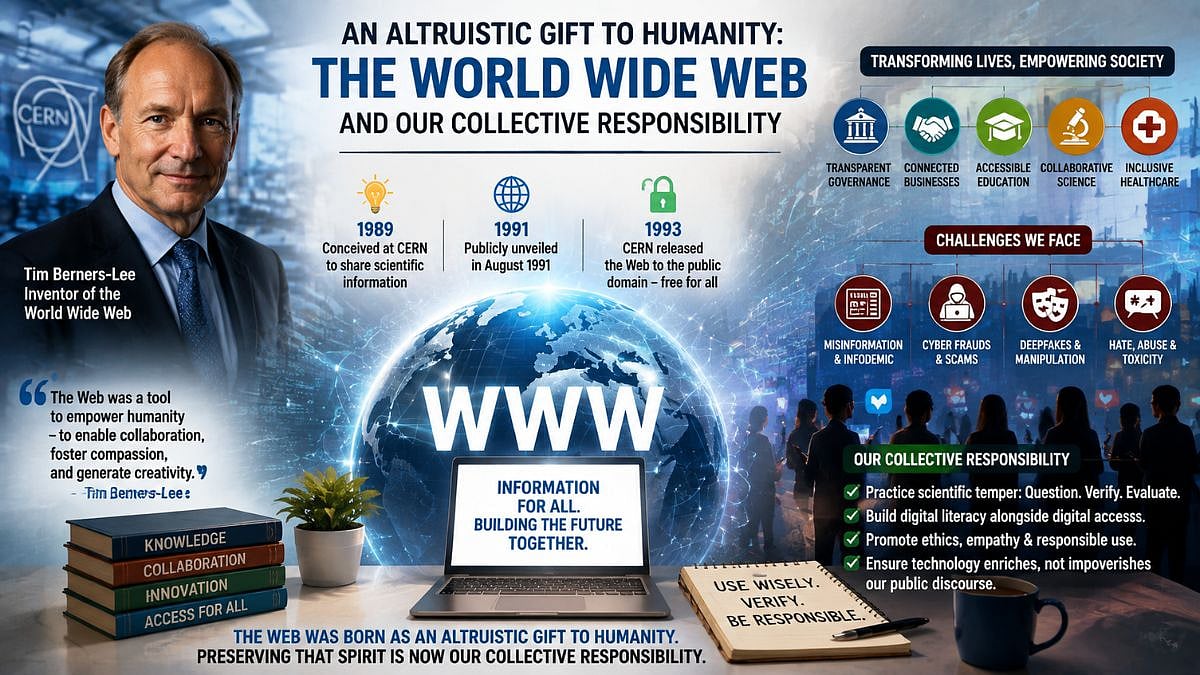
A scientist named Tim Berners-Lee thought of it in 1989 while working at a place called CERN.
In 1991, the Web was shown to the world for the first time.
Two years later, in 1993, CERN gave the Web away for free so everyone could use it.
That means nobody has to pay money to use the Web or build new things with it.
The Web helps people learn, work, and talk to each other all over the world.
But sometimes people use it to share fake news, tricks, and mean words.
Some computer tools can even make videos that look real but are not real.
The article says we should always check facts before believing them.
It reminds us that the Web is a gift, and we must use it with honesty and kindness.

Sir Tim Berners-Lee conceived the World Wide Web at CERN in 1989, and it was publicly unveiled in August 1991.
In April 1993, CERN released the Web into the public domain, free of patents, royalties or licensing restrictions.
The article warns that misinformation, deepfakes, online frauds, digital arrest scams and eroding civility challenge the Web's original spirit.
The author notes that 'World Wide Web Day' on August 1 has no internationally recognised observance by the United Nations, pointing to other key dates in Web history.
In his March 2024 open letter, Berners-Lee said the Web's original purpose was collaboration, compassion and creativity, but lamented it has often eroded these values.
- Who
- Sir Tim Berners-Lee, the inventor of the World Wide Web at CERN, and the essay's author, a senior advisor to the CSMVS Museum and former director of the Nehru Science Centre, Mumbai.
- What
- A reflection on the Web's history as an altruistic gift to humanity and a call for verification, digital literacy and ethical responsibility in the digital age.
- Where
- The Alpaiwalla Museum in Mumbai, India, where the lecture and website inauguration took place; the Web itself was invented at CERN.
- When
- The lecture was delivered on August 1 (observed as World Wide Web Day); the Web was conceived in 1989, unveiled in August 1991 and freed to the public in April 1993; Berners-Lee's open letter was posted on Medium on March 12, 2024.
- Why
- Because the Web's original spirit of collaboration, compassion and creativity is being eroded by misinformation, manipulation and incivility on digital platforms.
Web as empowerment
Web as risk
Digital benefits vs. digital harms
Web as empowerment
The Web has democratised information, made governments more transparent, businesses more connected, education more accessible and science more collaborative.
Web as risk
The Web also spreads misinformation and 'infodemics', deepfakes, online frauds, digital arrest scams and identity theft, with algorithms amplifying outrage and falsehood.
Freedom of expression vs. responsibility
Web as empowerment
Democratic societies must always protect freedom of expression, and technology has empowered billions of people.
Web as risk
Freedom must be matched by responsibility and verification so that technology enriches public discourse rather than impoverishing it.
Key facts
- Inventor
- Sir Tim Berners-Lee
- Invented at
- CERN
- Year conceived
- 1989
- Publicly unveiled
- August 1991
- Released to public domain
- April 1993
- World Wide Web Day observed
- August 1 (not a UN-recognised observance)
- Berners-Lee's 'three Cs'
- Collaboration, compassion, creativity
- Open letter
- 'Marking the Web's 35th Birthday', posted on Medium, March 12, 2024
Sources
Related news
Viral Mix-Ups Reveal Why Online Claims Spread So Easily
Modi Promotes Historical Atlas and Drug-Free India Campaign

Readers Debate AI Content Rights and National Identity

Bribes.fyi Indefinitely Pauses Submissions After Viral Surge

Wikipedia Founder Jimmy Wales Says AI Can't Be Trusted

Philosopher-poet Jernail Singh Anand releases essays on modernity's 'ethical blank'
India Rolls Out White Rabbit Technology

Iron-rich asteroids may pose greater threat to Earth

Tim Berners-Lee's Memoir Reflects on Web's Dark Side

Karnataka to Create Quantum Ecosystem Map on Swiss Model