4 days ago
DSP Ratio Suggests Nifty 50 Equal Weight Fund Strategy

A regular Nifty 50 fund puts more money in the biggest companies.
An equal-weight fund spreads money more evenly across all 50 companies.
Sometimes the biggest 10 companies perform better than the other 40.
This is called polarization.
At other times, the other 40 companies perform better, which is called depolarization.
DSP Mutual Fund says investors can watch a ratio comparing two equal-weight indexes.
If the ratio is below its 12-month average, DSP favors the Nifty 50 Equal Weight Index Fund.
DSP says that condition is currently in place, although investors should not decide only from the fund’s one-year performance.

Nifty 50 Equal Weight funds give similar weights to all 50 index stocks, unlike regular market-cap-weighted Nifty 50 funds.
DSP Mutual Fund distinguishes between polarization, when the top 10 stocks lead, and depolarization, when the broader 40 stocks outperform.
Investors can compare the Nifty Top 10 Equal Weight Index with the Nifty 50 Equal Weight Index using a 12-month moving-average ratio.
A ratio above its 12-month average signals polarization, while a ratio below the average signals depolarization.
DSP said its model has remained invested in the Nifty 50 Equal Weight Index since November 2025 because the indicator remains below its moving average.
- Who
- DSP Mutual Fund and investors considering Nifty 50 equal-weight or top-10 equal-weight index funds.
- What
- DSP has proposed using a 12-month ratio to identify whether market leadership favors a Nifty Top 10 Equal Weight or Nifty 50 Equal Weight strategy.
- Where
- The strategy concerns the Nifty 50 and its related indexes.
- When
- DSP said its model has remained invested in the Nifty 50 Equal Weight Index since November 2025; the article does not specify its publication date.
- Why
- The ratio is intended to show whether the largest 10 stocks or the broader group of 40 stocks is outperforming.
Top 10 Equal Weight Approach
Nifty 50 Equal Weight Approach
When to use the strategy
Top 10 Equal Weight Approach
DSP suggests considering a Nifty Top 10 Equal Weight Fund or ETF when the ratio is above its 12-month moving average, signaling polarization.
Nifty 50 Equal Weight Approach
DSP suggests considering a Nifty 50 Equal Weight Fund or ETF when the ratio is below its 12-month moving average, signaling depolarization.
Current implication
Top 10 Equal Weight Approach
The top-10 strategy is not the strategy indicated by DSP’s current below-average ratio signal.
Nifty 50 Equal Weight Approach
DSP said its model remains invested in the Nifty 50 Equal Weight Index because the current signal indicates that the broader 40 stocks are outperforming the top 10.
Key facts
- Strategy discussed
- Nifty 50 Equal Weight Index Fund
- Alternative strategy
- Nifty Top 10 Equal Weight Index Fund or ETF
- Polarization
- The top 10 Nifty 50 stocks outperform the remaining 40 stocks.
- Depolarization
- The broader group of 40 Nifty 50 stocks outperforms the top 10.
- Indicator
- Current Nifty Top 10 Equal Weight Index level divided by current Nifty 50 Equal Weight Index level.
- Signal threshold
- The ratio is compared with its 12-month moving average.
- Current DSP signal
- The ratio is below its 12-month moving average, indicating that DSP considers depolarization to remain intact.
Quotes

DSP Mutual Fund
Mutual fund provider whose report presents the investment framework.
“Polarization & Depolarization is cyclical in nature and are witnessed in phases. Phase of polarization is generally followed by phase of depolarization.”
 livemint.com
“The indicator remains below its 12-month moving average, signaling that the depolarization phase is still intact.”
livemint.com
Sources
Related news

Expert compares large-cap mutual funds and Nifty 50 index funds

DSP Says Large-Caps Offer Better Value After Recent Divergence

Indian Markets Polarise as Valuation Gaps Widen Across Sectors
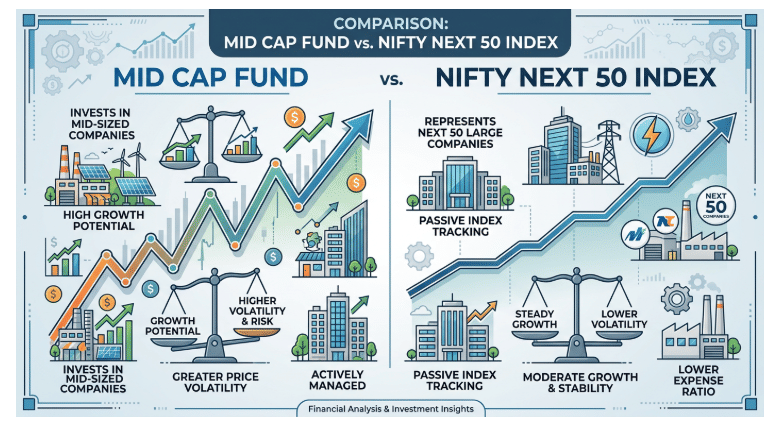
Mid Cap Funds and Nifty Next 50 Offer Different Risks

Axis MF launches low-volatility Nifty 500 index fund

ICICI Prudential Contra Fund NFO Promotes Contrarian Core Portfolio Strategy

Nifty Total Market Funds Offer Broad Indian Equity Exposure

BSE Replaces Wipro in Nifty 50 Index Reshuffle