5 days ago
Expert compares large-cap mutual funds and Nifty 50 index funds

Nifty 50 index funds and large-cap mutual funds both invest mainly in large companies.
An index fund simply follows the 50 companies in the Nifty 50.
An active fund lets a manager choose stocks, usually from the biggest 100 companies.
The expert said investors should decide whether they want a passive or active investment style.
People who want less active decision-making may prefer an index fund.
People willing to take more risk may prefer an actively managed fund.
The expert said SIPs are generally suitable for both choices.
Investors who closely follow market valuations could instead consider investing a lump sum.

Nifty 50 index funds passively replicate the 50 stocks in the index.
Active large-cap funds must invest at least 80% of assets in large-cap stocks.
Expert Harsh Vardhan Dawar said investors should classify holdings by investment style and market-cap category.
Risk-averse investors may prefer Nifty 50 index funds, while riskier investors may prefer active large-cap funds.
Dawar recommended SIPs for both fund types, although market-aware investors may consider lump-sum investing.
- Who
- Investors and Harsh Vardhan Dawar, Founder of Wealth Cafe.
- What
- A comparison of large-cap mutual funds, Nifty 50 index funds, SIPs and lump-sum investing.
- Where
- The discussion concerns Indian mutual funds and the Nifty 50.
- When
- The article discusses one-year performance and current investment choices; no publication date is provided.
- Why
- Investors need to choose between passive and active large-cap exposure and decide how to invest.
Passive approach
Active approach
Which fund should investors choose?
Passive approach
Risk-averse investors may prefer Nifty 50 index funds because they follow the index through a passive strategy.
Active approach
Riskier investors may prefer actively managed large-cap funds, where a fund manager selects stocks.
Performance during weakness
Passive approach
Nifty 50 index funds and exchange-traded funds were in the red while the Nifty 50 TRI declined 7.09% over one year.
Active approach
The expert said actively managed Indian mutual funds can outperform index funds, and four named active large-cap schemes had positive one-year returns.
Key facts
- Nifty 50 index funds
- Passively replicate the 50 stocks in the Nifty 50.
- Active large-cap funds
- Must invest at least 80% of assets in large-cap stocks.
- Typical stock universe
- Active large-cap funds generally select stocks from the top 100 companies by market capitalisation.
- SIP guidance
- The expert preferred SIPs for both Nifty 50 index funds and active large-cap funds.
- Nifty 50 TRI performance
- The Nifty 50 TRI was down 7.09% over one year.
- Positive active-fund schemes
- Four active large-cap schemes had positive one-year returns: Taurus Large Cap, Quant Large Cap, Bank of India Large Cap and Invesco India Large Cap.
- Lump-sum investing
- Investors who actively track market valuations may consider lump-sum investments.
Sources
Related news

HSBC Mutual Fund CEO Urges Discipline and Diversification Amid Volatility

Choosing Between Large-Cap and Small-Cap Funds Requires Context
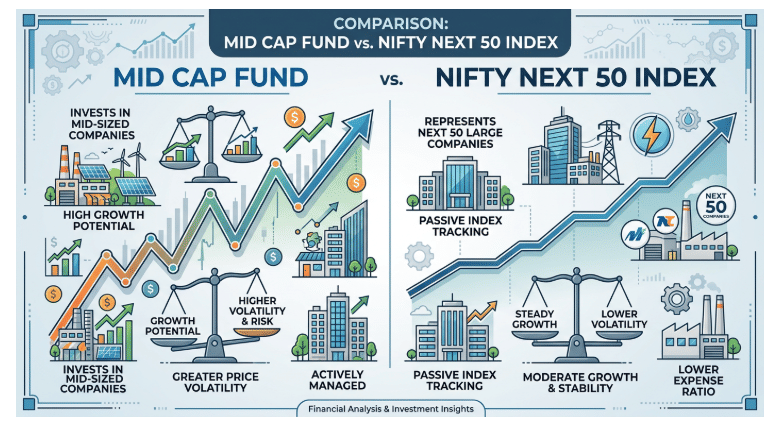
Mid Cap Funds and Nifty Next 50 Offer Different Risks

Large-Cap Fund Outflows Deepen as Investors Rotate Within Equities

DSP Says Large-Caps Offer Better Value After Recent Divergence

Nifty Total Market Funds Offer Broad Indian Equity Exposure