1 month ago
Supreme Court Reaffirms Need for Prior Environmental Clearance
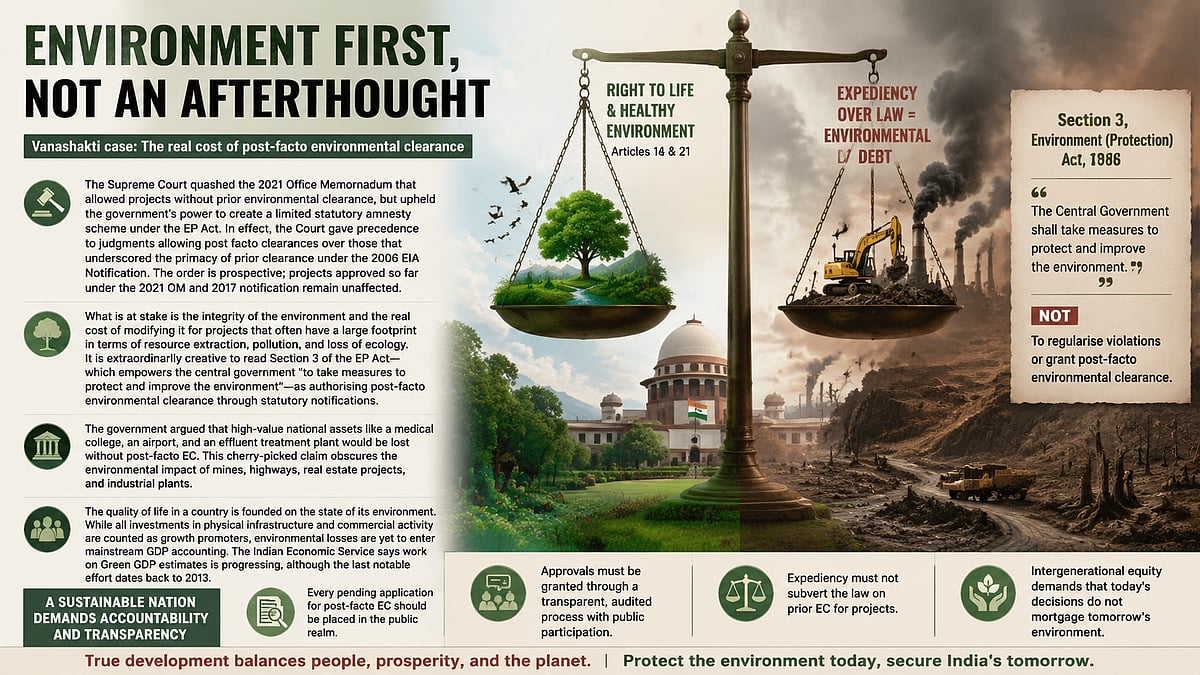
The Supreme Court of India said that projects need to get permission before they start, so the environment stays safe.
It cancelled a government memo that let projects go ahead without this permission.
The court still allows the government to give a special permission for some projects, but only in a limited way.
The decision is for the future, so projects that already got permission are still okay.
The court wants to make sure that the environment is protected and that people can see how projects will affect nature.

Supreme Court quashed the 2021 Office Memorandum that allowed projects without prior environmental clearance.
Court upheld the executive’s power to introduce a limited statutory amnesty scheme under the Environment (Protection) Act.
The order is prospective; projects approved under the 2021 memo and a 2017 notification remain unaffected.
The court emphasized the primacy of prior clearance under the 2006 Environmental Impact Assessment regulations.
The article warns that post‑factual clearance could undermine environmental integrity and public interest.
- Who
- Supreme Court of India, led by Chief Justice Surya Kant
- What
- Quashed a 2021 Office Memorandum and upheld a limited amnesty scheme for environmental clearance
- Where
- India
- When
- Recently (2024)
- Why
- To protect environmental integrity and enforce prior clearance under the EP Act
Key facts
- Supreme Court decision
- Quashed 2021 Office Memorandum allowing post‑factual clearance
- Executive amnesty scheme
- Allowed under Environment (Protection) Act
- Prior clearance requirement
- Primacy under 2006 EIA regulations
- Prospective order
- Projects approved under 2021 memo and 2017 notification remain unaffected
- Environmental impact
- Potential loss of ecology and resource extraction