

1 week ago
US Begins Returning Diplomats to Middle East Embassies

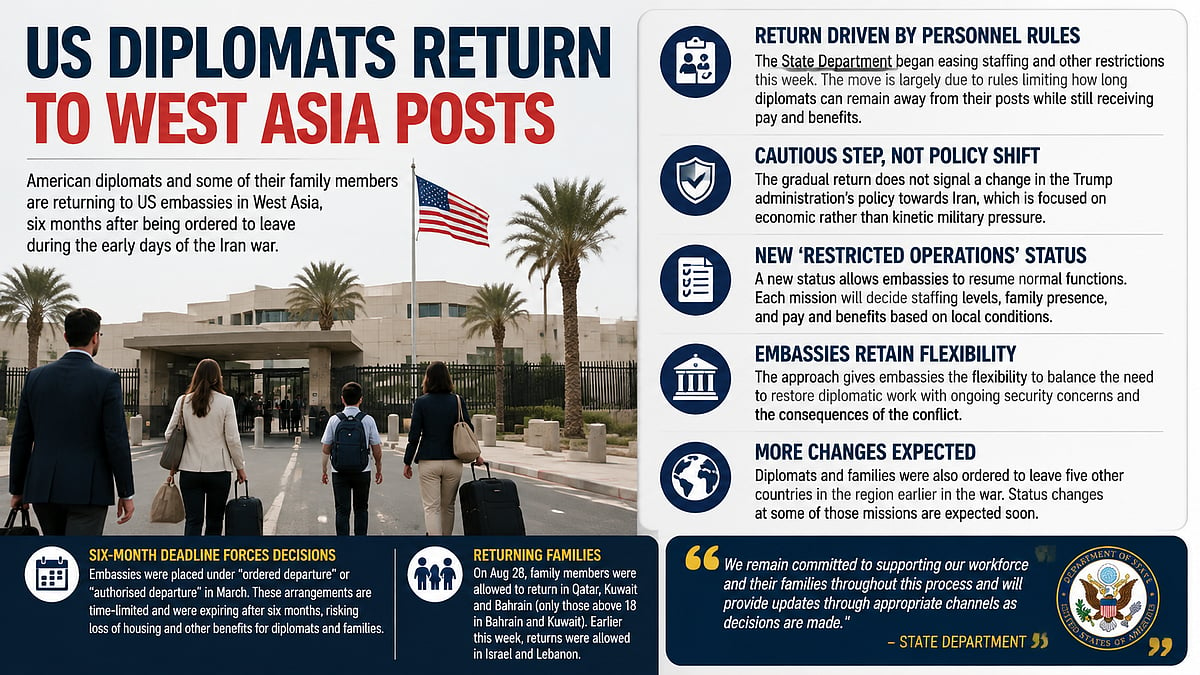
The United States moved some embassy workers away from the Middle East when fighting and tensions with Iran made the area more dangerous.
It is now sending some workers back to several embassies.
The first workers were expected to return to Lebanon, and Reuters later reported that the process had begun at some posts.
Embassies in Israel, Jordan and Oman may eventually have their normal number of workers again.
Other embassies will have limits on how many workers can be there.
Some family members still cannot return to several locations, although families may return to the US post in Riyadh.
The State Department says it is watching safety conditions and changing staffing to protect employees.
Some former officials see the move as evidence that the fighting is less likely to worsen soon.
Another former official says the remaining restrictions show that serious risks have not disappeared.

The United States has begun returning personnel to some Middle Eastern diplomatic missions evacuated or downsized during tensions with Iran.
Embassies in Lebanon, Israel, Saudi Arabia and Baghdad are among the posts receiving returning staff, Reuters sources said.
The plan includes higher staffing levels at missions in Jordan, Oman, Kuwait and Qatar, with some posts operating below capacity.
Israel, Jordan and Oman are expected to eventually return to full staffing; other missions face 85% or 75% caps.
The State Department says staffing decisions follow security assessments, while analysts say restrictions show that risks remain elevated.
- Who
- The United States Department of State and US diplomatic personnel are involved; former officials Dan Shapiro and John R. Bass commented on the changes.
- What
- The United States is returning or preparing to return diplomats and other personnel to Middle Eastern embassies that were evacuated or downsized during tensions and fighting involving Iran.
- Where
- US diplomatic missions in Lebanon, Israel, Saudi Arabia, Iraq, Jordan, Oman, Kuwait, Qatar, the United Arab Emirates and Bahrain.
- When
- The changes were reported as beginning on August 25; earlier reports said the process could begin that week. Initial staff reductions began in February.
- Why
- The State Department said the changes follow updated security assessments intended to advance US foreign policy while protecting personnel and their families.
Signs of Lower Regional Tension
Security Risks Remain
Meaning of the redeployment
Signs of Lower Regional Tension
Dan Shapiro said that returning personnel to partly evacuated missions suggests the administration believes the war is winding down and does not currently expect a near-term return to all-out hostilities.
Security Risks Remain
John R. Bass said continued limits on staffing and family members indicate that the threat environment remains more dangerous than before the war.
Staffing limits
Signs of Lower Regional Tension
The return of personnel and possible restoration of full staffing in Israel, Jordan and Oman indicate that conditions have improved compared with the period of evacuations.
Security Risks Remain
Caps of 85% or 75% at several missions, along with continuing family restrictions, show that the United States still considers some posts unsafe for normal operations.
Timing amid Iran negotiations
Signs of Lower Regional Tension
The planned or initial redeployment suggests Washington sees a lower immediate risk of the conflict escalating.
Security Risks Remain
The changes are occurring while negotiations with Iran remain stalled and after the reported expiration of a 60-day cease-fire, so the risks have not fully ended.
Key facts
- Current status
- Reuters reported on August 25 that personnel were beginning to return to some missions.
- First reported return
- The New York Times said diplomats would initially be assigned to the US Embassy in Lebanon, which would remain below full staffing.
- Posts expected to reach full staffing
- Israel, Jordan and Oman.
- 85% staffing cap
- Missions in the United Arab Emirates, Saudi Arabia, Qatar and Lebanon.
- 75% staffing cap
- Missions in Iraq, Kuwait and Bahrain.
- Family restrictions
- Restrictions on bringing family members remain in place at six Gulf-country posts and Lebanon, according to the internal document; Reuters sources said families could return to the US post in Riyadh.
- Earlier reductions
- Washington authorized voluntary departures of non-emergency personnel and family members from Israel in February.
Quotes

US State Department
US government department responsible for diplomatic missions and foreign policy
“continuously reviews the security posture at our diplomatic missions around the world. Based on our latest assessment, we are adjusting our staffing posture at certain posts in the Middle East to ensure we can continue advancing US foreign policy objectives while protecting the safety and security of our personnel.”
 wionews.com
 telegraphindia.com
“The limits on family members in the Gulf suggest that the government still believes there is an elevated risk. They suggest that the threat environment is less than 30, 60, or 90 days ago, but more than before the start of the war.”
wionews.com
Sources

Related news
US Diplomats Gradually Return to West Asian Embassies

US Warns Middle East Travelers Amid Escalating Iran-Linked Tensions

Iran War Prompts Pentagon Rethink of Gulf Bases

Pentagon Weighs Gulf Troop Cuts After Iran War Damage

US, Iran Near Hormuz Agreement as Fighting Continues in Region

Trump Rejects Iran Talks as Regional Attacks Raise Escalation Risks

Eric Trump Showcases New Patriot Passport Bearing Trump’s Image
Family Seeks US Intervention Over VanDyke Detention in Delhi

India and World Bank Discuss Deeper Capital Cooperation

Trump Administration Proposes Parental Status Proof for Children’s Passports
