1 week ago
Climate Risks Rise as Extreme Weather Threats Intensify Worldwide
Earth is getting warmer because people keep adding heat-trapping gases to the air.
This makes some dangerous weather events more likely and more powerful.
Scientists cannot say exactly when a huge disaster will happen.
They do say the chance becomes greater as the planet warms.
Many serious disasters have already happened around the world.
Some natural systems, such as coral reefs and the Amazon rainforest, are under severe stress.
Even if emissions stopped immediately, some effects would continue because carbon dioxide stays in the atmosphere for a long time.
Experts say countries should both reduce emissions and prepare buildings and communities for dangerous weather.
Some political leaders reject or downplay climate warnings, while scientists argue that the risks are real and growing.

Scientists warn that accumulating greenhouse gases are making heat waves, storms, floods and droughts more frequent and intense.
Earth’s average temperature in 2025 was reported as 1.44°C warmer than in the early 1800s.
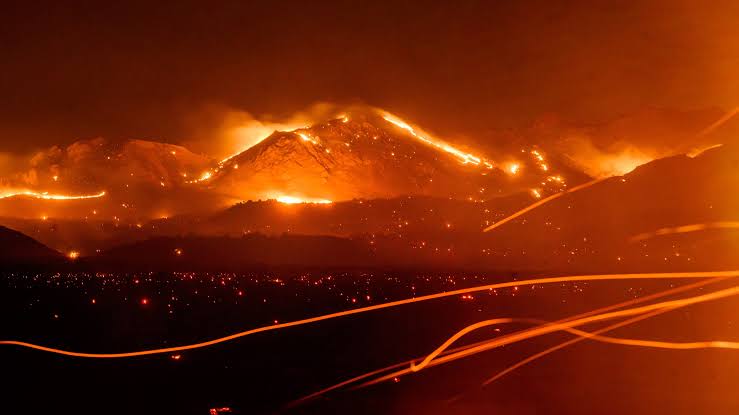
Recent disasters include Australia’s 2019-2020 wildfires, Pakistan’s 2022 floods and Hurricanes Milton and Helene in 2024.
Scientists say the timing of a catastrophic climate event cannot be predicted, but the risk increases with every fraction of a degree of warming.
Coral reefs and the Amazon rainforest may be approaching climate tipping points, while governments remain largely unprepared for major disasters.
- Who
- Climate scientists, governments, communities and political leaders, including U.S. President Donald Trump, are involved in the debate and response.
- What
- The article examines the growing risk of catastrophic climate-related extreme weather and the world’s limited preparedness.
- Where
- The threat is global, with examples from Australia, Pakistan, the United States, the United Kingdom, the Amazon rainforest and elsewhere.
- When
- The risks are increasing now; the article cites events from 2019 through 2025 but says the timing of a future catastrophe is uncertain.
- Why
- Human emissions of greenhouse gases from coal, oil and gas are warming the planet and disrupting weather patterns.
Climate Action and Preparedness
Climate Skepticism and Delay
Whether climate risks require urgent action
Climate Action and Preparedness
Scientists argue that greenhouse-gas emissions are increasing the likelihood and intensity of extreme weather, requiring emissions cuts and infrastructure preparation.
Climate Skepticism and Delay
Some climate-change deniers and political leaders question the warnings or portray climate policies as excessive; Donald Trump has called climate change a hoax and climate policies a “Green New Scam.”
How to discuss catastrophic scenarios
Climate Action and Preparedness
Scientists such as Sonia Seneviratne and Tim Lenton say people should be warned about severe possibilities because the risks are growing and past projections have sometimes been too conservative.
Climate Skepticism and Delay
Researchers also recognize that precise timing cannot be predicted, and they worry that dramatic warnings may be dismissed as exaggeration or cause people to disengage.
Prospects for avoiding the worst outcomes
Climate Action and Preparedness
Reducing emissions and preparing communities can lower risks, and Lucy Jones’s earthquake-preparedness work is presented as an example of effective risk planning.
Climate Skepticism and Delay
The article describes a widespread tendency among governments and individuals to ignore or downplay the issue, partly because climate change feels overwhelming and solutions seem difficult.
Key facts
- Reported warming
- Earth was reported as 1.44°C warmer in 2025 than in the early 1800s.
- Australia’s Black Summer
- Wildfires in 2019 and 2020 burned 19 million hectares, or more than 46 million acres.
- Pakistan floods
- Flooding in 2022 left a third of Pakistan under water.
- Recent U.S. hurricanes
- Hurricanes Milton and Helene ravaged parts of the southern United States in 2024.
- Coral bleaching
- The article says 84% of the world’s corals experienced heat-stress algae loss between 2023 and 2025.
- Atmospheric persistence
- Carbon dioxide can remain in the atmosphere for hundreds of years.
- Preparedness
- The article says no country is truly prepared for a major climate disaster.
Quotes

Sonia Seneviratne
Swiss climatologist and vice chair of an IPCC working group
“The risk is that people just think you are exaggerating. It’s the ‘Boy Who Cried Wolf’ problem. Sometimes wolves are real. If it’s outside the door, wouldn’t you want to know?”
 deccanchronicle.com
“We need to be talking about some of the worst things that can happen. It’s natural to think that some bigger shocks are on the way.”
deccanchronicle.com
Sources
Related news

Climate Crisis Demands Urgent Action and Moral Responsibility, Column Argues

Climate Crisis Realized as Extreme Weather Wreaks Havoc Worldwide

Climate Change Makes Extreme Weather A Global Norm
UN Warns of Rising Sea Levels Threatening India
Musk Warns Climate Action Alone May Not Save Humanity

Nepal Flood Disaster Highlights Hindu Kush Himalayas Fragility

India Replaces Sri Lanka as 2027 Women’s Champions Trophy Host

Mitsubishi Revives Pajero With 201PS Fifth-Generation SUV
IIM-Born CEO Says Australia’s Everyday Life Runs on Trust
UN Report Says 1.5°C Overshoot, Return Remains Possible

Uday Kotak Warns Global Bond Markets Face Roller-Coaster Volatility