1 week ago
Why Theory of Knowledge Matters in an AI-Driven World
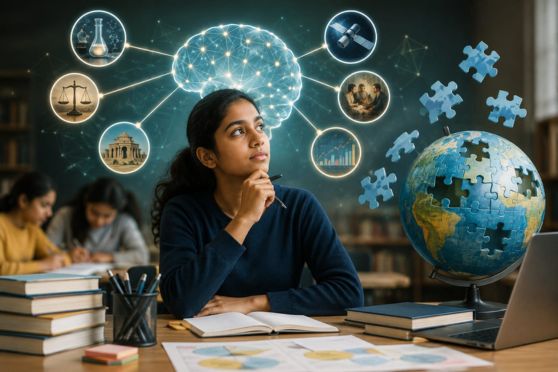
The article says schools have traditionally focused on what students know.
Today, information is easy to find, especially because of artificial intelligence.
Students therefore also need to learn how to decide whether information is trustworthy.
Theory of Knowledge, or TOK, teaches students to ask questions about evidence, assumptions and different points of view.
It can help connect subjects instead of treating them as completely separate.
TOK also encourages students to think about bias and responsibility when using AI.
The article says schools should show how students develop their thinking, not only test their memory.
This could include reflection, teamwork, portfolios and presentations.
The main message is that future learners need to ask careful questions and use knowledge responsibly.

The article argues that education should focus less on memorizing facts and more on how students evaluate knowledge.
Theory of Knowledge, part of the International Baccalaureate Diploma Programme, is presented as a framework for critical inquiry.
TOK can connect subjects such as science, history, economics, technology and the arts when addressing complex problems.
Students are encouraged to examine artificial intelligence, misinformation, algorithms, evidence, bias and intellectual property.
The article calls for reflective, collaborative and portfolio-based assessment rather than relying mainly on high-stakes memory tests.
- Who
- Students, educators and schools are the focus; the article is written by Sai Bhavya Prabhu, Head of International Curriculum at Shiv Nadar School, Gurugram.
- What
- The article argues that Theory of Knowledge can prepare students to evaluate information and make responsible decisions in an AI-shaped world.
- Where
- Educational institutions around the world, including international education settings and Shiv Nadar School in Gurugram.
- When
- The discussion concerns the current period, as generative AI, misinformation, algorithms and climate challenges reshape education.
- Why
- Because information is abundant and increasingly shaped by AI, misinformation, algorithms, cultural perspectives and complex global problems.
Key facts
- Core framework
- Theory of Knowledge (TOK), described as the intellectual spine of the International Baccalaureate Diploma Programme.
- Educational shift
- The article proposes moving from asking what students know to asking how they know it.
- Subjects connected
- TOK is presented as a way to connect science, history, economics, technology and the arts.
- AI concerns
- The article raises questions about AI-generated knowledge, intellectual property, training bias and opaque evidence.
- Recommended assessment
- Reflection, critical collaboration, portfolios and presentations are favored over solely memory-based examinations.
- Author
- Sai Bhavya Prabhu is identified as Head of International Curriculum at Shiv Nadar School, Gurugram.
Sources
Related news

AI Should Support Understanding, Not Replace Independent Thinking
OpenAI Urges Responsible AI Use While Preserving Student Learning

Teaching in the AI age: Why human connection matters
AI Copyright Debate Puts the Future of Information Ahead

Saikat Majumdar on Education, Intelligence, and AI’s Human Future

Interdisciplinary Education Prepares Leaders for an AI-Shaped Future

Sharma and Malik share halfway lead at Telangana Golconda Masters

Gurgaon CEO’s Sleep Debate Challenges India’s Early-Rising Expectations

Gurugram Fake Call Centre Targeting US Citizens Busted, 11 Arrested

Sheoran And Sharma Share Course-Record Lead At Golconda Masters

POWERGRID AGM Highlights Network Growth and Technology Plans