

1 week ago
Census Drops Beggar Category as Unemployment Realities Persist

The article discusses a change in how the census counts vulnerable people.
It says the separate category for “beggars and vagrants” has been removed.
The writer argues that changing a form does not make poverty disappear.
People who beg can still be seen at traffic crossings and outside restaurants.
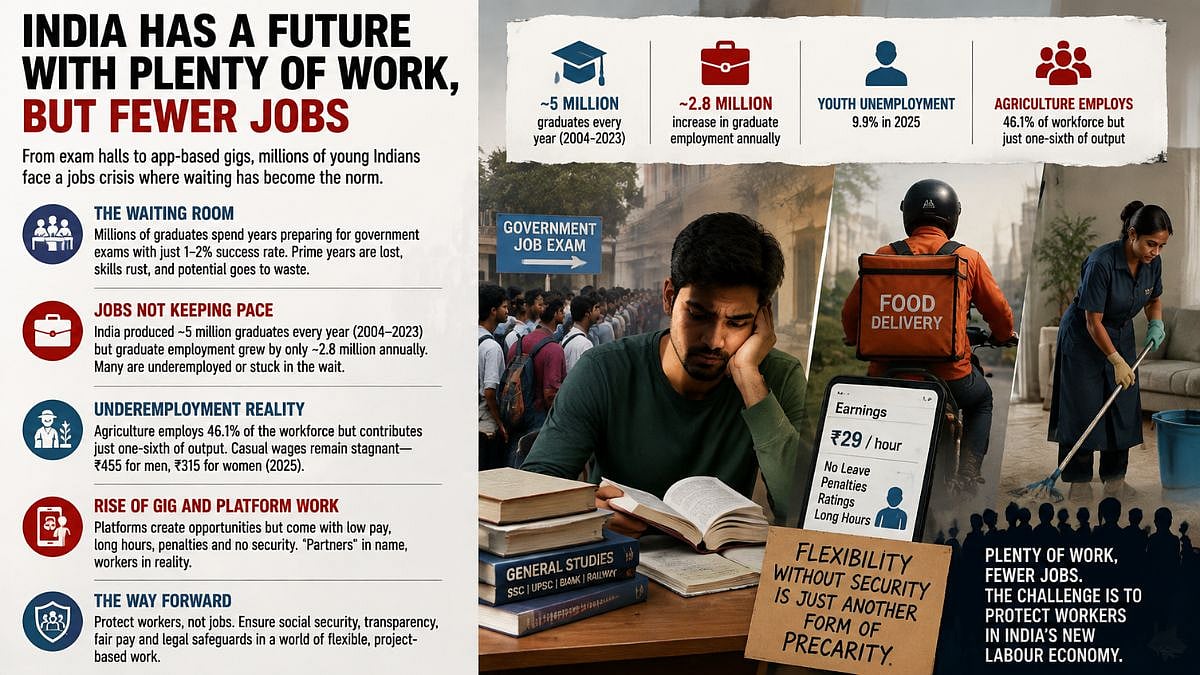
Many educated young people are also competing for a small number of basic jobs.
This shows that unemployment and economic insecurity remain serious problems.
The article uses satire to question whether official statistics can hide these realities.
It imagines that technology and economic growth might change the situation by 2047.

The latest census framework reportedly removes the separate “beggars and vagrants” classification from its questionnaire.
The article says fewer than five lakh people remain officially counted as beggars, while noting their continued visibility in public places.
It argues that removing a category from official statistics does not eliminate poverty, homelessness, or economic insecurity.
Large recruitment drives in Uttar Pradesh and Bihar reportedly attract huge numbers of highly educated applicants for limited low-level jobs.
The article satirically imagines that artificial intelligence and economic change by 2047 could eventually erase today’s employment anxieties.
- Who
- The census authorities, vulnerable people, unemployed applicants, and the government are discussed in the article.
- What
- The latest census framework has dropped the separate classification of “beggars and vagrants,” prompting criticism that unemployment and poverty remain visible.
- Where
- The article refers to traffic intersections, restaurants, Uttar Pradesh, Bihar, and Indian Railways recruitment drives.
- When
- The change is described as part of the latest census framework; the article also refers to a possible future in 2047.
- Why
- The classification was removed as part of a census framework that presents a changing picture of vulnerable populations; the article argues that this does not resolve their underlying economic problems.
Administrative Simplification
Social-Reality Critique
Removing the beggar classification
Administrative Simplification
Supporters could view dropping the separate category as a pragmatic update that avoids permanently defining vulnerable people by their current condition.
Social-Reality Critique
Critics argue that deleting a statistical category may make poverty and homelessness less visible without changing the conditions people face.
Official progress versus lived conditions
Administrative Simplification
The framework can be presented as consistent with a future-oriented vision in which begging and extreme vulnerability decline.
Social-Reality Critique
The article emphasizes that people remain visible in public spaces and that unemployment and economic insecurity continue despite changes in official classification.
Employment prospects
Administrative Simplification
The article’s optimistic scenario suggests that economic realignment and artificial intelligence could eventually reduce current employment anxieties.
Social-Reality Critique
The present recruitment situation, with highly educated applicants competing for limited low-level jobs, is portrayed as evidence of a severe and immediate labour-market imbalance.
Key facts
- Census change
- The separate “beggars and vagrants” category has reportedly been removed from the questionnaire.
- Reported population
- The article states that the number of beggars is below five lakh.
- Visible hardship
- The article says people who beg remain visible at traffic intersections and outside upscale restaurants.
- Recruitment pressure
- Mass recruitment drives reportedly draw lakhs of applicants for a small number of low-level support roles.
- Applicant qualifications
- Applicants are described as including people with engineering degrees, management diplomas, and postgraduate qualifications.
- Regional examples
- The article cites Uttar Pradesh and Bihar as places affected by mass unemployment and recruitment-related protests.
- Future reference
- The article speculates that artificial intelligence may take over a substantial portion of human labour by 2047.
Sources
Related news

Census 2027 Drops Beggars Category, Adds Natural Calamities
India Faces a Future With Plenty of Work, Fewer Jobs

NITI Aayog Report Highlights India’s Youth Jobs and Skills Crisis

India’s Youth Work Crisis Affects One in Three Gen Zs

Noon Briefing Covers Gurugram Floods, Census Changes, Technology and More

India’s Youth NEET Crisis Exposes Limits of Unemployment Data

Chalkboards, AI Professors, and the Future of Human Teaching

India’s Insolvency Framework Faces New Questions From AI Transactions

AI, Networking Debate Intensifies Over Future of Tech Careers

Bessent Says AI Could Fuel U.S. Startup Boom

Readers Debate AI Content Rights and National Identity
