1 month ago
Modi's Adaptability Sustains His Political Power
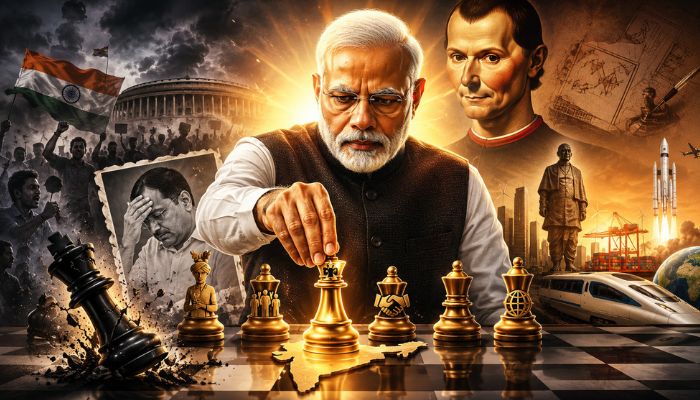
Narendra Modi has been the Prime Minister of India for a long time.
People often describe him as a strong leader who wins elections easily.
But he is also very good at making small changes when needed to keep his power.
For example, he let farmers change some laws in 2021 and gave up a cabinet minister in 2026 to stop student protests.
He does this to keep his supporters happy and avoid big problems.
Modi also talks directly to people using social media and special programs, making him seem like a servant rather than a distant leader.
Some people worry that his leadership is making India less democratic, but others say he is just adapting to new situations.
Modi's ability to change his methods while keeping his main goals makes him a very effective leader.

Narendra Modi's political strategy involves making small concessions to neutralize larger threats.
He sacrificed a cabinet minister in 2026 to end student protests, similar to policy reversals in 2021 and 2024.
Modi communicates directly with the public through social media and programs like Mann Ki Baat.
Critics argue his leadership has led to a decline in India's democratic institutions.
Supporters view his adaptability as a strength that allows him to maintain power and achieve long-term goals.
- Who
- Narendra Modi, Prime Minister of India
- What
- Modi's political adaptability and strategic concessions to sustain his power
- Where
- India
- When
- Various events from 2014 to 2026
- Why
- To neutralize political threats and maintain his position as the central figure in Indian politics
Critics of Modi's Leadership
Supporters of Modi's Leadership
Democratic Backsliding
Critics of Modi's Leadership
Critics argue that Modi's leadership has led to a decline in India's democratic institutions, with increased intimidation of journalists and pressure on rights groups, as noted by Freedom House and the V-Dem Institute.
Supporters of Modi's Leadership
Supporters contend that Modi's government has maintained genuine contested elections and that opposition parties still run major states, indicating a robust democratic process.
Policy Flexibility
Critics of Modi's Leadership
Critics view Modi's policy reversals, such as the repeal of farm laws, as tactical moves that undermine his strongman image and indicate a lack of conviction.
Supporters of Modi's Leadership
Supporters see these reversals as strategic adaptations that protect his voter base and demonstrate his ability to respond to political pressures without compromising long-term objectives.
Key facts
- Resignation
- Education Minister resigned in 2026 to end student protests.
- Farm Laws
- Repealed in 2021 after nationwide protests.
- Coalition Allies
- Given cabinet seats and veto power in 2024.
- G20 Presidency
- India presented as a leading voice for the developing world in 2023.
- Democratic Scores
- India's scores on political rights and civil liberties have declined since 2014.
Sources
Related news
IIT Bombay Launches E-PG Diploma In Computer Science And AI

Google Launches Gemini 3.8 Flash With Cybersecurity Upgrades

Gujarat launches DNA-based sports talent hunt for 2030 Commonwealth Games

St Peter's Engineering College launches Robotics Centre of Excellence
Bengaluru Engineers Develop Affordable AI PC KEO
Bangladesh Recall Shanto, Mahmud for Asian Games T20 Squad

Sharma and Malik Share Halfway Lead at Golconda Masters
India Replaces Sri Lanka as 2027 Women’s Champions Trophy Host
Centre Assures JDU Bihar’s Interests In Farakka Treaty Decision
India’s Record Wheat Harvest Opens $1.5 Billion Export Window