2 weeks ago
Tata Sons' Listing Dilemma Hardens as RBI Keeps NBFC Tag

Tata Sons is the company that controls the big Tata Group in India.
The country's central bank, called the Reserve Bank of India, has put Tata Sons on a special list of financial companies.
Being on this list could mean that Tata Sons has to sell shares to the public one day, which is called listing.
Some people think that would be good because the Tata Group needs a lot of money for big projects like airplanes and computer chips.
The Shapoorji Pallonji family, which owns part of Tata Sons, also wants to sell its share to get money.
Other people, including Noel Tata, do not want a listing because it would let outside investors in and bring more rules and attention.
Tata Sons has asked the bank to remove it from the list, and the bank says the request is still being looked at.
The next chairman of Tata Sons will have to balance all these different opinions.
So the big question is whether Tata Sons will have to go public or can stay private.

The RBI retained Tata Sons on its revised upper-layer NBFC list for 2026-27 on August 6, making it the only unlisted company among the 18 entities on the list.
Tata Sons' inclusion was based on standalone assets of about Rs 2.01 lakh crore as of March 2026, roughly twice the Rs 1 lakh crore threshold under the new principle-based framework.
The RBI said its inclusion is without prejudice to Tata Sons' pending application to deregister as a core investment company, which remains under examination.
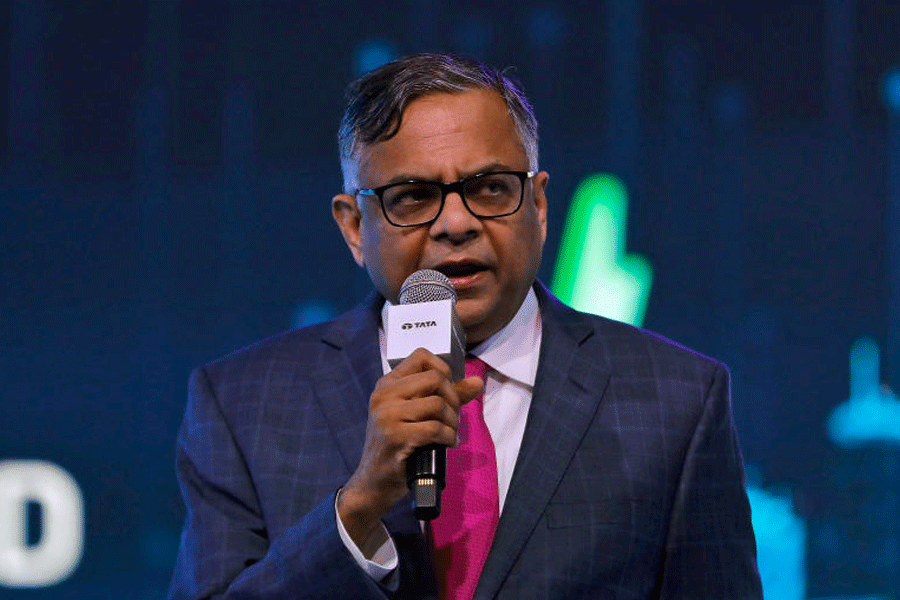
The listing issue has become a point of friction between Tata Trusts chairman Noel Tata, who privately opposes a listing, and outgoing chairman N Chandrasekaran, who resisted committing to keep the company private.
The Shapoorji Pallonji Group, which owns a little over 18 per cent of Tata Sons, sees an IPO as an opportunity to sell its stake and unlock liquidity.
- Who
- Tata Sons, its majority shareholder Tata Trusts, the Reserve Bank of India, Tata Trusts chairman Noel Tata, outgoing Tata Sons chairman N Chandrasekaran and the Shapoorji Pallonji Group.
- What
- The RBI retained Tata Sons on its revised upper-layer NBFC list for 2026-27, keeping open the possibility of a mandatory listing despite Tata Sons' pending deregistration application.
- Where
- India.
- When
- The revised upper-layer list was released on August 6; the new principle-based NBFC framework was released in June 2026; Tata Sons was first included on the list in 2022.
- Why
- Because Tata Sons' assets exceed the upper-layer threshold, and the outcome will shape the Tata Group's ability to fund investment-heavy areas like aviation and semiconductors while the SP Group seeks to unlock liquidity.
Pro-Listing Camp
Anti-Listing Camp
Listing of Tata Sons
Pro-Listing Camp
Some within Tata Sons and Tata Trusts believe it is time to relook at listing given the Tata Group's growing investment needs, especially in capital-intensive areas like aviation and semiconductors; the SP Group sees an IPO as a chance to sell its stake and unlock much-needed liquidity.
Anti-Listing Camp
Noel Tata has privately opposed a listing, as going public would open the doors for external investors and bring far more public and regulatory scrutiny.
Likelihood of a forced listing
Pro-Listing Camp
From the regulator's perspective, retaining Tata Sons on the upper-layer list under the principle-based metric, with assets roughly twice the threshold, may make a listing inevitable.
Anti-Listing Camp
Tata Sons has repaid its debts to strengthen its case and applied to deregister as a core investment company; the RBI says its inclusion is without prejudice to that pending application, and legal experts say the classification alone does not settle whether Tata Sons must list.
Key facts
- RBI action
- Retained Tata Sons on the revised upper-layer NBFC list on August 6
- Entities on upper-layer list
- 18, with Tata Sons the only unlisted company
- Tata Sons standalone assets (March 2026)
- About Rs 2.01 lakh crore (over Rs 2 lakh crore)
- Upper-layer NBFC threshold
- Rs 1 lakh crore and above
- SP Group stake
- A little over 18 per cent
- Deregistration application
- Pending and under examination
- New NBFC framework
- Principle-based framework released in June 2026
- Initial upper-layer inclusion
- 2022, as a core investment company (CIC)
Sources
Related news
RBI's New NBFC-UL List Ahead; Tata Sons Listing Question Open
RBI Keeps Tata Sons Waiting on NBFC Deregistration Decision

RBI keeps Tata Sons in upper-layer NBFC list, listing in balance
RBI Classifies Tata Sons, 16 Others as Upper-Layer NBFCs
Tata Sons deregistration hinges on RBI's 'public funds' rule
Tata power struggle deepens as Chandrasekaran declines reappointment

RBI Governor Meets US Fed Chief Kevin Warsh at G20

FCNR(B) Inflows Cross $100 Billion as RBI Closes Window

Indian Bond Yields Near 7% as Rate Hike Bets Rise

India Hosts BRICS 2026 Amid US-Iran War Tensions

Finance Ministry Flags Global Yield and Inflation Risks for India