

2 weeks ago
How Independence Revived India's Hollowed-Out Economy After British Rule
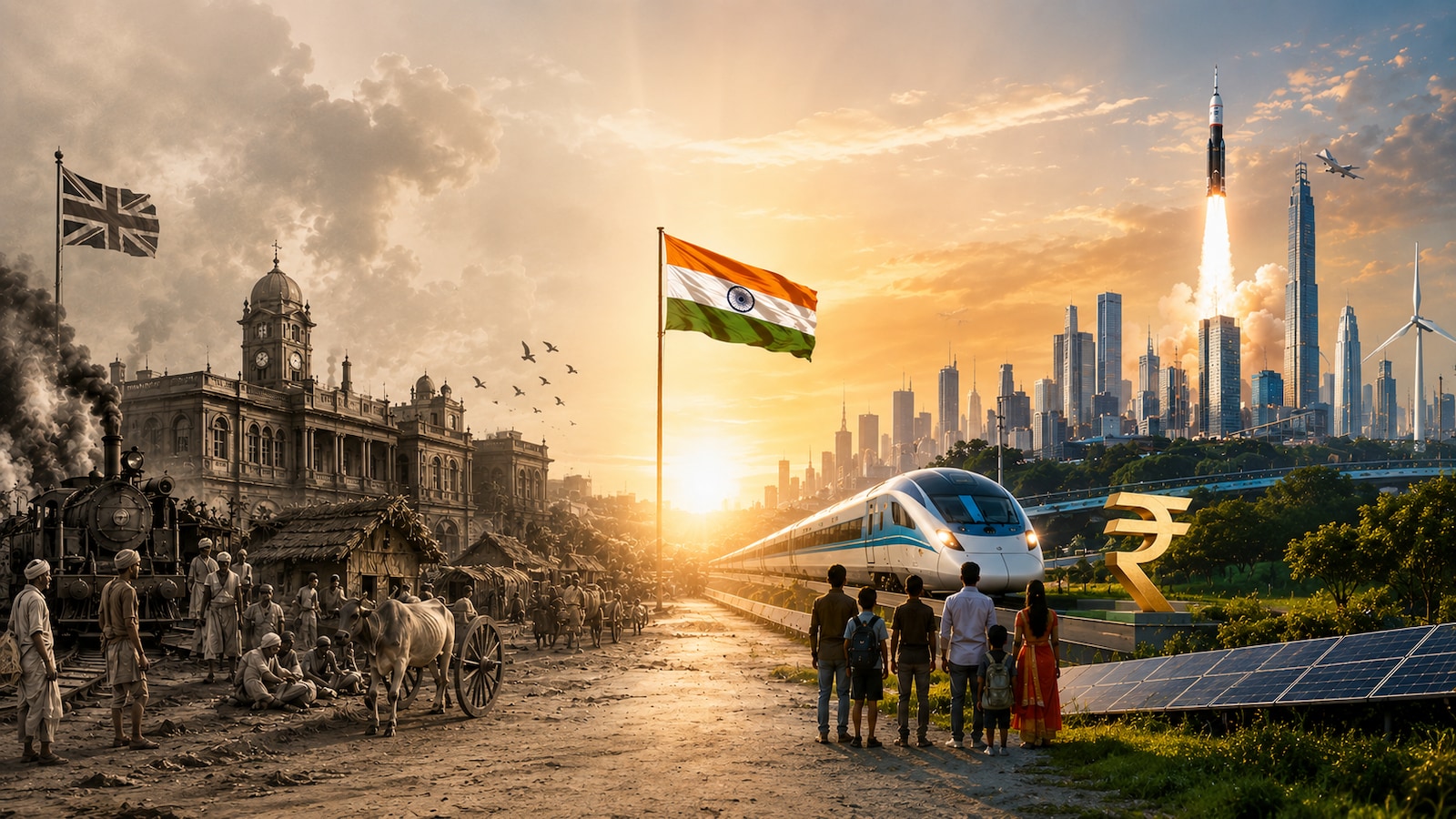
A long time ago, before India became free, most Indian people were quite poor.
Their country's economy had become much weaker than many other countries around the world.
When India gained independence, things stayed difficult for many years.
Then, in the early 1990s, India changed its rules so businesses could grow more easily.
After that, India's economy started growing very fast.
Today India is one of the biggest economies in the world.
Many experts think India will keep growing faster than almost every other large country.
India now also sells more products to other countries than it used to.
The next step is making sure that all Indian people share in this new wealth.

India's GDP per capita fell from 83% of the global average in 1820 to 32% by 1940, according to the Maddison Project Database 2023.
Economic liberalisation in the early 1990s drove a decisive turnaround, lifting India's GDP per capita to 46% of the global average by 2025.
The IMF's July 2026 World Economic Outlook projects India's GDP growth at 6.4% in 2026, ahead of China (4.6%), Brazil (2.4%) and the United States (2.3%).
India is the world's sixth-largest economy with a nominal GDP of $4.15 trillion in 2025, per IMF April 2026 estimates.
India's share of global merchandise exports rose from 0.61% in 1970 to 2.52% today, supported by initiatives such as Atmanirbhar Bharat, Startup India and PLI schemes.
- Who
- India and the Indian people, whose economic standing declined under British rule and recovered after Independence, with data and projections from institutions including the IMF, the University of Groningen and Our World in Data.
- What
- India's economy recovered from its colonial-era decline to become the world's sixth-largest and projected fastest-growing major economy.
- Where
- India, measured in comparison to the global economy.
- When
- The data spans from 1820 through 2026, with the key turnaround occurring after economic reforms in the early 1990s.
- Why
- Economic liberalisation in the early 1990s and government initiatives such as Atmanirbhar Bharat, Startup India and production-linked incentive schemes unlocked higher growth and global integration.
Key facts
- GDP per capita in 1820
- 83% of the global average (late Mughal period)
- GDP per capita in 1940
- 32% of the global average
- GDP per capita in 2025
- 46% of the global average (Our World in Data)
- 2025 nominal GDP
- $4.15 trillion, making India the world's sixth-largest economy
- Projected GDP growth 2026
- 6.4% (IMF July 2026 World Economic Outlook)
- Share of global GDP
- ~3.3%, up from 1.6% in 1980; expected to exceed 4% by 2030
- Share of global merchandise exports
- 2.52%, up from 0.61% in 1970
Sources
Related news
India's Economy: From Rs 2.7 Lakh Crore to $4 Trillion

India’s GDP Growth Accelerates to 7.8% in 2025-26
From 'Fragile Five' to world's fastest-growing major economy: Modi
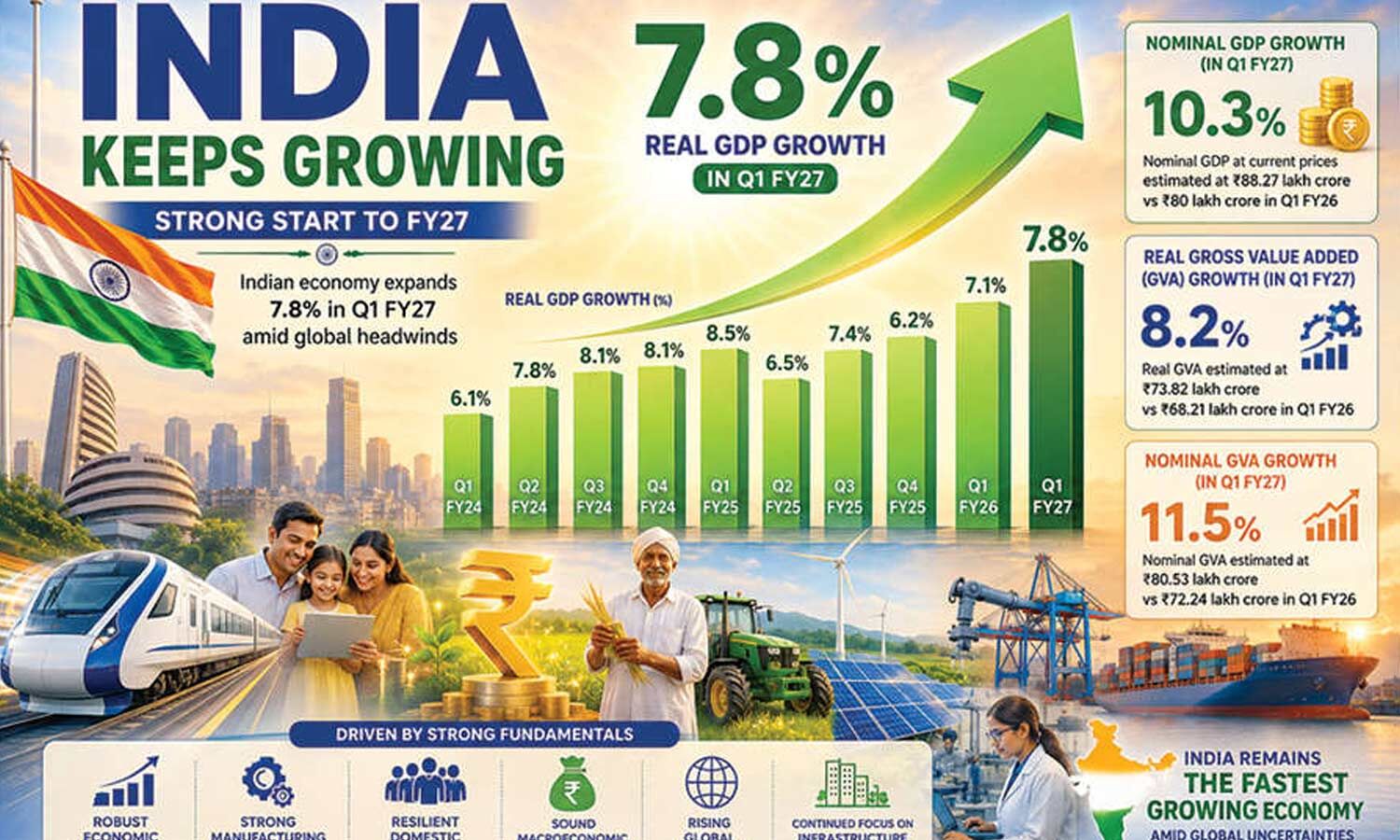
India’s Q1 FY27 Growth Beats Forecast Despite Iran War Fears

India's 7.8% GDP Growth Defies Global Uncertainty, Modi Hails Resilience