1 hr ago
India’s Data Centre Boom Draws Billions, Giants and Challengers
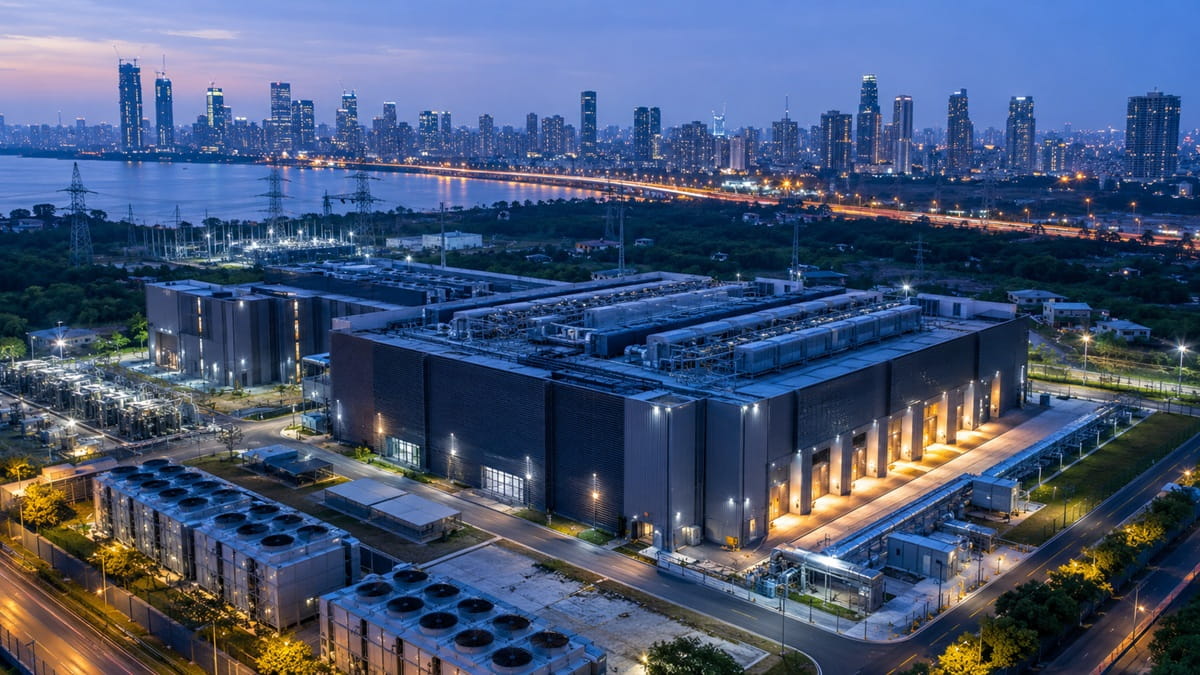
Companies are building many more data centres in India.
Data centres are large facilities that store information and run online services.
The growth of artificial intelligence is making companies need even more of these facilities.
Large technology companies and Indian business groups are planning billions of dollars in investments.
Smaller companies such as Sify, CtrlS and Nxtra also believe they can compete.
They say their local knowledge helps them deal with India’s infrastructure challenges.
A major problem is finding enough electricity and connecting projects to the power grid on time.
Some companies are using solar and wind power to make their operations cleaner.
The industry expects India’s data-centre capacity to double by 2028.

Yotta plans to invest $2–2.5 billion in the next few months and says its sites could scale to 2 GW.
India’s operational data-centre capacity is estimated at 2 GW and is projected to reach 4 GW by 2028.
Sify, CtrlS and Nxtra are expanding alongside Google, Microsoft, Amazon, Meta and major Indian conglomerates.
AI data centres are increasing demand for electricity, making grid access and timely power availability major constraints.
Companies including Iron Mountain are turning to solar, wind and hybrid renewable power to support expansion.
- Who
- Yotta, Sify Infinit Spaces, CtrlS Datacenters, Nxtra Data, major global technology companies and Indian conglomerates.
- What
- Companies are rapidly expanding data-centre capacity in India to serve cloud computing and artificial-intelligence demand.
- Where
- Across India, including Mumbai, Pune, Bengaluru, Chennai, Gujarat and Hyderabad.
- When
- Expansion is underway, with capacity projected to rise from 2 GW to 4 GW by 2028; several projects have longer-term targets through 2035.
- Why
- Demand from hyperscalers, cloud services and AI is increasing, while companies are attracted by India’s talent, costs and power economics.
Local and smaller operators
Large-scale investors and conglomerates
Competitive advantage
Local and smaller operators
Sify and other smaller local operators say their knowledge of India’s infrastructure challenges gives them an advantage, and that AI and cloud growth will require more capacity than is currently being built.
Large-scale investors and conglomerates
Global technology companies and large Indian groups are committing substantial capital, large campuses and gigawatt-scale projects that could dominate the market.
Power and project delivery
Local and smaller operators
Operators including CtrlS emphasize that grid access and timely power availability must move together, while companies are pursuing renewable and hybrid power sources.
Large-scale investors and conglomerates
Despite power and infrastructure constraints, major investors and operators are continuing to announce aggressive expansion schedules and large AI-ready facilities.
Key facts
- Current capacity
- India has an estimated 2 GW of operational data-centre capacity.
- 2028 projection
- Operational capacity is projected to double to 4 GW by 2028.
- Projected investment
- Data-centre investments are tipped to exceed $250 billion over five years.
- Yotta investment
- Yotta plans to invest $2–2.5 billion in the next few months.
- Sify footprint
- Sify operates 14 data centres across six major cities with 188 MW of built IT power capacity.
- Nxtra target
- Nxtra Data aims to expand from nearly 300 MW to 1 GW and target about 25% market share.
- Major constraint
- Grid access and timely power availability are described as defining constraints for high-power AI deployments.
Sources
Related news

India Data Centre Capacity Seen Reaching 6 GW by 2029
India’s Data Centre Sector Draws Massive Investment Projections

AI, localisation laws drive India’s data center boom

India’s Data Centre Capacity Could Triple by 2030
India's Data Centre Boom Reshapes Real Estate Amid AI Demand

India’s Data Centre Capacity Set to Triple by 2030
Why Young Affluent Indians Are Choosing Land Over Apartments

India Becomes Asia’s Fourth-Largest REIT Market, Cushman Says
Indian REIT Returns Combine Capital Gains With Distributions
Hyderabad’s GCC Hub Set to Add 70 Centres Within Year