

2 weeks ago
Childcare key to sustaining India's women workforce participation
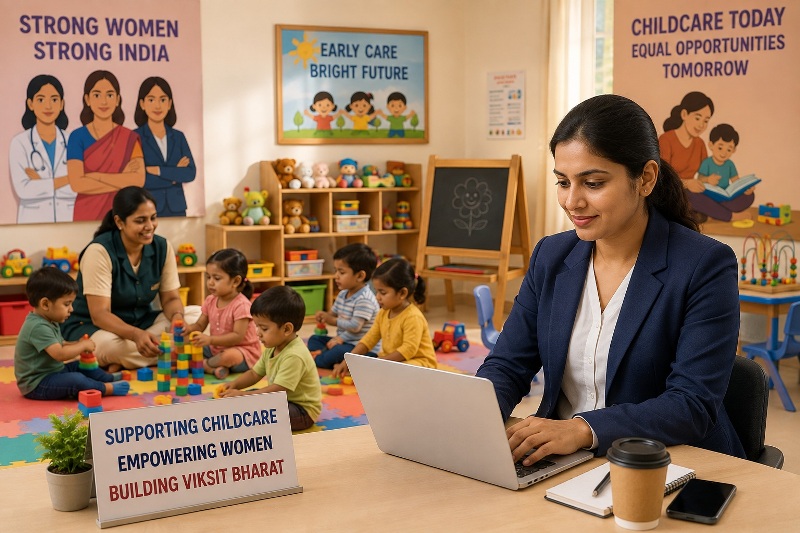
In India, many women do not work outside the home because they have to take care of their children.
A big government survey for 2025 found that only 40 out of every 100 women aged 15 and above are working.
The same survey says that about 44 out of every 100 women who are not working say the main reason is looking after children or doing home duties.
The government already has a law that says workplaces with 50 or more workers must provide a crèche, which is a place where children can be looked after.
The law also lets mothers visit the crèche four times a day.
Childcare experts say that good crèches make it easier for mothers to get back to work.
Helpers and organisations are working to make childcare better and easier to find.
The state of Odisha has a plan called KALIKA that wants to set up care centres for children from six months to six years old.
These centres could be near offices, factories, markets and other places where women work.
When safe childcare is available, women get more chances to work, earn money and make their own choices.

India's female labour force participation rate for ages 15 and above stood at 40 per cent in 2025, per the Periodic Labour Force Survey.
The survey found 44.4 per cent of women outside the labour force cited childcare or homemaking commitments as their main reason for not working.
The Maternity Benefit (Amendment) Act, 2017 requires establishments with 50 or more employees to provide crèche facilities, including four daily visits by women employees.
Experts like Chirashree Ghosh of FORCES say affordable, quality childcare can help women return to work and build careers after childbirth.
Odisha's KALIKA policy proposes a Care Centre framework for children aged six months to six years to reduce women's childcare burden and boost labour participation.
- Who
- Policymakers, childcare advocates such as FORCES and Nand Ghar, and governments including Odisha
- What
- Childcare support is emerging as key to raising and sustaining women's participation in India's workforce
- Where
- India, with Odisha proposing a Care Centre framework under its KALIKA policy
- When
- Based on 2025 Periodic Labour Force Survey data
- Why
- Because 44.4 per cent of women outside the labour force cite childcare or homemaking commitments as their main reason for not working
Key facts
- Female labour force participation rate (15+)
- 40 per cent in 2025 (PLFS)
- Women outside labour force citing childcare/homemaking
- 44.4 per cent
- Crèche requirement
- Establishments with 50+ employees under the Maternity Benefit (Amendment) Act, 2017
- Crèche visits per day
- Four visits, including rest interval
- Nand Ghar network size
- More than 15,000 centres
- Odisha KALIKA care centre age coverage
- Children aged six months to six years
- Advocacy body
- Forum for Crèches and Child Care Services (FORCES)
Quotes
Chirashree Ghosh
National Coordinator, Forum for Crèches and Child Care Services (FORCES)
“At the heart of our chairman, Anil Agarwal’s vision for Nand Ghar is the belief that empowering women and nurturing children go hand in hand. The organisation’s network of more than 15,000 Nand Ghars provides children with nutrition, early learning and care, while supporting women in pursuing livelihoods, skills and economic opportunities.”
 deccanchronicle.com
“Accessible, affordable and quality childcare facilities can make it easier for women to return to work after childbirth and continue building their careers.”
deccanchronicle.com
Sources
Related news
Corporate Daycares Offer Working Parents Convenience Amid Safety Concerns
NITI Aayog Flags Women’s Low Formal Employment, Urges Skilling Reform
Tamil Nadu urged to support women guest workers beyond factories
AI Could Help Women Return to Work With Skills
Private Players Urged to Provide Housing for Women Guest Workers

Pakistan lags South Asia in women's employment, report finds
Youth Protests Expose India's Institutional Failures, Guruswamy Says

Bihar Youth Seek Government Jobs Amid Low Workforce Participation
India’s Youth NEET Crisis Exposes Limits of Unemployment Data
Young Indians Demand Good Jobs as Aspirations Meet Reality

NITI Aayog Finds 8.7 Crore Youth Outside Work, Education
