2 weeks ago
Schools Urged to Rethink Report Cards for Holistic Development
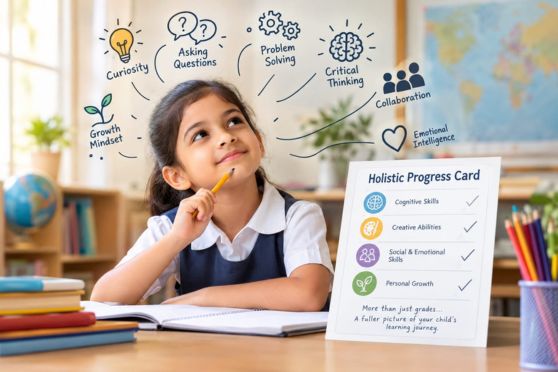
A report card usually tells us how many answers a child got right.
The article says this is not enough to understand how a child learns.
Children should also be encouraged to ask questions, solve problems and explain their ideas.
Teachers can watch these skills through projects, discussions and presentations.
Learning from mistakes is also important.
India has created PARAKH Holistic Progress Cards to recognize several parts of development.
These include thinking, creativity, emotional growth and other abilities.
A better report card would show how a child is growing as a learner and person, not just which marks they received.

Traditional marks mainly record academic achievement and do not fully show conceptual understanding.
The article argues that assessments should examine questioning, problem-solving, creativity, collaboration and learning from mistakes.
India’s PARAKH Holistic Progress Cards are cited as an effort to assess cognitive, creative, socio-emotional and developmental growth.
Projects, discussions, presentations, problem-solving activities and self-reflection can reveal how children think and learn.
Future report cards should show children’s broader development, including confidence, curiosity, independence and readiness for life beyond school.
- Who
- Schools, teachers, parents and children; the article is authored by Sumathi Shivashankara.
- What
- A proposal to move beyond marks and use report cards that measure children’s academic, cognitive, creative, socio-emotional and developmental growth.
- Where
- The discussion is global, with PARAKH Holistic Progress Cards cited as an example from India.
- When
- As educational practices evolve and education systems place greater emphasis on creativity and continuous learning.
- Why
- Marks alone provide limited insight into conceptual understanding, thinking processes, collaboration, curiosity, confidence and the practical use of knowledge.
Key facts
- Author
- Sumathi Shivashankara
- Current assessment focus
- Traditional grading primarily documents academic achievement.
- Indian example
- PARAKH Holistic Progress Cards
- Assessment areas
- Cognitive, creative, socio-emotional and developmental aspects
- Suggested methods
- Projects, classroom discussions, presentations, problem-solving activities and self-reflection
- Skills emphasized
- Questioning, making connections, handling uncertainty, learning from errors and finding answers independently
- Broader purpose
- Preparing children for future education, careers and life
Sources
Related news
Why Student Progress Should Mean More Than Marks

Why Education Must Move Beyond Marks and Report Cards
Devdutt Pattanaik Urges Schools to Prioritise Understanding and Curiosity

Vijendra Chauhan Urges Learning Beyond Marks and Ranks
CISCE to Hold Optional Online Assessments for Three Classes