0 months ago
Supreme Court directs technology-driven push for universal vehicle insurance
Driving a car or riding a bike in India means the owner must buy something called insurance.
Insurance is a promise to pay money if there is an accident.
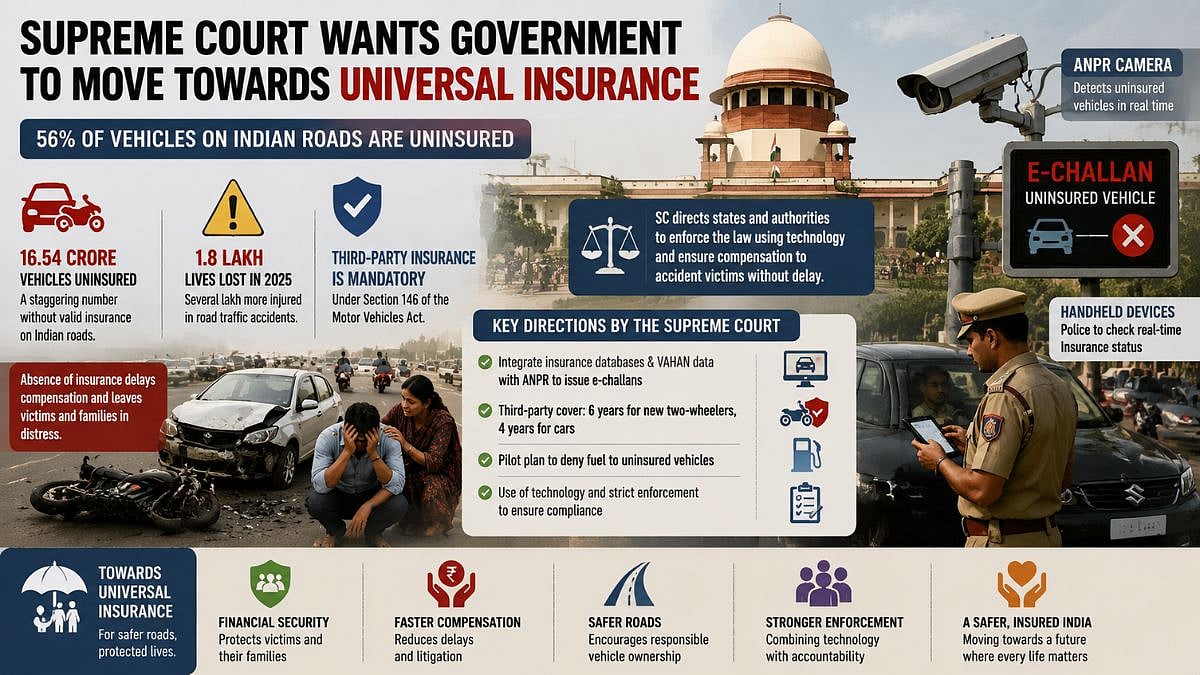
Right now, more than half of the vehicles in India do not have insurance.
The Supreme Court, the country's most important court, said this is a serious problem.
It made new rules to help fix it.
Police will get special devices to check whether vehicles have insurance, and cameras on highways can catch cars without it and send a ticket.
People who buy a new car must now have insurance for four years, and for a new bike, six years.
The court also wants petrol pumps to refuse to sell fuel to cars without insurance.
This encourages people to buy insurance so that accident victims and their families are paid quickly, without long court fights.

Nearly 56% of vehicles on Indian roads — about 16.54 crore — remain uninsured, according to a December 2024 Standing Committee on Finance report cited by the Supreme Court.
The court directed state police to use handheld devices and ANPR cameras linked to the VAHAN portal and insurance databases to monitor real-time insurance status and issue automatic e-challans.
Mandatory third-party cover was extended to four years for new cars and six years for new two-wheelers, and regulator IRDAI was told to issue necessary directions immediately.
The court mandated a uniform four-layer private vehicle insurance structure, requiring insurers to provide a customer option form and a consumer-friendly information sheet at purchase.
The court proposed pilot projects to link fuel supply with valid insurance status — refusing fuel to uninsured vehicles at petrol pumps — and to let citizens verify the insurance status of vehicles they travel in.
The directions arose from a 1996 road accident case in which the family of T Ramu was awarded Rs 10,00,500 by the Telangana High Court.
- Who
- The Supreme Court of India, in a bench comprising Justice Sanjay Karol and Justice P K Mishra
- What
- Issued binding directions to curb uninsured vehicles, including technology-based traffic enforcement, extended mandatory third-party insurance periods, and a uniform four-layer motor insurance sales structure
- Where
- India
- When
- Tuesday, August 4
- Why
- To enforce compulsory third-party insurance under Section 146 of the Motor Vehicles Act, 1988 and ensure road accident victims and their families are compensated without prolonged litigation
Support for automated enforcement
Concern about technology errors
Technology-driven enforcement of insurance
Support for automated enforcement
ANPR cameras and handheld devices linked to the VAHAN portal and insurance databases will efficiently detect uninsured vehicles and automatically issue e-challans, improving compliance.
Concern about technology errors
ANPR technology can sometimes err and throw up false positives — as seen in disputes over FASTag toll debits — so a two-factor confirmation and a simple dispute-resolution process are necessary before such systems are relied upon.
Key facts
- Uninsured vehicles
- Nearly 56% of Indian vehicles (about 16.54 crore)
- Annual road accidents in India
- Over 4 lakh; 22% involve uninsured vehicles
- Road accident deaths in 2025
- 1.8 lakh
- Third-party cover for new cars
- 4 years (up from 3 years)
- Third-party cover for new two-wheelers
- 6 years (up from 5 years)
- Legal basis
- Section 146, Motor Vehicles Act, 1988
- Case origin
- 1996 road accident death of T Ramu; Rs 10,00,500 compensation upheld by Telangana High Court in 2024
- Fuel-linked insurance pilot
- IRDAI and the Union Ministry of Road Transport and Highways to deliberate linking fuel supply to valid insurance status
Quotes
Justice Sanjay Karol
Supreme Court judge who authored the judgment
“"The object behind mandatory insurance… is not just that victims of road accidents are compensated, it is also that they are not drawn into prolonged litigation."”
 indianexpress.com
Sources
Related news

Supreme Court Directs Pilot Project Linking Vehicle Fuel to Insurance

India’s ‘No Insurance, No Fuel’ Plan Signals New Digital Push
Supreme Court rulings may deepen motor insurers' underwriting woes
Two Years After RG Kar Doctor's Rape-Murder, Case Remains Unresolved

ED widens Chhattisgarh probes with two arrests and searches

Delhi High Court Orders Madhya Pradesh to Pay Advocate Dues
Haryana sanitation workers’ strike puts BJP government under pressure
Orissa High Court Says Brothel Customers Cannot Face Trafficking Charges