

1 hr ago
Europe Finds New Uses for Retired Wind Turbine Parts
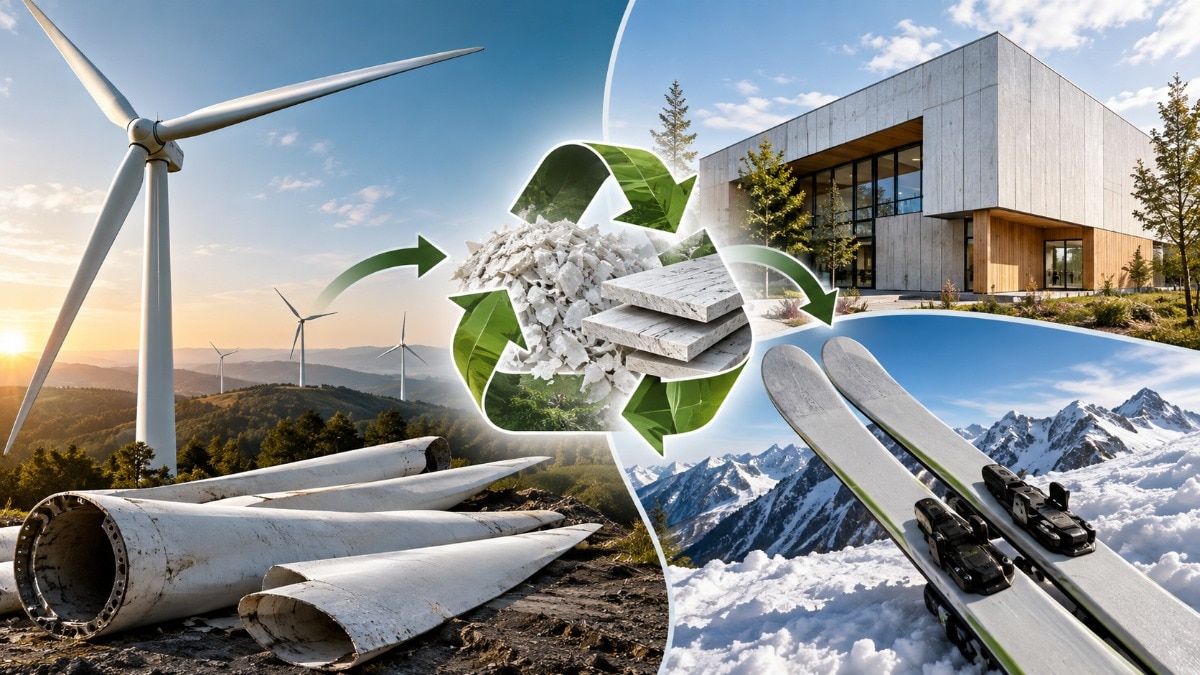
Wind turbines make electricity, but their giant blades eventually wear out.
Most turbine parts, such as steel and copper, can be recycled fairly easily.
The blades are harder because they are made from many materials glued together.
Some old turbine parts are now being turned into useful things.
One old cover became a small home with a kitchen and bathroom.
Old blades were also used on a car park and tested in skis and solar-panel frames.
These projects are still small experiments rather than a complete solution.
Companies are developing better recycling methods and blades that are easier to take apart.
The goal is to keep more turbine materials out of landfills as older wind farms are retired.

Up to 90% of a wind turbine’s mass consists of recyclable steel, copper, aluminium and concrete.
Blades are difficult to recycle because they combine glass and carbon fibres, epoxy resin, wood, metals and fillers.
Vattenfall has reused retired components in a tiny home, a car park facade, solar-panel frames and skis.
Mechanical recycling and pyrolysis can recover materials, but inconsistent blade supply makes large-scale recycling difficult.
Vattenfall aims for 100% composite-material circularity by 2030, while the European Union has no bloc-wide blade-landfill ban.
- Who
- Vattenfall, Siemens Gamesa and other wind-energy participants are developing ways to reuse or recycle retired turbine components.
- What
- Old wind-turbine parts, especially difficult-to-recycle blades, are being reused in buildings, skis, solar-panel frames and other applications while new recycling methods are developed.
- Where
- Across Europe, including projects in Austria, Denmark and Lund, Sweden.
- When
- The article describes current projects and a Vattenfall goal of achieving 100% circularity for composite materials by 2030; the Nørre Økse Sø wind farm was decommissioned in 2023.
- Why
- To reduce landfill use, recover valuable materials and create a more circular wind-energy industry as older turbines reach the end of their working lives.
Key facts
- Recyclable turbine mass
- Up to 90% of a turbine’s mass is made from materials such as steel, copper, aluminium and concrete.
- Blade size
- Wind-turbine blades can be 50 to 100 metres long.
- Blade lifespan
- Blades are designed to withstand harsh weather for up to 25 years.
- Vattenfall landfill policy
- Vattenfall has banned landfilling blades, nacelle covers and nose cones since 2021.
- Reuse example
- The 57 blades from Denmark’s Nørre Økse Sø wind farm were used in the facade of a multistorey car park in Lund.
- Circularity target
- Vattenfall is working toward 100% circularity for composite materials by 2030.
- EU regulation
- The European Union has not introduced a bloc-wide ban on landfilling decommissioned blades; Austria, Finland, Germany and the Netherlands have national bans.
Quotes
Eva Julius-Philipp
Director of Environment and Sustainability of Business Area Wind at Vattenfall
“Separating the composite materials from the resin requires specialised processes, often involving high temperatures or other energy-intensive treatment methods. In some cases, these processes can affect the quality and value of the recovered materials, making large-scale recycling more challenging.”
 businesstoday.in
“Projects such as the Tiny House, blade-based building projects and recycled skis are not yet a large-scale solution, however they are intended to help us gain experience, develop new applications and stimulate the market for circular solutions”
businesstoday.in
Sources
Related news

Greenwave Circularity Raises $31.5 Million for Indian Recycling Capacity
altM Turns Crop Residue Into A New Materials Industry
Runaya Turns Industrial Waste Into Precision Aluminium Metal

Musk’s Turbine Strategy Could Boost AI Power Amid Pollution Concerns
NALCO Launches Industrial Residue Recovery Pilot Plants With Research Partners

Energy Prices Raise Winter Crisis and Interest Rate Fears

Putin Backtracks on Europe Threat After Tough Talk

Europe’s Factories Face Harsh Winter as Energy Costs Surge

Metal Prices Recover as Rising Input Costs Threaten Sustainability
